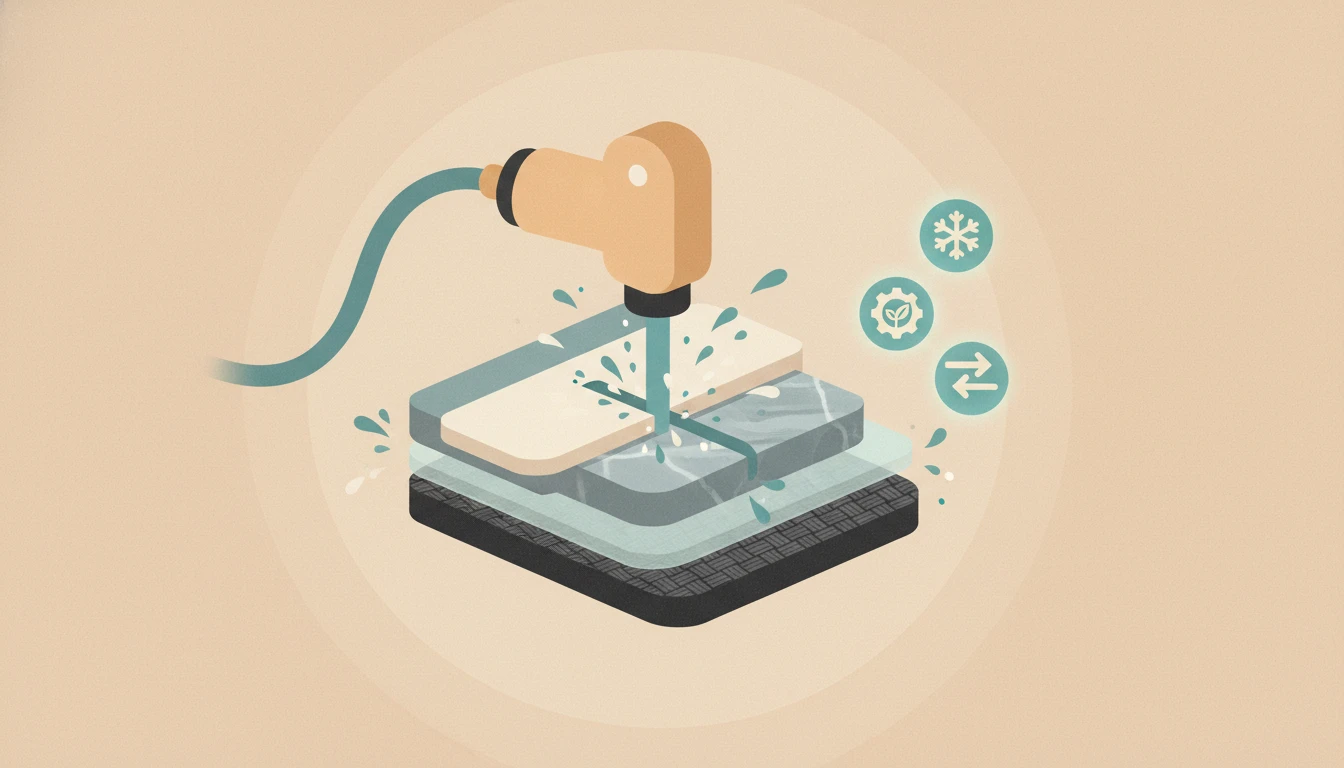
When your cutting list includes titanium aircraft brackets, marble countertops, carbon fiber drone arms, and a 6-inch-thick steel plate for a press brake,all due in the same week,there's only one machine in your shop that can handle every job without changing tools. This is the daily reality for modern manufacturers, who are constantly challenged by heat-affected zones, material-specific limitations, and the need for a single, versatile process that can handle diverse materials without compromising quality. If you're wrestling with the decision between waterjet and laser, or simply trying to optimize an existing waterjet operation, you need more than marketing hype. You need a practical, data-driven framework. By the end of this guide, you'll understand the unique cold-cutting advantages of waterjet technology, master the decision criteria for when it definitively beats laser cutting, learn how to select abrasives for cost and performance, and evaluate the true total cost of ownership for your specific applications.
Waterjet Cutting Advantages and Disadvantages: The Complete Picture
Choosing a cutting technology is a capital-intensive decision with long-term operational consequences. To make an informed choice, you need a balanced view that goes beyond the sales brochure. Waterjet cutting, which uses a high-pressure stream of water mixed with abrasive garnet to slice through material, offers a unique set of capabilities and constraints.
The Cold Cutting Advantage
The most significant waterjet cutting advantage is its status as a truly cold process. It produces zero heat-affected zone (HAZ). This isn't just a minor benefit; it's a fundamental game-changer for material integrity. When a laser or plasma torch cuts metal, it melts a thin layer along the cut edge. This rapid heating and cooling cycle can cause several issues: metallurgical changes (like altering the grain structure), the introduction of residual tensile stress, and edge hardening (where the cut edge becomes brittle).
For high-performance materials, these thermal effects are unacceptable. Consider a titanium component for an aerospace landing gear. Titanium's strength-to-weight ratio is phenomenal, but it is notoriously sensitive to heat. A laser-induced HAZ can create a zone of embrittlement, a potential initiation point for cracks under the extreme cyclic loads of flight. Waterjet cutting preserves the titanium's original mechanical properties, ensuring the part performs as the metallurgist designed it. This same principle applies to Inconel (used in jet engines for its heat resistance), hardened tool steels (where edge hardness is critical for longevity), and tempered glass (which would shatter from thermal stress). This cold cutting benefit is something no thermal process can match, making waterjet indispensable in medical, aerospace, and high-tooling applications.
Cost Considerations: The Full Breakdown
The financial picture of waterjet is nuanced. A common point of comparison is the hourly operating cost versus laser. While a laser might consume $8-$15 per hour in electricity and assist gases, a waterjet’s direct operating costs are typically higher, ranging from $15-$25 per hour for abrasive garnet alone. Add another $5-$10 per hour for routine maintenance, other consumables (orifices, mixing nozzles), and electricity for the intensifier pump, and the per-hour cost appears steeper.
However, focusing solely on hourly rate is a critical mistake. The total cost per part is what matters. This calculation must factor in two major waterjet strengths: material versatility and the elimination of secondary finishing. If a job shop with a laser gets an order for 1-inch thick aluminum, carbon fiber sheets, and granite tiles, they must either turn down the non-metal work or outsource it at a premium. The waterjet shop accepts all three jobs on one machine, maximizing asset utilization. Furthermore, because there's no HAZ, there is no thermal distortion to correct. A laser-cut 1-inch steel plate often requires costly and time-consuming milling or grinding to flatten it and clean up the hardened edge. A waterjet-cut part is typically ready for assembly or further machining straight off the table, slashing downstream labor costs.
Key Talking Points:
* Advantage: No heat-affected zone (HAZ). This preserves the base material properties, prevents warping, and eliminates edge hardening, saving significant time and cost on secondary operations.
* Advantage: Cuts virtually any material. From metals (soft aluminum to hardened steel) to stone, glass, composites, rubber, and foam, the same machine handles it all. This flexibility wins diverse jobs and keeps the machine busy.
* Advantage: No tool changes. Unlike milling, you don't swap end mills. The same abrasive stream cuts a 1mm gasket and a 200mm steel block by simply adjusting the speed and pressure.
* Disadvantage: Slower cutting speeds on thin materials. For mild steel under 6mm, a laser can be 10 to 50 times faster, making it the more productive choice for high-volume sheet metal work.
* Disadvantage: Higher consumable costs. Abrasive garnet is a continuous expense, and high-wear items like mixing tubes and orifices require regular replacement.
* Disadvantage: Water disposal and sludge management. The used abrasive and water mixture creates a slurry that must be separated and disposed of responsibly, adding an environmental and logistical consideration.
When Waterjet Beats Laser Cutting: The Decision Framework
So, when does the waterjet vs laser comparison definitively tip in waterjet's favor? Use this practical, five-point framework to guide your technology selection.
The Thickness Tipping Point
Cutting speed is not linear with thickness. For thin materials, laser dominates. For thick materials, the tables turn dramatically.
* < 6mm (0.25"): Laser territory. A 4kW fiber laser can cut 3mm mild steel at over 20 meters per minute. A waterjet might manage 150-200 mm/min. The laser is 100x faster.
* 6mm to 12mm (0.25" to 0.5"): The transition zone. Laser speed drops significantly as it requires more power to melt through the kerf. Waterjet speed remains relatively consistent. The decision here depends on material type and required edge quality.
* > 12mm (0.5"): Waterjet becomes competitive. Above 25mm (1"), waterjet dominates. A 90,000 PSI waterjet can cut 50mm (2") steel at 50-75 mm/min with a smooth, taper-controlled edge. A laser might struggle to pierce, cut extremely slowly with poor edge quality, or not be able to cut it at all. For plate work, waterjet is the clear choice.
Heat-Sensitive Materials
This is where waterjet is non-negotiable. If the material's performance is ruined by heat, you must use a cold process.
* Titanium & Aerospace Alloys: As discussed, the HAZ from a laser can cause alpha-case embrittlement in titanium and micro-cracking in nickel superalloys like Inconel, compromising fatigue life. Waterjet is the approved method for critical components.
* Composites (Carbon Fiber, Fiberglass): Lasers burn the polymer matrix, causing delamination, fraying, and toxic fumes. Waterjet slices through cleanly, leaving a machined-like edge without thermal damage, meeting stringent aerospace and automotive standards.
* Tempered/Annealed Metals: Cutting a hardened tool steel with a laser can anneal (soften) the cutting edge, destroying its utility. Waterjet leaves the hardness profile intact.
The Practical Framework:
1. Material Thickness: Is your primary work above or below 12mm (0.5")? Above favors waterjet.
2. Material Type: Is it reflective (copper, brass), heat-sensitive, or a composite? "Yes" favors waterjet.
3. Edge Quality Requirement: Does the part go straight to assembly or welding, or does it need secondary machining? No-HAZ edges favor waterjet.
4. Job Mix: Do you process metals, plastics, stone, and composites? Diverse materials favor waterjet.
5. Volume vs. Variety: High volume of identical thin sheet metal parts favors laser. High mix of different materials and thicknesses favors waterjet.
Abrasive Selection for Waterjet: Garnet, Aluminum Oxide, and Beyond
The abrasive is the "cutting tool" in a waterjet system. Choosing the right one is the single most important daily operational decision for balancing speed, quality, and cost.
Garnet: The Workhorse Abrasive
Garnet, a naturally hard mineral, is the industry standard for over 80% of applications. It's all about the mesh size (the particle size).
* 80-Mesh Garnet: This is the default choice for most metals and hard materials. It offers the best balance between cutting speed (enough particle mass for kinetic energy) and surface finish (Ra 125-250 µin).
* 120-Mesh Garnet: Used for thinner materials (< 6mm) or when a finer edge finish is critical (Ra 63-125 µin). The smaller particles cut slightly slower but produce a smoother surface.
* 50-60 Mesh Garnet: Used for faster, rougher cutting on very thick materials (> 50mm) where finish is secondary to speed. Cost runs $0.30-$0.50 per pound, with consumption between 0.5 and 1.5 pounds per minute depending on nozzle size and pressure.
Abrasive Recycling Economics
Abrasive represents 60-70% of the direct consumable cost. Recycling systems are a significant but often worthwhile investment.
* How it Works: Systems collect the used abrasive slurry, separate the garnet from the water and material sludge, clean it, and return it to a holding hopper for re-use.
* The Math: A good system can reclaim 50-70% of the garnet, reducing your abrasive purchase costs by 30-50%. For a shop running 40+ hours per week, consuming 1,000 lbs of garnet weekly ($400-$500), savings can hit $200/week. A $20,000 recycling system can pay for itself in under two years.
* The Trade-off: Recycled abrasive has slightly rounded edges from the first use, which can reduce cutting speed by 10-15%. However, for most non-aerospace applications, the finish is still acceptable, making the cost savings compelling.
Abrasive Selection Quick Reference Table
| Abrasive Type | Hardness (Mohs) | Best For | Cost Relative to Garnet | Notes |
|---|---|---|---|---|
| Garnet (80 Mesh) | 7.5-8.0 | Most metals, stone, composites (General purpose) | 1.0x (Baseline) | Optimal balance of cost, cut speed, and part quality. |
| Aluminum Oxide | 9.0 | Extremely hard materials (Technical ceramics, hardened steel) | 2-3x | Cuts faster than garnet but is more expensive and wears machine components quicker. |
| Olivine | 6.5-7.0 | Softer materials, limited HAZ (Copper, aluminum, plastics) | 0.8x | Softer than garnet; used where minimal abrasive embedding is critical. |
| Recycled Garnet | 7.5-8.0 | Cost-sensitive applications where a 10-15% speed loss is acceptable. | 0.5-0.7x | Key for high-volume shops to reduce the largest consumable cost. |
Multi-Material Applications: What Waterjet Cuts Best
Waterjet's superpower is its indifference to material composition. This multi-material capability unlocks applications across industries.
Composites and Laminates
For carbon fiber, fiberglass, and Kevlar composites, waterjet is often the only viable cutting method. It doesn't delaminate the layers or burn the epoxy resin. With proper parameters, it produces a clean, sanded-edge quality that meets aerospace standards without additional finishing. A major productivity trick is stack cutting,layering multiple sheets of thin composite material and cutting them simultaneously. This can improve throughput by 3-5x compared to processing sheets individually.
Architectural and Artistic Applications
This is where waterjet shines visually. It dominates the fabrication of:
* Stone & Tile: Intricate marble inlays, detailed granite countertops with integrated drainboards, and complex porcelain tile patterns. The process creates smooth, chip-free edges and curves impossible with diamond saws.
* Glass: Decorative architectural glass, automotive glass prototypes, and textured glass panels. Waterjet can cut detailed patterns without causing micro-cracks or thermal stress, which lasers or scribing often introduce.
* Metals: Decorative stainless steel or bronze panels for building facades, intricate metal artwork, and signage. The cold cut preserves the metal's finish on the edge.
The range is vast: from cutting thick armor plate for defense contracts to slicing delicate food products like frozen pastries or circuit boards from fiber-laminate, the same fundamental process applies.
Waterjet Cutting Parameters: Optimizing Speed, Quality, and Cost
Dialing in your machine settings is where expertise turns into profit. The main levers are pressure, abrasive flow, and nozzle management.
Pressure and Productivity: The 90,000 PSI Advantage
Modern ultra-high-pressure pumps operate at 60,000, 87,000, or 90,000+ PSI. The increase is not incremental.
* Impact: A jump from 60,000 to 90,000 PSI can increase cutting speeds on thick materials (over 1 inch) by 30-50% with similar abrasive consumption. The higher pressure creates a faster, more coherent stream.
* Economic Justification: A 90,000 PSI pump carries a premium of roughly $50,000 over a 60,000 PSI system. For a job shop cutting thick materials 40+ hours a week, the productivity gain can pay back that investment in 12-24 months through increased revenue capacity.
Nozzle Maintenance Economics
The mixing tube (nozzle) and orifice are wear items. Proactive replacement is cheaper than running them to failure.
* Orifice: The tiny jewel (usually sapphire or diamond) that creates the initial water jet. Cost: $30-$50. Life: 100-500 hours. A worn orifice reduces pressure and stream coherence, slowing cuts and degrading edge quality.
* Mixing Tube: The carbide tube where water and abrasive mix. Cost: $80-$150. Life: 50-200 hours. As it wears, the bore diameter increases and the interior roughens, causing the abrasive stream to diverge (creating taper) and slow down.
* Best Practice: Track hours and replace on schedule. Cutting with worn consumables can increase cycle times by 20% or more, costing far more in lost machine time than the price of a new nozzle.
Waterjet Equipment Selection: Entry-Level to Industrial Systems
Buying a waterjet is a major capital expenditure. Right-sizing for your needs today and tomorrow is crucial.
Right-Sizing Your Investment
The most common pitfall is buying a machine that's too small or under-powered.
* Entry-Level (Under $100,000): Typically a 2' x 2' to 4' x 4' table with a 40,000-60,000 PSI pump. Good for prototyping, sign shops, or shops with very small, specific parts. The limitation is size and speed; many shops outgrow this capacity within 2-3 years.
* Commercial Job Shop Standard ($100,000 - $200,000): A 5' x 10' table with a 60,000-90,000 PSI pump. This configuration handles over 80% of commercial work, from full sheets of metal and stone to large plates. It's the sweet spot for versatility and productivity.
* Industrial/High-Production ($200,000+): Large-format tables (6' x 20'+, multiple cutting heads, 90,000+ PSI pumps, automated loading/unloading). Justified by continuous, high-volume production.
The Value of 5-Axis Capabilities
A standard 3-axis waterjet (X, Y, Z) cuts vertically. A 5-axis head adds two rotational axes (typically A and C), allowing the nozzle to tilt.
* What It Enables: Bevel cutting for weld preparation, eliminating natural taper to produce perfectly square edges on thick material, and 3D contouring on shaped parts.
* Cost/Benefit: Adds $50,000-$100,000 to the machine cost. For a shop doing heavy plate welding or aerospace components, it can eliminate hours of secondary milling, providing a rapid return on investment. For a shop cutting flat sheet goods, it's an unnecessary expense.
Frequently Asked Questions (FAQ)
1. How accurate is waterjet cutting?
Modern waterjets with precision rails and advanced controllers can hold tolerances of ±0.003" (0.076mm) on a well-maintained machine under ideal conditions. A more general, reliable tolerance for production cutting is ±0.005" to ±0.010" (0.127mm to 0.254mm), which is sufficient for the vast majority of industrial applications.
2. Can waterjet cut a perfectly square edge?
On material thicker than about 0.5 inches, a standard vertical cut will have a slight taper (the kerf is wider at the top than the bottom). This is inherent to the process. However, using taper compensation software (which tilts the head slightly during the cut) or a 5-axis machine can produce edges that are square to within less than 0.5 degrees.
3. Is the waterjet cut edge ready for welding?
Yes, one of its major advantages. The waterjet edge is clean, oxide-free, and has no hardened layer. It is typically ready for welding directly off the machine without any grinding or cleaning, saving significant labor.
4. How thick can a waterjet cut?
There's no theoretical upper limit, as the stream does not lose energy to heat dispersion. Practically, cut speed becomes the constraint. Waterjets routinely cut metals over 12 inches thick for the nuclear and defense industries. For most shops, 6-8 inches is a common practical maximum for maintaining reasonable cycle times.
5. How does waterjet compare to wire EDM?
Wire EDM is more accurate (tolerances to ±0.0001") and can produce sharper internal corners, but it is significantly slower and only cuts electrically conductive materials. Waterjet is faster, cuts any material, and has lower operating costs for most general applications. They are complementary technologies.
6. What maintenance does a waterjet require?
Daily: Check abrasive levels, inspect for leaks, clean the tank. Weekly: Check pump oil, clean filters. Regularly: Replace consumables on schedule (orifice, mixing tube, high-pressure seals). Annually: Major system inspection and preventive maintenance by a technician.
Key Takeaway and Next Steps
The key takeaway is clear: waterjet cutting's unique cold process and unparalleled material versatility make it an indispensable technology for shops that handle heat-sensitive alloys, thick plates, or a diverse mix of materials. While it may be slower and have higher consumable costs than laser for thin sheet metal, its ability to cut virtually anything without thermal damage or tool changes delivers exceptional value that often results in a lower total cost per finished part.
Written with LLaMaRush ❤️