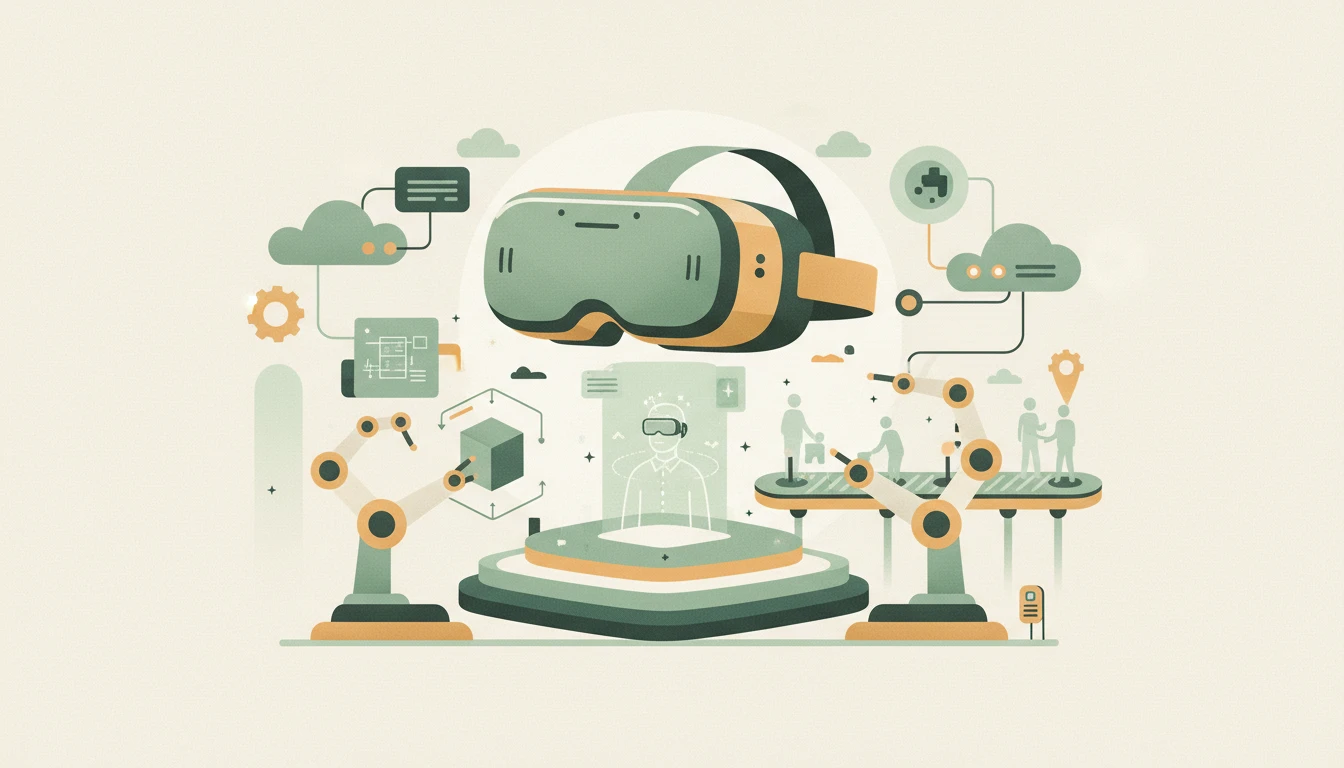
Imagine training an employee to operate a 10-ton hydraulic press or perform live electrical maintenance without a single second of real-world danger. This is no longer science fiction; it's the tangible, transformative reality of VR manufacturing training. While augmented reality (AR) has been a stepping stone, overlaying digital information on the real world, virtual reality (VR) creates an entirely new, fully immersive world for your workforce to master. The problem? Traditional training methods, and even their AR-enhanced cousins, often fall short. They lack the deep immersion required for true skill retention, struggle to simulate high-risk scenarios safely, and are notoriously difficult to scale efficiently, leading to inconsistent skills, avoidable accidents, and ballooning operational costs. By reading this guide, you will understand why VR is set to dominate manufacturing training, offering unparalleled advantages over AR. You'll gain a clear blueprint for evaluating, budgeting, and implementing a VR training system that delivers measurable safety improvements, cost savings, and a future-ready workforce.
What is VR Manufacturing Training and Why It Matters
At its core, VR manufacturing training is the use of fully immersive, computer-generated simulations to train personnel on equipment, processes, and safety protocols. Unlike AR, which adds a digital layer to a user's physical environment, VR transports the user into a completely digital environment. This allows for the safe, repeatable, and scalable practice of tasks ranging from simple assembly operations to complex, hazardous machine interventions.
The historical journey to this point is key. Early industrial training relied on shadowing, manuals, and physical mock-ups. The advent of AR in manufacturing was a leap forward, allowing for interactive instructions overlaid on machinery. However, AR’s limitation is its tether to the physical world; it cannot block out real-world distractions or simulate entirely new environments. The key technological advancements driving VR forward include:
* High-Resolution Displays: Modern VR headsets offer near-lifelike visual fidelity, crucial for identifying small components or reading dials.
* Inside-Out Tracking: Eliminating the need for external sensors or lighthouses has made setup faster and spaces more flexible.
* Haptic Feedback Gloves: These are moving beyond simple controller vibrations to provide realistic touch and force feedback, letting trainees "feel" a virtual wrench's resistance.
Why is 2026 the pivotal year? Market analysts point to a convergence of factors. The global market for VR in training is projected to grow at a CAGR of over 30% through 2026, moving beyond early adopters into mainstream industrial use. This growth is fueled by a significant reduction in hardware costs,quality enterprise VR headsets are now 60% cheaper than just five years ago,coupled with a surge in sophisticated, industry-specific software platforms. Furthermore, a generational shift in the workforce and the pressing need to upskill employees rapidly in the face of technological change are pushing manufacturers to seek more effective solutions. Adopting VR manufacturing training is no longer an experiment; it's a strategic imperative for staying competitive, safe, and efficient.
Core Components of VR Training Systems
A successful VR training system is built on two equally important pillars: hardware and software.
Hardware forms the physical interface. The cornerstone is the VR headset, with choices ranging from all-in-one wireless devices like the Meta Quest Pro for flexibility, to powerful PC-tethered headsets like the Varjo XR-4 for ultra-high-fidelity simulations requiring minute detail. For specialized training, haptic feedback devices are critical. These can be gloves that simulate grip and touch, or full-arm exoskeletons that replicate the weight and resistance of heavy tools. Finally, tracking systems,either built into the headset (inside-out) or using external sensors (outside-in),precisely map the user’s movements into the virtual space, ensuring that reaching for a virtual valve aligns perfectly with their real-world motion.
Software is where the training magic happens. The simulation platform (e.g., ENGAGE, Talespin, or Varjo’s Industrial Suite) acts as the operating system, providing tools to create or import 3D models of your factory floor and equipment. The most crucial component is the authoring tool, which allows your L&D team,not just programmers,to build interactive scenarios. Using drag-and-drop logic, they can set conditions: "If trainee attempts to start the machine before the safety guard is engaged, trigger a visual warning and log the error." This software layer is what transforms a 3D model into an interactive, pedagogical experience.
VR Adoption
Several powerful trends are aligning for widespread VR use in manufacturing training.
- Cost-Benefit Tipping Point: The initial investment barrier has crumbled. A robust VR training station now costs less than a single high-end industrial CNC controller. When paired with the savings from reduced material waste, lower incident rates, and compressed training time, the ROI period has shrunk from years to often less than 12 months.
- Industry-Wide Standardization: Major automotive and aerospace companies have not only adopted VR but are now demanding their suppliers use compatible systems for collaborative design and training. This creates a pull-through effect, standardizing platforms and best practices across the supply chain.
- The Skills Gap Crisis: As experienced workers retire, capturing and transferring their tacit, hands-on knowledge is a severe challenge. VR training solutions provide a vessel for this knowledge. An expert can record a perfect procedure in VR, creating a masterclass that dozens of new hires can experience identically, anywhere in the world.
- Data-Driven Validation: Modern VR platforms provide unprecedented analytics. Trainers no longer need to just observe; they get a data dashboard showing a trainee’s gaze tracking, movement efficiency, error rates, and completion time. This objective data proves training effectiveness to stakeholders and identifies specific areas for individual coaching.
Key Advantages of VR Over AR in Manufacturing Training
While AR serves excellent purposes for real-time guidance and remote assistance, VR holds distinct, superior advantages for comprehensive training and assessment.
The most significant benefits include enhanced immersion and realism, leading to markedly better skill retention and engagement. In VR, a trainee is not glancing at a tablet overlaid on a real machine; they are inside the machine's digital twin. This total focus eliminates distractions and leverages "muscle memory" encoded in a 3D space. Studies, such as those from PwC and the University of Maryland, consistently show that learners in VR train up to four times faster than in a classroom and are 275% more confident in applying skills learned. Furthermore, safety is revolutionized. VR allows for the risk-free simulation of otherwise impossible or prohibitively dangerous scenarios,like dealing with a chemical spill, a pressurized line rupture, or a robot cell intrusion. Employees can make critical mistakes, see the catastrophic consequences in a safe space, and learn the correct procedure, driving compliance deep into instinct.
Finally, scalability and cost-effectiveness are where VR truly outpaces both traditional methods and AR. Once a digital environment is built, it can be replicated infinitely at near-zero marginal cost. You can train 10 or 10,000 employees on the same virtual assembly line without wear, tear, or material consumption. This leads to measurable outcomes: companies like Bosch and Siemens report reductions in training time by over 50% and error rates in subsequent real-world tasks by up to 40%.
Immersion Levels Compared: VR vs AR
The difference in immersion is fundamental and has a direct impact on training effectiveness.
| Feature | Virtual Reality (VR) Training | Augmented Reality (AR) Training |
|---|---|---|
| Visual Field | Complete 360° digital environment. Real world is fully blocked. | Digital overlays on top of the real-world view. |
| Sensory Engagement | High. Can integrate spatial audio and haptics to simulate touch. | Low to Moderate. Primarily visual, with limited audio cues. |
| Distraction Potential | Very Low. User is fully immersed in the simulation. | High. Real-world environment and events can distract. |
| Best For | Mastering complex procedures, safety drills, high-risk scenarios, and soft skills. | Real-time guidance, equipment diagnostics, part identification, and remote assistance. |
| Realism of Scenario | Can simulate any environment, real or imagined, with high fidelity. | Limited to enhancing the existing physical environment. |
In practice, imagine training someone to weld. An AR system might highlight the weld path on a real piece of metal. A VR manufacturing training system, however, places the trainee inside a virtual welding booth with a simulated torch, complete with the sound of the arc, the visual flare of the weld pool, and haptic feedback mimicking the tool's vibration. The brain encodes this full-body experience far more deeply, leading to superior retention and readiness.
Safety Metrics and Case Studies
The safety argument for VR is backed by compelling data and real-world cases. Boeing uses VR to train technicians on aircraft evacuation procedures, a scenario impossible to practice safely at scale in reality. After implementation, they measured a 70% improvement in procedural recall during real safety audits.
In heavy manufacturing, a leading automotive manufacturer implemented VR to train workers on lockout-tagout (LOTO) procedures for robotic assembly lines. In the virtual environment, trainees could experience the consequences of missing a step,like a simulated robot arm reactivating. Within one year of using this VR for safety training, the facility reported a 45% reduction in near-misses related to LOTO and a 30% decrease in time required to certify employees on the procedure. The risk-free environment allows for the deliberate practice of rare but critical emergency responses, building calm, competent reactions that save lives and assets.
How to Implement VR Training in Your Manufacturing Facility
Transitioning to VR training requires a structured approach. Don't try to boil the ocean; start with a focused pilot program.
Step 1: Needs Assessment. Identify a high-impact, high-cost, or high-risk training pain point. Is it expensive equipment operation, complex assembly with high error rates, or critical safety protocols? This becomes your pilot project.
Step 2: Define Success Metrics. What will you measure? Reduced training time (target: -40%), lower material waste (target: -25%), improved assessment scores (target: +30%), or reduced incident reports.
Step 3: Select Your Platform. Choose between off-the-shelf content libraries (faster start) and custom development (perfect fit). For most, a hybrid approach works best: modify an existing simulation to match your specific machine model.
Step 4: Develop and Pilot. Build your scenario with a small group of trainees and instructors. Gather feedback on usability and effectiveness, and iterate.
Step 5: Scale and Integrate. Roll out the successful program widely. Integrate VR completion and performance data into your existing Learning Management System (LMS).
A common challenge is employee resistance. Overcome this by involving veteran workers in content creation,their buy-in is golden,and by positioning VR as a "superpower tool," not a replacement. Technical issues are mitigated by starting with robust, all-in-one wireless headsets to minimize IT complexity.
Budgeting and ROI Analysis
A clear financial framework is essential for stakeholder buy-in. The costs fall into three categories:
- Hardware: VR Headsets ($1,500 - $4,000 per unit for enterprise-grade), optional haptic devices ($2,000 - $8,000 per pair), and a dedicated PC if needed ($1,500 - $3,000).
- Software: Platform licensing fees (annual, typically $1,000 - $3,000 per seat) and content development (Off-the-shelf: $5,000 - $20,000 per module; Custom: $20,000 - $100,000+).
- Operational: IT support, trainer upskilling, and physical space setup.
To calculate ROI, quantify your savings. The following table outlines a typical analysis for training 50 machine operators:
| Cost/Saving Category | Traditional Training Cost | VR Training Cost & Saving | Notes |
|---|---|---|---|
| Trainer Time | $15,000 | $7,500 | VR allows one trainer to oversee multiple simultaneous trainees. |
| Machine Downtime | $25,000 | $0 | Training occurs offline on virtual machines. |
| Material Waste | $10,000 | $500 | Only negligible power cost for VR; no physical parts consumed. |
| Safety Incident Cost Avoidance | $5,000 (risk) | $5,000 Saved | Proactive safety training reduces probability of costly incidents. |
| Total Program Cost | $55,000 | $43,000 | Includes hardware amortization and software. |
| Net Savings (ROI) | - | $12,000 (Year 1) | ROI becomes significantly higher in subsequent years as hardware is reused. |
As shown, the return on investment for VR training programs often materializes in the first year, with the most significant recurring savings coming from reduced downtime and waste.
Partnering with VR Solution Providers
Choosing the right partner is critical. Look for vendors with proven experience in manufacturing VR examples, not just gaming. During selection:
- Request Site Visits or Detailed Case Studies: Don't just watch promo videos. Ask for contacts at manufacturing clients who have implemented their solution.
- Evaluate the Authoring Tools: Can your own L&D team use them, or are you locked into paying the vendor for every content change?
- Ask About Data & Analytics: The platform must provide detailed, exportable trainee performance data.
- Clarify Post-Launch Support: What is the SLA for technical issues? Is ongoing training and content updates included?
A successful partnership is collaborative. Provide your vendor with detailed SOPs, photos, and 3D CAD models of your equipment. Assign an internal project champion to manage feedback and ensure the final product meets your specific operational language and standards.
Real-World Examples and Case Studies
Automotive Industry Applications
Global automakers are at the forefront. Volkswagen Group uses VR to train employees across hundreds of sites on new vehicle assembly processes. Before a physical production line is built, workers in different countries can practice assembling a new car model in VR. This allows engineers to identify and rectify ergonomic issues or tooling conflicts digitally, saving millions in physical rework. For safety, Ford Motor Company employs VR to simulate hazardous scenarios like battery fires in electric vehicles or stamping press malfunctions. Trainees learn emergency shutdown procedures in a perfectly safe yet psychologically intense environment. The results are tangible: 30% faster time-to-competency for new hires on assembly lines and a significant drop in safety protocol violations.
Aerospace Training Programs
Precision and zero-error tolerance define aerospace, making it ideal for VR. Airbus uses immersive VR simulations to train technicians on the complex wiring harness installation within an aircraft fuselage. In the virtual cabin, technicians practice routing hundreds of cables, with the system providing instant feedback if a cable is routed incorrectly or a clip is missed. This has led to a reduction in installation errors by up to 40% and a cut in training time by half. Similarly, Lockheed Martin uses VR for satellite assembly training, where technicians can practice handling multi-million-dollar components in a zero-gravity simulation, eliminating any risk of damage during the learning phase.
These successful VR implementations share common best practices: they started with a clear, measurable problem; they involved end-users in design; and they used the rich performance data from the VR sessions not just to grade trainees, but to continuously improve the actual work procedures themselves.
Future Trends: VR in Manufacturing
The evolution of VR manufacturing training will be shaped by convergence with other transformative technologies.
AI and VR Convergence
Artificial Intelligence will move VR from a static simulation to an intelligent, adaptive coach. AI can observe a trainee's performance in real-time,where they hesitate, where their gaze lingers, the sequence of their actions,and dynamically adjust the scenario. For example, if a trainee masters a basic welding technique quickly, the AI can introduce a more challenging scenario, like a warped joint. Conversely, if they struggle, it can slow down, offer targeted hints, or replay a master performance. This AI and VR convergence enables truly personalized learning paths at scale, optimizing the training time for each individual and ensuring no one is left behind. Furthermore, AI can be used to generate realistic virtual "colleagues" for soft skills training, like managing a difficult conversation on the factory floor or leading a safety briefing.
Global Adoption Scenarios
VR in manufacturing will become as standard as computer-based training is today. We will see the rise of collaborative VR environments, where teams in different countries,designers in Germany, engineers in the US, and assembly line planners in China,meet inside a virtual prototype to collaborate in real-time. Haptic technology will advance to the point where simulating the feel of different materials (rubber vs. steel) or the subtle feedback of a torque wrench is indistinguishable from reality. Economically, as the technology becomes even more affordable, small and medium-sized enterprises (SMEs) will be the major growth drivers, using cloud-based VR services to access world-class training simulations without large upfront capital expenditure. The long-term impact will be a fundamental shift in workforce development: a move from periodic, location-bound training to continuous, on-demand, hyper-realistic skill development that keeps pace with the accelerating rate of technological change.
Conclusion
VR is poised to dominate manufacturing training, offering unparalleled immersion, safety, and scalability over AR, with actionable insights for immediate adoption. The journey from observing a procedure to physically performing it inside a perfect digital twin represents a quantum leap in how we build human expertise. The technology has matured, the costs have rationalized, and the evidence of superior outcomes is overwhelming. The question for forward-looking manufacturers is no longer if to adopt VR, but how soon and how strategically. By starting with a focused pilot, measuring tangible ROI, and choosing the right partners, you can transform your training from a cost center into a powerful engine for quality, safety, and innovation.
Frequently Asked Questions (FAQs)
1. How much does it really cost to start a VR training program?
You can launch a pilot program for a single, focused training module for as little as $15,000 - $30,000. This typically covers 2-3 VR headsets, licensing for an off-the-shelf or lightly customized training simulation, and initial setup. Full-scale deployment for multiple procedures will require a larger investment, but with a clear ROI model, it justifies itself quickly through savings in trainer time, materials, and downtime.
2. Can our older workforce adapt to using VR technology?
Absolutely, and often more easily than expected. The key is intuitive design. Modern VR systems are far more user-friendly than early versions. The most successful implementations involve veteran workers in the development process. When they see the value in capturing their hard-earned knowledge and can help shape the simulation to be realistic, they become its biggest advocates. Start with simple, short sessions and provide clear support.
3. Is VR training effective for soft skills, like leadership or communication?
Yes, this is a rapidly growing application. VR excels at placing people in realistic social scenarios,like delivering performance feedback, de-escalating a workplace conflict, or conducting a safety walkthrough,where they can practice conversations and read body language in a safe space. This allows for deliberate practice and reflection, which is far more effective than role-playing in a conference room.
4. How do we create VR content for our specific, proprietary machinery?
There are two main paths. First, if you have high-fidelity 3D CAD models of your equipment (common in modern manufacturing), these can be directly imported into VR authoring platforms. Second, specialized 3D scanning services can create precise digital twins of existing legacy equipment. Your VR solution provider can then make these models interactive, adding the correct physics and operational logic.
5. What about cybersickness? Will some employees be unable to use VR?
Cybersickness, similar to motion sickness, affects a small percentage of users, but strategies minimize its impact. Using high-resolution, high-refresh-rate headsets is crucial. Training scenarios should be designed to avoid unnatural, user-initiated rapid movements (like virtual walking while physically stationary). Instead, use teleportation mechanics or have the user physically walk in a cleared space. Most people acclimate quickly, and sessions can start short and gradually lengthen.
Written with LLaMaRush ❤️