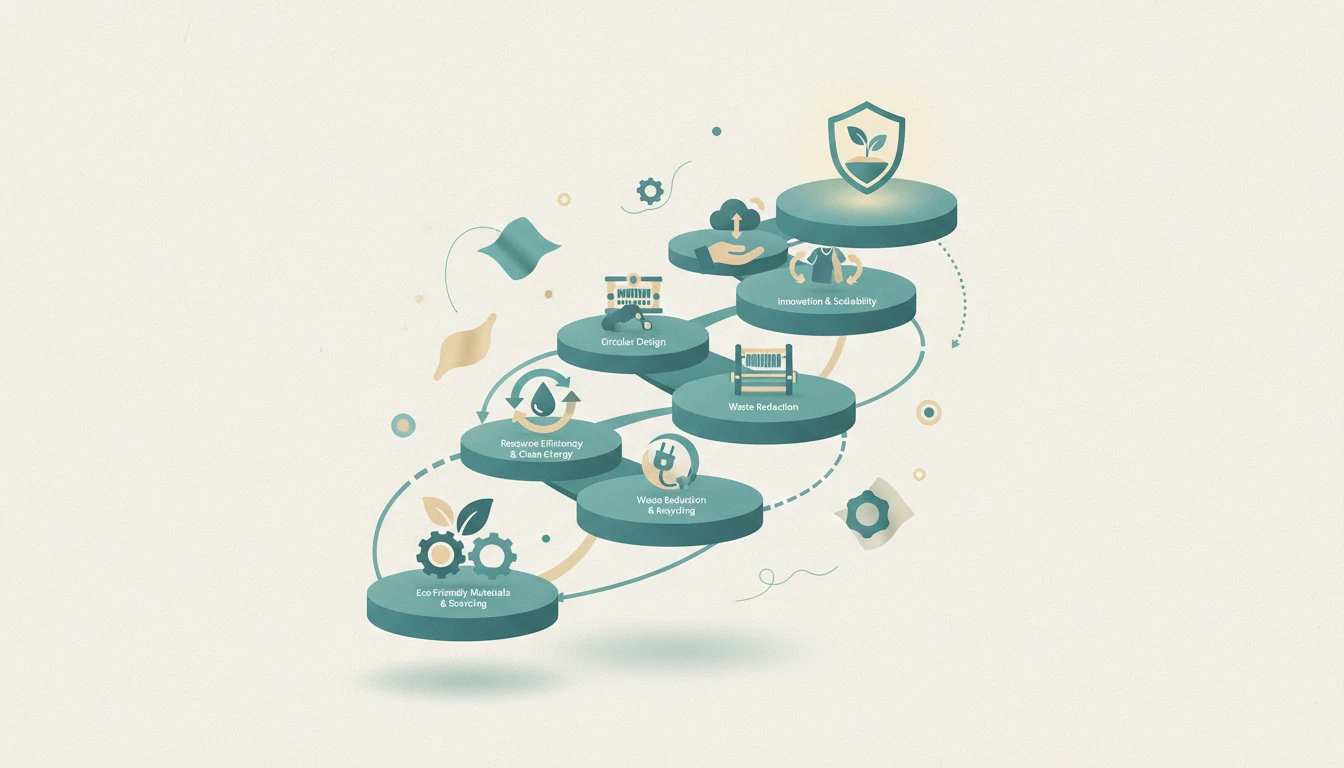
The fashion and textile industry generates over 92 million tons of waste annually, a staggering figure that embodies the environmental cost of a "take-make-dispose" world. For manufacturers, this linear model isn't just ecologically bankrupt; it’s increasingly economically unsustainable. Consumers demand better, regulations are tightening, and supply chains are fraught with risk. But there is a clear, profitable path forward. This article breaks down how to implement a circular economy model in textile manufacturing, moving beyond theory with a real-world case study and a five-step action plan. You’ll learn how to transform waste into value, reduce operational costs, and build a resilient, future-proof manufacturing operation.
The Urgency for Sustainable Textile Manufacturing
The traditional linear model of textile production,extracting raw materials, manufacturing products, and discarding them after use,is hitting its physical and financial limits. The industry's environmental footprint is vast, but the economic and regulatory pressures to change are now equally powerful, creating an undeniable business case for sustainability.
Global Textile Waste Crisis
The scale of the problem is monumental. According to the Ellen MacArthur Foundation, the equivalent of one garbage truck of textiles is landfilled or incinerated every second. By 2030, global apparel consumption is projected to rise by 63%, pushing annual waste to over 134 million tons if current practices continue. This waste represents a catastrophic loss of resources. Producing a single cotton t-shirt requires about 2,700 liters of water, and when that shirt is discarded, all that embedded water, energy, and labor is lost. Beyond landfill space, synthetic textiles like polyester can take hundreds of years to decompose, leaching microplastics into soil and waterways. This textile waste crisis is no longer a distant ethical concern; it's a direct threat to planetary boundaries and a glaring symptom of an inefficient system.
Economic Incentives for Sustainable Practices
Adopting sustainable textile manufacturing is no longer just a "green" initiative; it's a core business strategy driven by powerful economic incentives.
- Cost Savings: Circular practices directly attack waste, which is a sign of inefficiency. Reducing material waste, recycling water in dyeing processes, and improving energy efficiency in production lines slash operational costs. For instance, recycling polyester from PET bottles or post-consumer garments uses up to 59% less energy than producing virgin polyester from petroleum.
- Market Demand: Consumer preferences have shifted decisively. A 2023 study by McKinsey found that over 60% of consumers are willing to pay more for products with sustainable packaging, a sentiment that extends to the products themselves. Brands are scrambling to meet this demand, and they are prioritizing suppliers who can provide verifiably sustainable materials and processes.
- Compliance Advantages: Governments worldwide are implementing Extended Producer Responsibility (EPR) schemes and stricter environmental regulations. The EU's Strategy for Sustainable and Circular Textiles is a prime example, setting binding design and recycling targets. Manufacturers who proactively adopt circular models will be ahead of the curve, avoiding future compliance costs and potential penalties.
The circular economy benefits are clear: it transforms the linear model's end-of-life costs into new revenue streams, whether through material recovery, product longevity, or resale. It mitigates risk from volatile virgin material prices and builds brand loyalty in an increasingly conscious market.
Understanding Circular Economy Principles
At its core, a circular economy is a systemic shift designed to eliminate waste and pollution, circulate products and materials at their highest value, and regenerate nature. It’s a deliberate departure from the linear model, aiming to decouple economic activity from the consumption of finite resources.
What is a Circular Economy?
The concept, while gaining modern traction, has roots in industrial ecology and systems thinking. It moves beyond simple recycling (often a downgrading process) to create a closed-loop system. In a circular economy, a textile is designed from the start with its next life in mind. This means using safe, non-toxic, and easily separable materials, designing for durability and easy repair, and establishing systems for take-back, refurbishment, and high-value recycling. The goal is to keep fibers in use for as long as possible, extracting their maximum value during each lifecycle before recovering and regenerating them at the end of service.
Key Principles for Manufacturing Adaptation
For a textile manufacturer, applying circular economy principles requires rethinking every stage of production.
- Design for Longevity and Circularity: This is the first and most critical principle. It involves selecting mono-materials (like 100% cotton) or designed-to-separate blends, using durable construction techniques, and avoiding chemical treatments that hinder recycling. It’s about creating a garment that lasts longer and, when it finally wears out, can be cleanly broken down into its constituent fibers.
- Resource Recovery and Regeneration: This principle focuses on the "end-of-life" as a new beginning. Closed-loop manufacturing systems are established to collect post-industrial scrap (off-cuts, defective fabric) and post-consumer garments. Through advanced sorting and recycling technologies,both mechanical (shredding and re-spinning) and chemical (breaking polymers down to their raw monomers),these materials are regenerated into new, high-quality fibers, reducing dependency on virgin cotton, polyester, or wool.
- Shift to Renewable Energy and Inputs: A truly circular system also addresses its energy and resource inputs. This means powering facilities with renewable energy and sourcing raw materials that are renewable (like organic cotton, lyocell) or cycled (recycled polyester).
The contrast is stark. A linear model sees a $10 shirt produce $2-3 of disposal costs and lost resource value. A circular model sees that same shirt, at the end of its life, as a $4-5 source of raw material for a new product, creating value and reducing environmental impact.
Case Study Overview: Implementing in a Textile Facility
To move from principle to practice, let’s examine the journey of "EcoTextile Solutions," a mid-sized fabric manufacturing facility in Portugal specializing in knitted fabrics for the activewear market.
Facility Background and Goals
EcoTextile Solutions employed 150 people and had an annual output of 500 tons of fabric, primarily polyester blends. Facing pressure from European brand clients and rising polyester prices, management set a goal in 2022: reduce virgin polyester use by 40% and cut production waste to landfill by 75% within three years. Their vision was to become a regional leader in circular economy fabric production.
Initial Challenges and Barriers
The path was not smooth. The team encountered several common obstacles:
- Supply Chain Complexity: Sourcing consistent, high-quality recycled polyester (rPET) in sufficient volumes was difficult. Traditional suppliers were geared toward virgin materials.
- Technical Hurdles: Their existing machinery was calibrated for virgin fibers. Recycled fibers often have different tensile strengths and dye affinity, requiring process adjustments.
- Cost Concerns: The upfront investment in recycling equipment and the premium for certified recycled materials strained initial budgets. Calculating a clear ROI was challenging.
- Internal Mindset: Shifting from a "volume-at-lowest-cost" to a "value-through-circularity" mindset required retraining and convincing staff at all levels.
Strategic Implementation Plan
EcoTextile adopted a phased, strategic approach to manage risk and build momentum:
- Phase 1 - Foundation (Months 1-6): They started with a comprehensive audit of material and energy flows (see Step 1 below) and initiated a pilot project to replace 15% of virgin polyester with rPET in one product line for a willing brand partner.
- Phase 2 - Scale & Integrate (Months 7-18): Based on pilot learnings, they invested in a mechanical recycling line to process their own post-industrial waste (fabric off-cuts) back into yarn. They also forged long-term contracts with two rPET suppliers.
- Phase 3 - System Close (Months 19-36): The final phase involved launching a take-back program with their brand clients for end-of-life garments, exploring chemical recycling partnerships for blended fabrics, and fully integrating circular KPIs into management performance reviews.
This real-world application proves that transition is possible with a structured, incremental plan.
5 Proven Steps to Achieve Circular Manufacturing
Drawing from the case study and industry best practices, here is a actionable five-step framework for any textile manufacturer.
Step 1: Conduct a Sustainability Audit
You can't manage what you don't measure. Before making any changes, conduct a thorough audit of your entire operation.
* Map Material Flows: Track every kilogram of raw material from receipt to shipment. Identify where waste is generated (cutting room, sampling, quality control).
* Measure Energy and Water Use: Install sub-meters to pinpoint high-consumption areas like dyeing, drying, and compressed air systems.
* Analyze Costs: Attach a financial cost to every waste stream,not just disposal fees, but the lost value of the raw materials.
* Set Baselines and SMART Goals: From this data, establish baselines (e.g., "We generate 10 tons of fabric waste monthly") and set Specific, Measurable, Achievable, Relevant, and Time-bound goals (e.g., "Reduce fabric waste by 50% in 18 months").
Quick Win: Implement a simple sorting system on the production floor for fabric scraps. Just separating cotton from polyester can dramatically increase their recycling value.
Step 2: Innovate Product Design
Circularity is decided at the design stage. Work closely with your clients' design teams to influence material choices and construction.
* Design for Disassembly: Advocate for the use of mono-materials or compatible blends. Replace permanent chemical finishes with physical finishes. Use snap fasteners instead of glued elements.
* Design for Durability: Select higher-quality yarns, specify tighter knits or weaves, and reinforce high-stress points. A longer-lasting product stays in the economy longer.
* Co-create with Recyclers: Engage with recycling partners early. Understand their technical requirements for input materials (e.g., no metal zippers, certain polymer types) and design accordingly.
Step 3: Streamline Supply Chain Logistics
A circular supply chain is collaborative and transparent.
* Source Circular Inputs: Actively seek suppliers of recycled fibers (rPET, recycled cotton), bio-based materials, and low-impact dyes. Certifications (GRS, GOTS) are key here.
* Establish Reverse Logistics: Develop systems to get materials back. This could be internal (collecting cutting-room scraps via bins) or external (offering clients a service to collect their production waste or end-of-life products).
* Build Partnerships: Forge strategic partnerships with recycling specialists, logistics companies for collection, and even competitors to create larger, more efficient collection pools for post-consumer textiles.
Step 4: Adopt Advanced Recycling Technologies
Invest in the technology to close the loop on your own waste streams.
* Mechanical Recycling: Ideal for mono-material fabrics like polyester or cotton. Machines shred fabric back into fiber, which can be re-spun. This is best for post-industrial waste which is clean and sorted.
* Chemical Recycling: A game-changer for blended fabrics (e.g., poly-cotton). Processes like enzymatic recycling or hydrothermal processes can separate and recover pure polymers and cellulose. While capital-intensive, partnerships with specialized firms can provide access.
* Start In-House: Begin with a mechanical granulator for fabric scraps. The resulting "shred" can often be sold to recyclers or, with more investment, re-spun on-site for lower-grade applications like filling or insulation, creating an immediate new revenue stream.
Step 5: Establish Continuous Improvement Cycles
Sustainability is a journey, not a destination. Embed a culture of continuous improvement.
* Define Circular KPIs: Track metrics beyond profit. Key ones include: Percentage of recycled content in output, waste diversion rate from landfill, water/energy use per unit of production, and revenue from recycled material sales.
* Implement Feedback Loops: Regularly review KPI data with your team. What’s working? Where are we stuck? Use this to inform R&D and process adjustments.
* Communicate and Iterate: Share successes and challenges with your team and clients. Their feedback will reveal new opportunities for improvement and innovation.
Measuring Success and Overcoming Obstacles
Transitioning to a circular model requires new ways of measuring success and proactively tackling barriers.
Key Performance Indicators (KPIs)
To track progress, monitor this core set of metrics:
| KPI Category | Specific Metric | Why It Matters |
|---|---|---|
| Material Circularity | % of Recycled/Bio-based Content in Output | Measures direct displacement of virgin resources. |
| Waste Management | Waste Diversion Rate from Landfill (%) | Tracks progress in eliminating disposal. |
| Resource Efficiency | Energy Consumption (kWh/kg of fabric) | Identifies efficiency gains and cost savings. |
| Resource Efficiency | Water Consumption (Liters/kg of fabric) | Critical for environmental impact and operational cost. |
| Economic | Revenue from Recycled Material Sales ($) | Turns waste into a direct income stream. |
| Economic | ROI on Circularity Investments | Calculates the financial payoff of sustainability projects. |
Addressing Supply Chain and Cost Barriers
The challenges are real, but surmountable.
* For Supply Chain Issues: Diversify your supplier base. Join industry consortia to increase collective buying power for recycled materials. Start small with pilot volumes to build supplier confidence. Consider pre-competitive collaboration with other local manufacturers to create a stable regional demand for recycled feedstocks.
* For Cost Barriers: Frame investments in terms of risk mitigation (against rising virgin material costs) and new revenue (from waste sales). Seek out government grants, green loans, or sustainability-linked financing, which often have favorable terms for circular economy projects. Start with "low-hanging fruit" projects with quick payback periods (e.g., waste segregation, basic mechanical recycling) to generate early wins and fund more ambitious projects.
Future Outlook and Industry Best Practices
The momentum behind circular textiles is accelerating, driven by technology and shifting market forces.
Technological Innovations in Textile Manufacturing
The factory floor will be smarter and more sustainable.
* Digital Twins & AI: Virtual models of production lines will simulate changes in real-time, optimizing for minimal waste and energy use. AI will improve fabric defect detection, reducing seconds and waste.
* Advanced Materials: Expect wider adoption of next-gen materials: fibers made from agricultural waste (like pineapple leaves or mushroom mycelium), self-healing fabrics, and truly biodegradable polymers for specific applications.
* Automated Sorting: AI-powered optical sorting robots, using hyperspectral imaging, will accurately separate mixed textile waste streams by fiber type and color, unlocking high-value recycling at scale.
Policy and Consumer Trends Shaping the Industry
External pressures will continue to drive change.
* Policy: Regulations will move from encouragement to mandate. Expect stricter EPR laws, circular economy design standards, and even "right-to-repair" legislation for textiles. Proactive manufacturers will view compliance as a competitive advantage.
* Consumer Demand: Transparency will be non-negotiable. Consumers will use digital passports (QR codes) to trace a garment's origin, material composition, and end-of-life instructions. Brands will favor manufacturers who can provide this data seamlessly.
* Best Practices: Start designing for circularity now. Invest in supplier relationships for alternative materials. Pilot a take-back or recycling program, however small. Most importantly, measure and communicate your progress. Sustainability is becoming the ultimate sign of quality and resilience.
Conclusion
The evidence is conclusive: implementing circular economy principles in textile manufacturing is not only environmentally responsible but also economically viable. The journey from a linear to a circular model, as shown in our case study, involves clear steps: auditing your baseline, innovating at the design stage, collaborating across your supply chain, investing in recycling technology, and committing to continuous improvement. The barriers are real, but the strategies to overcome them are proven. The future of textiles is circular,it conserves precious resources, unlocks new value, and builds a resilient business ready for the demands.
Share your experiences or explore more case studies on sustainable manufacturing at ManufactureNow.
Frequently Asked Questions (FAQ)
1. What is the most cost-effective first step towards circular textile manufacturing?
Conducting a thorough material flow audit is the most impactful and low-cost first step. It identifies your largest waste streams and their associated costs, revealing the "quick wins" with the fastest return on investment, such as simple waste segregation or reselling fabric scraps.
2. Can circular economy principles be applied to small-scale textile manufacturers?
Absolutely. The principles are scalable. A small manufacturer might start by sourcing 20% recycled yarn for a specific product line or partnering with a local recycling hub to process their cuttings. The key is to start somewhere, measure the impact, and build from there.
3. How do I ensure the quality of fabrics made from recycled materials?
Work closely with reputable suppliers who provide certified recycled materials (e.g., GRS-certified rPET). Conduct rigorous testing on the new material blends before full-scale production. Often, recycled fibers can be blended with a portion of virgin fibers to maintain specific performance characteristics without sacrificing circularity goals.
4. What happens to blended fabrics (like poly-cotton) in a circular model?
This is a significant challenge for mechanical recycling. The future lies in chemical recycling technologies, which can break down blends into their base polymers and cellulose. Today, the best practice is to design out complex blends where possible, or ensure the blend is designed for a specific chemical recycling process.
5. How do I calculate the ROI on investing in circular economy practices?
Look beyond simple equipment payback periods. A comprehensive ROI calculation should include: cost savings from reduced virgin material purchases, revenue from selling recycled materials, avoided waste disposal fees, potential for premium pricing from eco-conscious clients, and risk mitigation against future regulatory fines or virgin material price spikes.
Written with LLaMaRush ❤️