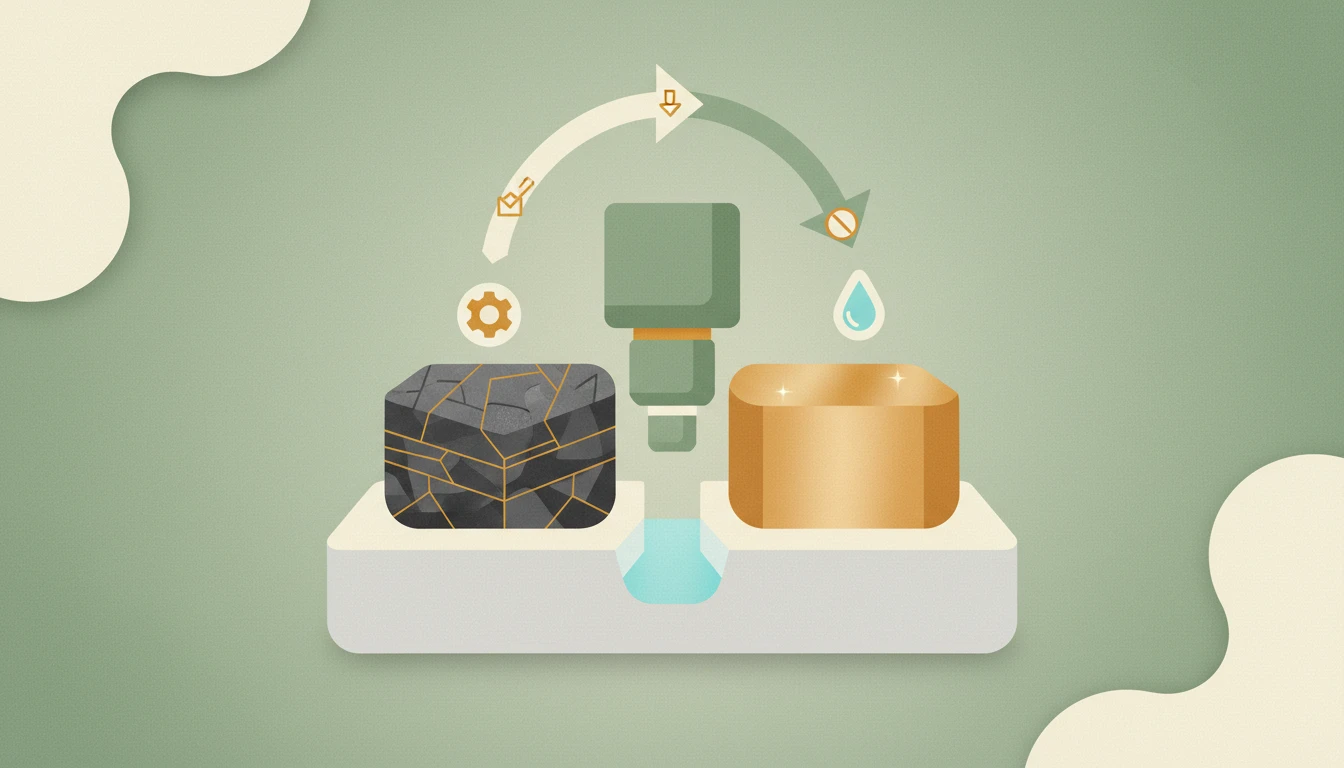
In mold and die manufacturing, the difference between a perfect cavity and a scrapped part often comes down to one decision: your electrode material and how you compensate for wear. Toolmakers consistently struggle with electrode selection, unpredictable wear patterns, and inefficient workflows that drive up costs and extend lead times. The wrong choice can mean hours of lost machining time, compromised surface finish, or, worst of all, a ruined mold insert after days of work. This guide cuts through the confusion. You’ll learn how to select the right sinker EDM electrode material for your specific application, implement effective wear compensation strategies that guarantee accuracy, and streamline your entire mold and die manufacturing workflow for maximum precision and profitability. We’ll move beyond theory into the practical, data-driven decisions that separate high-performing shops from the rest.
Sinker EDM Electrode Materials: The Foundation of Precision
The electrode in a sinker EDM (Electrical Discharge Machining) process is more than just a tool; it’s a consumable master that shapes the workpiece through controlled erosion. Selecting the correct material is the first and most critical step in ensuring a successful burn. The common contenders are graphite, copper, copper-tungsten, and silver-tungsten, each with a unique set of properties that make it suitable for specific challenges in mold and die work.
The performance of an EDM electrode is governed by a few key material properties. Electrical conductivity determines how efficiently electrical energy is transferred from the generator to the spark gap. Higher conductivity typically allows for more stable machining. Thermal conductivity is equally crucial, as it dictates how quickly heat is dissipated from the electrode tip. Materials with high thermal conductivity resist localized heating, which reduces wear and helps maintain the electrode’s shape. Finally, the melting point of the electrode material directly influences its wear resistance. A higher melting point means the electrode material is harder to erode, but this can sometimes come at the cost of a lower metal removal rate on the workpiece. Machinability is the practical consideration,how easily and precisely you can fabricate the often-complex electrode geometry.
Key Material Properties Explained
Understanding the interplay of these properties allows you to predict performance. Electrical conductivity is the highway for the machining current. Superior conductors like copper enable efficient energy transfer, which can translate to faster, more stable cutting with less risk of erratic sparking. Thermal conductivity acts as the cooling system. As thousands of sparks superheat a tiny area, the electrode material must pull that heat away rapidly. If heat builds up, it accelerates electrode wear and can even cause thermal cracking, especially in delicate features. This is why copper, with its excellent thermal conductivity, is often chosen for intricate electrodes with thin ribs or sharp corners.
The melting point is the electrode’s inherent resistance to the process that is designed to erode it. Graphite has an extremely high sublimation point (it turns directly from solid to gas at around 3,600°C), which gives it remarkable wear resistance, particularly during roughing operations. However, a very high melting point isn’t always the sole goal. The interaction between the electrode and workpiece material is key. The goal is to have a significant difference in melting points where the workpiece material erodes much more readily than the electrode, creating a favorable wear ratio.
Application Matching
Matching the electrode material to the machining phase is non-negotiable for efficiency. For roughing applications, the primary objective is to remove the bulk of material as quickly as possible. Here, you need materials that support a high metal removal rate (MRR). Graphite excels in this role due to its ability to withstand high amperages and its natural porosity, which aids dielectric flushing. Certain grades of copper can also be used for roughing, especially where subsequent finishing will be done with the same material.
Finishing applications have a completely different set of demands. The focus shifts to achieving a fine surface finish, maintaining tight tolerances, and preserving the integrity of sharp edges and fine details. This requires materials that exhibit minimal wear and can produce a consistent, predictable spark gap. Fine-grain graphite (with grain sizes under 5 microns) and copper are the stars here. For the most demanding finishes on hardened tool steels or carbide, copper-tungsten is often selected for its exceptional combination of wear resistance and stability, despite its higher cost and challenging machinability.
Overview of Common Electrode Materials:
* Graphite: The workhorse for mold making. Offers excellent machinability, good wear resistance in roughing, and is lightweight. Available in various grain sizes for different applications.
* Copper: The classic choice for superior surface finishes. Provides excellent electrical and thermal conductivity, ideal for fine details and finishing operations. Heavier and softer than graphite.
* Copper-Tungsten (CuW): A premium material typically comprising 10-50% copper. The tungsten provides a very high melting point and extreme wear resistance, while the copper offers conductivity. Essential for machining tungsten carbide or for long-running production electrodes.
* Silver-Tungsten (AgW): Similar to CuW but with even higher conductivity due to the silver. It’s a specialized, high-cost option used for the most challenging applications where minimal wear and highest precision are paramount, such as in aerospace or micro-EDM.
Cost and Availability: Graphite is generally the most cost-effective and widely available. Copper is also readily available but commands a higher raw material price. Copper-tungsten and silver-tungsten are significantly more expensive and are often considered specialty items, used strategically where their properties justify the investment.
Graphite vs Copper Electrodes: The Definitive Comparison
The debate between graphite and copper electrodes is central to EDM strategy. There is no universal "best" material,only the best material for your specific job. Understanding their fundamental differences allows you to make a choice that optimizes cycle time, cost, and quality.
Graphite Deep Dive
Graphite’s structure is its superpower. It’s a porous, crystalline form of carbon. This porous structure creates microscopic channels that allow dielectric fluid to permeate the electrode material itself, leading to superior flushing at the spark gap. This drastically reduces the risk of arcing caused by trapped debris, a common issue in deep cavity work. This makes graphite exceptionally forgiving and stable, especially in less-than-ideal flushing conditions.
The grain size of graphite is the primary determinant of its application. Coarse-grain graphite (10 microns and above) is the champion of roughing. Its structure allows it to handle very high currents, resulting in aggressive metal removal rates with surprisingly low wear, often achieving wear ratios of 1% or even lower on steel. Fine-grain graphite (1-5 microns) is engineered for finishing. The tighter grain structure erodes more uniformly, allowing it to produce excellent surface finishes, down to 0.2 Ra or better, while holding sharp corners. Micro-grain graphites push this further, enabling near-mirror finishes and ultra-fine detail replication, blurring the line between graphite and copper performance.
Graphite Advantages:
* Lightweight & Easy to Machine: Can be machined 3-5 times faster than metals on a standard CNC mill, reducing electrode fabrication time.
* Excellent Roughing Performance: High MRR with low wear.
* Superior Flushing: Porous nature resists arcing.
* No Burrs: Machines without leaving burrs, saving bench time.
Copper Deep Dive
Copper is the density and conductivity king. Its high thermal conductivity is its most significant advantage for precision work. Heat generated at the spark interface is wicked away rapidly, preventing the electrode from overheating and distorting. This makes copper the undisputed choice for intricate electrodes with thin walls, fine slots, or sharp internal corners that would thermally crack or wear prematurely in graphite.
For precision EDM work, not all copper is equal. Oxygen-free high-conductivity (OFHC) copper is the preferred grade. The removal of oxygen impurities maximizes both electrical and thermal conductivity, ensuring the most efficient and stable sparking conditions. This leads to the superior surface finish copper is famous for,often smoother and more consistent than graphite, particularly on harder steels. Copper electrodes also tend to produce a slightly different, often more polished, surface texture that may require less manual polishing in mold applications.
Copper Advantages:
* Best Surface Finish: Capable of producing the finest, most lustrous finishes.
* Thermal Stability: Ideal for complex, delicate electrode geometries.
* Predictable Spark Gap: Provides very consistent and predictable erosion, crucial for precision tolerances.
* High Density: The weight can be an advantage for stability in some setups.
Performance Comparison Table:
| Feature | Graphite Electrode | Copper Electrode |
|---|---|---|
| Machinability | Excellent (Fast, easy, no burrs) | Good (Slower, can gum tools, leaves burrs) |
| Weight | Light (Easy handling, simple workholding) | Heavy (More stable, but requires robust holding) |
| Thermal Conductivity | Moderate | Excellent (Best for thin features) |
| Wear Resistance (Roughing) | Excellent (1-3% typical wear) | Moderate to Low (Higher wear than graphite) |
| Wear Resistance (Finishing) | Good (With fine-grain grades) | Excellent |
| Surface Finish Capability | Very Good (Fine-grain: 0.2+ Ra) | Excellent (Can achieve <0.1 Ra) |
| Typical Cost (Raw Material) | Lower | Higher |
| Best For | High-speed roughing, deep cavities, general mold work | Fine finishing, intricate details, sharp corners |
When to Choose: Use graphite when you need fast electrode fabrication, are doing significant roughing, have challenging flushing scenarios, or are working on large molds where electrode weight is a concern. Use copper when you are prioritizing the absolute best surface finish, machining delicate features, working on hardened materials where exceptional thermal stability is needed, or when you require the most predictable spark gap for critical dimensions.
Electrode Wear Compensation: Strategies for Accuracy
Electrode wear is not a flaw in EDM; it’s a fundamental characteristic of the process. The goal is not to eliminate wear, but to predict it, manage it, and compensate for it to achieve the desired workpiece geometry. Ignoring wear compensation is a direct path to out-of-tolerance parts.
Wear Ratio Fundamentals
The wear ratio is the cornerstone metric for compensation. It’s expressed as a percentage: (Volume of Electrode Lost) / (Volume of Workpiece Material Removed) x 100%. A 1% wear ratio means for every 100 cubic millimeters of steel you remove, you lose 1 cubic millimeter of your electrode. This ratio is not a fixed number; it varies dramatically based on the material pairing (electrode vs. workpiece) and the EDM parameters used.
Typical Wear Ratios:
* Graphite (Roughing) vs. Tool Steel: 1% - 3%
* Graphite (Finishing) vs. Tool Steel: 3% - 8%
* Copper (Finishing) vs. Tool Steel: 10% - 20% (or higher)
* Copper-Tungsten vs. Carbide: 0.5% - 2%
It’s critical to understand that wear is not uniform. End wear (wear on the bottom face) is most common in cavity sinking. Corner wear occurs more rapidly because corners present two surfaces for erosion and concentrate spark energy. Side wear becomes relevant in slotting or when using orbital machining. Effective compensation strategies must account for these different wear patterns.
Compensation Programming Techniques
Modern CNC sinker EDM machines and CAM software provide powerful tools to counteract wear automatically.
-
Z-Axis Wear Compensation: The most basic and essential form. You program the machine to feed the electrode deeper into the workpiece than the nominal final depth, accounting for the length it will wear away. For example, if you need a 10.00 mm deep cavity and expect 2% end wear, you might program the final depth to 10.20 mm, allowing the electrode to "wear down" to the correct dimension.
-
3D Wear Compensation (Scale & Offset): For complex 3D cavities, simple Z-compensation isn't enough. Advanced CAM systems can generate electrode paths that are actually scaled larger than the final part geometry. As the electrode wears down to its original programmed size, it creates the correct cavity. Alternatively, the toolpath can be offset, moving the electrode path inward to account for side wear. This is essential for maintaining the correct profile of a mold core or cavity over the duration of the burn.
-
Electrode Wear Libraries & Multi-Electrode Strategies: The most robust approach involves using multiple electrodes. A common strategy is:
- Roughing Electrode: Undersized by 0.2-0.3mm per side (spark gap + stock). Wears aggressively to remove bulk material.
- Semi-Finishing Electrode: Undersized by 0.05-0.1mm per side. Removes the stock left by the roughing electrode and begins to establish final form.
- Finishing Electrode: Undersized only by the final spark gap (e.g., 0.02-0.05mm per side). Makes the final pass with minimal wear to achieve size and finish.
-
Orbital Machining: This is a game-changer for wear distribution. Instead of just plunging vertically, the electrode orbits in a small circular or planar path. This constantly presents a fresh, unworn surface of the electrode to the workpiece, dramatically reducing localized wear (especially corner wear) and improving flushing. It allows a single electrode to perform both roughing and finishing duties more effectively.
Sinker EDM in Mold & Die Workflows: From Design to Delivery
EDM is rarely a standalone operation. Its success depends on seamless integration into the broader mold manufacturing workflow. A disconnect between CAD design, electrode machining, and EDM setup is a major source of errors and delays.
Electrode Design for Mold Cavities
Electrode design starts with a crucial calculation: the undersize. An electrode is never the exact size of the cavity you want. It must be smaller to account for the spark gap (the distance the spark jumps) and any desired finishing allowance.
The Formula: Electrode Dimension = Cavity Dimension - [2 x (Spark Gap per Side + Finish Allowance)]
For a simple example: To create a 25.00 mm wide slot in a steel block with a 0.05mm/spark gap and a 0.10mm finishing allowance per side, your electrode width should be: 25.00 - [2 x (0.05 + 0.10)] = 24.70 mm.
Best Practices:
* Document Your Standards: Establish shop standards for spark gaps and allowances for common material pairs (e.g., graphite-P20, copper-H13).
* Design for Manufacturability: Ensure the electrode can be easily and rigidly held. Include mounting features like a shank or threaded hole in the CAD model.
* Use Multiple Electrodes Strategically: As discussed, breaking down a complex cavity into rough, semi-finish, and finish electrodes is the key to efficiency and accuracy. The finishing electrode only needs to remove the last few hundredths of a millimeter.
Workflow Integration Points
Optimization happens at the hand-offs between departments.
- CAD/CAM to CNC Milling: The electrode CAD model must be directly usable by the CNC programmer. A robust digital thread prevents translation errors. Many shops use dedicated electrode CAM software that automates the application of undersize and generation of holding fixtures.
- EDM Scheduling & Heat Treat: A critical sequencing point. Do you EDM before or after heat treatment? Sinking soft material and then hardening can cause distortion. Sinking hardened material is slower but guarantees final geometry. Your workflow must have a clear, consistent policy.
- Electrode Management: For job shops running multiple molds, an electrode management system is vital. This can be a simple spreadsheet or dedicated software to track: Job number, electrode ID, material, undersize value, location in the shop, current wear state, and inspection data. This prevents mix-ups and ensures you use the correct electrode at the correct stage.
A Streamlined Mold Workflow:
1. Mold Base Design (CAD)
2. Cavity/Core Insert Design & Electrode Design
3. Electrode CNC Machining & Inspection
4. Heat Treatment of Insert Blanks (if applicable)
5. Sinker EDM of Cavities/Cores (using managed electrodes)
6. Bench Work (Polishing, Assembly)
7. Try-out & Final Validation
Optimizing Sinker EDM Parameters for Mold & Die Applications
The machine’s generator settings are where the theoretical meets the physical. The right parameters for your electrode/workpiece pairing will determine your metal removal rate, surface finish, and electrode wear.
Roughing vs. Finishing Parameter Strategies
The parameter strategy must align with the machining phase.
Roughing Parameters are all about speed. The goal is maximum metal removal rate (MRR).
* High Current (Amperage): Delivers more energy per spark, removing larger craters.
* Long Pulse-on Time (Ton): Allows the spark channel to develop fully, creating deeper, wider craters for faster material removal.
* Minimal Pulse-off Time (Toff): Reduces downtime between sparks, increasing spark frequency.
* Lower Gap Voltage: Helps maintain a stable spark under the heavy debris load of roughing.
Finishing Parameters shift the priority to surface quality and accuracy.
* Low Current (Amperage): Creates smaller, shallower craters for a finer surface texture.
* Short Pulse-on Time (Ton): Produces precise, controlled sparks.
* Increased Pulse-off Time (Toff): Provides more time for debris to be flushed away, preventing arcing and improving stability.
* Higher Gap Voltage: Promotes a more stable spark in a clean gap.
Modern CNC EDM generators feature technology that automatically transitions between roughing, semi-finishing, and finishing parameter sets within a single program, optimizing the entire cycle without manual intervention.
Adaptive Control Benefits
Fixed parameters assume perfect conditions. Real-world EDM is messy. Adaptive control systems are the intelligent response. These systems continuously monitor the spark gap condition by analyzing voltage and current signals.
- Arc Prevention: If the system detects a buildup of debris threatening to cause an arc (a destructive short circuit), it can instantly retract the electrode, increase flushing pressure, or adjust off-time to clear the gap before resuming.
- Real-Time Optimization: By analyzing spark consistency, adaptive control can fine-tune parameters on-the-fly to maintain the most efficient sparking condition, whether the electrode is plunging into a fresh area or working in a crowded, difficult-to-flush corner of a cavity.
- Wear Reduction: By preventing arcs and optimizing stability, adaptive control can significantly reduce unpredictable electrode wear. Reductions of 15-30% in electrode wear are common compared to running fixed parameters, directly improving accuracy and lowering consumable costs.
Dielectric Fluid Management: Never overlook the fluid. In mold and die work, where fine finishes are critical, maintaining clean, filtered dielectric fluid (typically hydrocarbon oil) is essential. Contaminated fluid lowers the dielectric strength, leading to erratic sparking, poor surface finish, and increased wear. Implement a regular maintenance schedule for filters and dielectric condition.
Frequently Asked Questions (FAQ)
1. Can I use the same graphite electrode for roughing and finishing?
Sometimes, but it's not ideal. A coarse-grain graphite excellent for roughing will not produce a fine finish. A fine-grain graphite can be used for both, but you will compromise on roughing speed. The most efficient method is to use a coarse electrode for roughing and a separate, fine-grain electrode for finishing.
2. How do I calculate spark gap for a new material pair?
The safest method is to conduct a test burn. Machine a simple electrode (e.g., a 10mm square), burn a shallow cavity into a scrap piece of your workpiece material using your intended finishing parameters, and carefully measure the resulting cavity. The difference between the electrode size and cavity size is your total spark gap (divided by two for "per side"). Generator manuals and material suppliers also provide starting reference tables.
3. What is the biggest mistake beginners make with electrode wear?
Failing to account for corner wear. They compensate for end wear but don't realize the sharp corner of their electrode has become rounded, transferring that radius to the workpiece cavity. Using orbital machining or dedicated corner-wear compensation in your CAM software is the solution.
4. Is copper-tungsten worth the high cost?
It is when machining tungsten carbide or for long-run production electrodes where you will be burning multiple cavities or molds with the same electrode. Its extreme wear resistance pays for itself by maintaining accuracy over dozens or hundreds of burns, where graphite or copper would need frequent replacement or major compensation.
5. How important is electrode polishing before EDM?
Very important for finishing operations. Any machine marks or roughness on the electrode surface can be transferred to the workpiece. A polished electrode, especially for copper, results in a better surface finish, more predictable sparking, and can sometimes reduce burning time.
6. Can sinker EDM be fully automated?
Increasingly, yes. Systems with automated electrode changers (similar to a tool changer on a machining center), integrated probing, and palletized worktables allow for lights-out operation. A complete electrode set for a mold cavity can be loaded, and the machine can run unattended through roughing, semi-finishing, and finishing cycles.
Success in sinker EDM for mold and die work is not magic,it's a system. It comes down to matching electrode material to application, implementing systematic wear compensation, and integrating EDM seamlessly into your manufacturing workflow. The choice between graphite and copper defines your approach to speed and finish. Understanding wear ratios and compensation techniques transforms guesswork into predictable precision. Aligning your EDM process with design and machining closes the loop on efficiency.
Key Takeaway: View your electrodes not as disposable tools, but as precision-engineered components of your process. Their selection, design, management, and the parameters used to burn them are the levers you control to achieve profitability, quality, and on-time delivery in competitive mold making.
Written with LLaMaRush ❤️