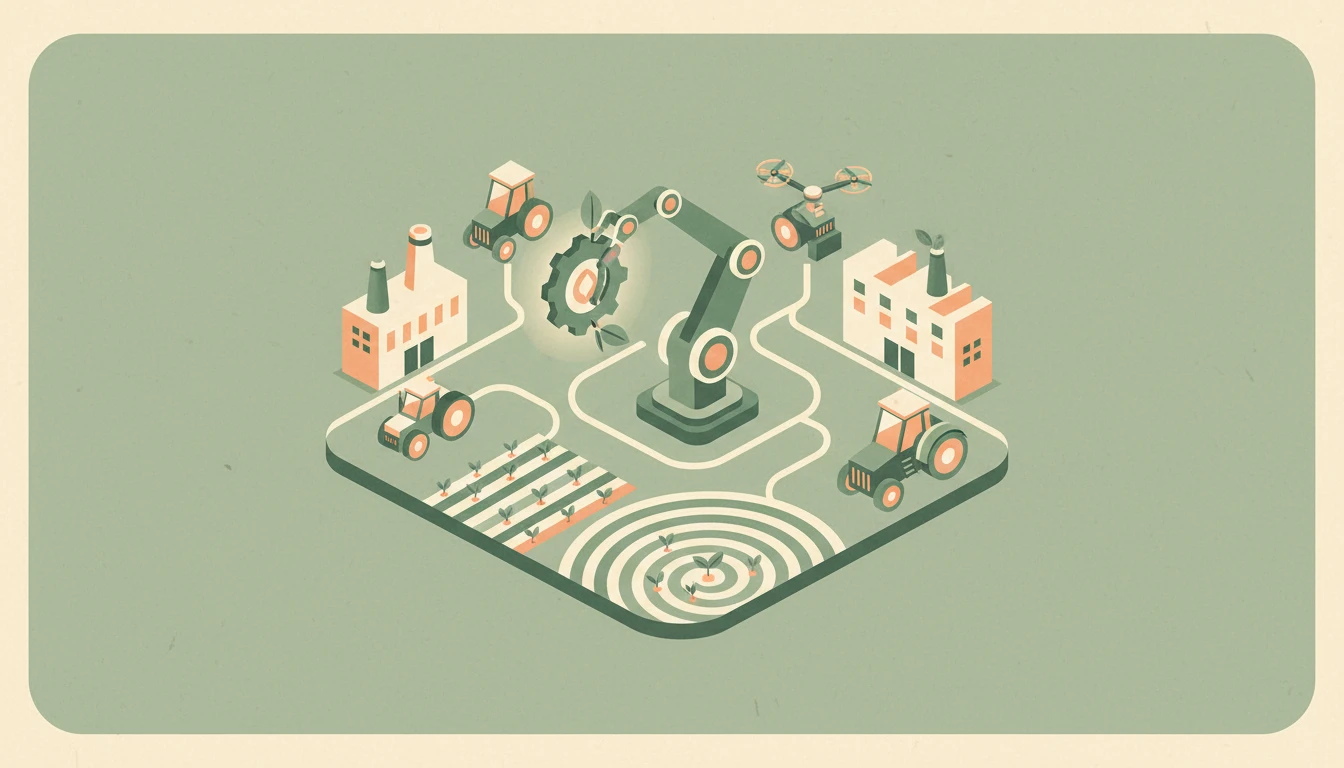
Imagine your assembly line producing tractors, combines, and planters with surgical precision, 24/7, with near-zero defects. The machines that feed the world are themselves being built by smarter, faster, and more adaptable machines. This is not a futuristic vision; it’s the present reality for leading agricultural equipment manufacturers who are leveraging robotics to solve pressing challenges. Manufacturers today are caught in a vise: squeezed by volatile labor costs and skilled worker shortages on one side, and pressured by global food demand and the need for flawless, customized equipment on the other. Navigating this requires more than incremental improvement,it demands a fundamental shift in how production happens. By synthesizing insights from industry leaders and technologists, this guide delivers a clear roadmap. You will gain actionable intelligence on how robotics is being deployed today, understand the tangible return on investment, anticipate the innovations that will define, and learn the practical strategies for successful implementation in your own operations.
The Current State of Robotics in Agriculture Manufacturing
The adoption of robotics in agricultural equipment manufacturing has moved past pilot programs and into the core of production strategy. While the industry was historically reliant on heavy, fixed automation for high-volume runs, the trend is now toward flexibility, precision, and data integration. Manufacturers of combines, tractors, sprayers, and implements are deploying robots not just to replace manual labor, but to enable levels of quality and customization previously unattainable. The current trends point toward a hybrid model where collaborative robots (cobots) work alongside humans on complex assembly tasks, autonomous mobile robots (AMRs) orchestrate the flow of massive components through factories, and sophisticated robotic arms perform high-precision, repetitive tasks with unwavering consistency.
Applications in Production Lines
The factory floor is where robotics delivers immediate, visible impact. Consider the manufacturing of a tractor transmission housing. A robotic arm equipped with advanced vision systems can precisely pick raw castings from a pallet, load them onto a CNC machine, and then unload the finished part,all without human intervention, maximizing machine uptime. In welding, robotic cells are now the standard for constructing the massive frames of combine harvesters. They execute complex, multi-pass welds with absolute repeatability, ensuring structural integrity and reducing the thermal distortion that can plague manual welding. This is critical for equipment that must withstand years of rugged use.
Painting and finishing represent another frontier. Robotic paint systems apply coatings with uniform thickness, eliminating runs and sags while dramatically reducing overspray and VOC emissions. This not only improves product quality and durability but also supports sustainability goals. Finally, automated inspection is revolutionizing quality control. 3D scanning robots can compare a freshly welded chassis against its digital twin in seconds, detecting sub-millimeter deviations that would be invisible to the human eye. This allows for corrections in real-time, preventing defective units from proceeding down the line and incurring massive rework costs later.
Technology Integration
The true power of modern agricultural robotics is unlocked through integration. Robots are no longer isolated islands of automation; they are intelligent nodes in a connected smart manufacturing ecosystem. IoT sensors embedded in robot grippers provide real-time feedback on grip force, ensuring delicate components are handled without damage. These sensors also monitor the robot’s own health, predicting maintenance needs before a breakdown causes downtime.
This sensor data streams into AI algorithms that perform two vital functions. First, they enable adaptive control. For example, an AI-driven welding robot can analyze the seam in real-time and adjust its path, speed, and heat input to compensate for minor variations in part fit-up. Second, AI is used for sophisticated data analytics, aggregating information from every robotic station to identify bottlenecks, optimize production schedules, and predict overall equipment effectiveness (OEE). The synergy between robotics, IoT, and AI creates a responsive production environment that can dynamically adjust to changing orders, material availability, and maintenance schedules, pushing manufacturing automation toward unprecedented levels of efficiency.
-
Common Robot Types in Use:
- Collaborative Robots (Cobots): Used for final assembly, screw driving, and delicate tasks where human-robot teamwork is essential. Their safety features and ease of programming lower the barrier to entry.
- Articulated Robotic Arms: The workhorses for welding, painting, heavy lifting, and machine tending. Known for their reach, payload capacity, and precision.
- Autonomous Mobile Robots (AMRs): These self-navigating carriers transport engines, axles, and cab assemblies between stations, replacing fixed conveyor lines and forklifts for more flexible layouts.
- SCARA Robots: Often found in high-speed assembly and electronic component placement for dashboard and control system manufacturing.
-
Market Snapshot: The global market for robotics in agriculture (including field and factory applications) is projected to grow from approximately $13.5 billion in 2024 to over $24 billion by 2030, reflecting a compound annual growth rate (CAGR) of around 10%. A significant portion of this investment is directed toward the manufacturing of the equipment itself.
Benefits and ROI of Implementing Robotics
The decision to integrate robotics is fundamentally an investment decision. The justification moves beyond simply “automating a task” to achieving strategic advantages in cost, quality, and capability. The benefits of robotics are quantifiable and directly impact the bottom line. For manufacturers facing margin pressure, the ROI in manufacturing from robotic systems is becoming increasingly compelling, with payback periods often measured in months rather than years.
Quantifiable Advantages
Data-driven results are the most persuasive argument for adoption. A major Midwest manufacturer of seeding equipment implemented a robotic cell for welding complex meter assemblies. The result was a 47% increase in daily output due to faster cycle times and the elimination of operator fatigue. More importantly, weld defect rates dropped by over 90%, virtually eliminating costly field failures and warranty claims. In assembly, a European tractor manufacturer deployed cobots for installing hydraulic lines. This reduced the process time per unit by 30% and cut installation errors,a common source of leaks,by 85%.
Time savings also extend to changeovers. Where retooling a manual line for a different product model might take a shift, robotic systems with quick-change tooling and digital programs can switch over in under an hour. This agility is key to supporting the trend toward mass customization in agriculture, where farmers request specific tire options, hydraulic configurations, or technology packages. Robotics makes small-batch, customized production economically viable.
Long-Term Cost Analysis
While the upfront capital expenditure is significant, a long-term cost analysis reveals the true value. The total cost of ownership (TCO) for a robotic system includes purchase, integration, programming, maintenance, and energy costs. When weighed against the costs of manual labor,including recruitment, training, wages, benefits, absenteeism, turnover, and potential injuries,the economics shift over time.
Maintenance for modern robots is predictable and often proactive, guided by the same IoT data they generate. Compared to the variable and rising cost of human labor, robotic operational costs are stable and can even decrease as software improves. The scalability benefits are profound. Expanding production with robotics often means duplicating a proven cell, which is faster and less disruptive than hiring and training a large new workforce. Furthermore, robots unlock quality enhancement that translates directly into brand reputation and reduced liability. The consistency they provide means every piece of equipment that leaves the factory meets the same high standard, strengthening customer trust and loyalty.
Example ROI Calculation for a Robotic Welding Cell
| Metric | Manual Process | Robotic Process | Improvement |
|---|---|---|---|
| Weekly Output (Units) | 100 | 147 | +47% |
| Direct Labor Cost/Unit | $120 | $40 | -66% |
| Defect Rate | 5% | 0.5% | -90% |
| Reject/Warranty Cost/Unit | $150 | $15 | -90% |
| Estimated Payback Period | N/A | 22 Months | Based on reduced labor, increased output, and quality savings. |
Expert Perspectives on Future Trends
The trajectory of agricultural robotics trends points toward greater intelligence, autonomy, and sustainability. Experts agree that the next wave will be defined not by robots working for us, but by robots working with us,and with each other,in increasingly sophisticated ways. The convergence of advanced AI, new materials science, and pressing environmental needs is driving sustainable manufacturing to the forefront of robotic design.
Innovations on the Horizon
We are moving from programmed robots to learning robots. AI-driven autonomy will enable systems that can perceive an unstructured task,like sorting a bin of mixed harvested components for refurbishment,and figure out how to accomplish it without explicit, step-by-step programming. This is crucial for handling the variability inherent in remanufacturing and repair operations.
Bio-inspired robots, designed with principles from nature, are being researched for applications like delicate fruit handling or navigating uneven terrain in test yards. More immediately impactful is the rise of modular robotic systems. Imagine a standard robotic “base” that can be fitted with different “toolkit” modules for welding, dispensing adhesive, or polishing, allowing a single platform to perform multiple tasks along a production line. Real-time adaptive manufacturing will be the ultimate goal, where the entire production system, guided by a central AI “brain,” can dynamically reconfigure itself in response to a supply chain delay, a custom order, or a machine failure, minimizing disruption.
Market Forecasts
The global adoption of robotics in agriculture manufacturing will not be uniform. Regions with high labor costs and strong technological infrastructure, like North America, Western Europe, and parts of East Asia, will lead in adoption. However, emerging economies are showing rapid uptake, often leapfrogging older technologies to deploy modern, flexible robotic solutions.
Investment is flowing heavily into software,the “brains” of the operation,and into swarm robotics, where multiple simple robots coordinate to perform a complex task, like assembling a large vehicle cab. Expert predictions also highlight the growing influence of regulatory pressures. Stricter emissions and safety standards will make the precision of robotics not just an economic advantage, but a compliance necessity. We expect to see robotics become a default consideration in the design of any new agricultural equipment production line, with digital twins and simulation software used to validate and optimize robotic workflows before a single physical robot is purchased.
Challenges and Solutions in Adoption
Despite the clear advantages, the path to integration is fraught with challenges in adoption. Recognizing these barriers and having a plan to overcome them is the difference between a successful transformation and a costly misadventure. The primary hurdles are not solely technological; they are financial, human, and organizational.
The most cited barrier is the high initial investment. The cost of robots, peripheral equipment, safety systems, and integration services can be daunting. A related challenge is the skill gap. Existing maintenance technicians may not be trained in robotics programming and troubleshooting, while engineers may lack experience in designing processes for automation. Integration complexity is another major concern. Retrofitting robots into a legacy factory with outdated machinery and control systems can be a significant engineering challenge, often requiring substantial auxiliary investments.
The solution lies in strategic implementation strategies. A phased approach is almost always best. Start with a single, high-ROI application,such as a robotic cell for a dangerous or highly repetitive welding task. This “lighthouse project” delivers a quick win, builds internal confidence, and creates a team with valuable experience. Concurrently, invest in workforce training. Partner with robotics vendors or local technical colleges to upskill your maintenance and engineering staff. Creating internal champions is critical for change management.
Regarding safety regulations, adherence to standards like ISO 10218 and ISO/TS 15066 is non-negotiable. Expert advice is to involve safety engineers from the very beginning of the design process. Implement comprehensive risk assessments and use appropriate safeguarding technologies, such as light curtains, safety-rated scanners, and pressure-sensitive floors, especially when deploying collaborative robots. When selecting the right robotics solutions, avoid the temptation to seek a one-size-fits-all answer. Be ruthlessly specific about your requirements: payload, reach, precision, cycle time, and required level of human interaction. Pilot different options with your actual parts and processes before committing to a large-scale purchase.
Real-World Examples and Case Studies
Theory is compelling, but real-world examples provide the ultimate proof. Examining success stories from industry leaders offers invaluable practical applications and highlights transferable lessons learned.
Case Study 1: Major Tractor Manufacturer – Painting and Finishing
A global leader faced challenges with consistency and environmental compliance in painting large tractor cabins. Manual processes led to variance in coating thickness and high VOC emissions. The company implemented a multi-robot painting cell with integrated overspray filtration and recovery. The results were transformative: a 30% reduction in paint consumption, a 60% reduction in VOC emissions, and a 99.8% first-pass quality rate. The consistency also allowed for a thinner, more even coat that improved corrosion resistance. “The ROI was calculated not just in material savings, but in compliance assurance and brand enhancement,” noted the plant’s automation lead.
Case Study 2: Mid-Sized Implement Manufacturer – Assembly and Kitting
A manufacturer of planting and tillage equipment struggled with assembly errors and parts picking for custom orders. They deployed a fleet of collaborative robots at assembly stations to guide technicians through complex procedures using digital work instructions and to hand them the correct fasteners and components. Simultaneously, they used autonomous mobile robots (AMRs) to deliver pre-kitted part sets for each unique order directly to the line. This reduced assembly errors by 75%, cut parts picking time by 50%, and increased overall throughput by 20%. The production manager shared, “The cobots didn’t replace our people; they made them superheroes. Error rates plummeted, and our team could focus on value-added tasks rather than hunting for parts.”
Case Study 3: Combine Harvester Factory – Heavy Component Handling
The final assembly of a combine harvester involves maneuvering massive components like headers and grain tanks. This was traditionally done with overhead cranes and multiple operators, a slow and potentially hazardous process. The manufacturer integrated large-payload robotic arms on mobile bases. These robots now precisely lift and position these heavy modules, drastically reducing strain on workers and slashing positioning time from 45 minutes to under 10. The productivity gains were immediate, and the injury rate associated with manual handling dropped to zero. The engineering director concluded, “We turned a bottleneck into a showcase of efficiency and safety.”
The revolution in robotics agriculture manufacturing is not a distant promise,it is an ongoing, accelerating reality. From streamlining complex welding and painting to enabling agile, customized assembly, robotics is delivering tangible benefits of robotics: dramatic improvements in output, quality, and cost control. The future of robotics in agriculture points toward even greater integration, with AI and adaptive systems creating truly smart factories. However, this robotics implementation journey is not without its challenges. Success hinges not on simply purchasing hardware, but on strategic planning, investing in workforce training, and seeking expert guidance to navigate integration and change management.
The key takeaway is clear: Robotics is fundamentally enhancing how we build the machines that feed the world, offering a path to greater efficiency, resilience, and innovation. The competitive advantage will belong to those who start their journey today.
Subscribe to manufacturenow for more in-depth guides and updates on manufacturing technologies, or explore our resources to implement robotics in your operations today.
Frequently Asked Questions (FAQs)
1. What is the typical payback period for a robotics system in agricultural equipment manufacturing?
Payback periods vary widely based on the application, scale, and labor costs replaced. For focused, high-throughput applications like welding or painting, payback can often be achieved in 18 to 36 months. For more complex assembly or material handling systems, it may extend to 3-5 years. The calculation must include soft benefits like quality improvement, safety, and gained production capacity, which often shorten the effective ROI timeline.
2. Are collaborative robots (cobots) safe to work alongside human employees?
Yes, when implemented correctly following strict international safety standards (ISO/TS 15066). Cobots are designed with inherent safety features like force-limited joints, rounded edges, and sensors that detect unexpected contact. However, a full risk assessment is mandatory for each application. Safeguarding, such as defining safe working zones and using additional protective devices, is often still required to ensure absolute safety.
3. We have an older factory with legacy machinery. Can we still integrate robotics?
Absolutely. Retrofitting is a common scenario. The key is a thorough audit. Solutions often involve using mobile robots (AMRs) for material transport or mounting robotic arms on mobile pedestals that can be positioned as needed. Interface modules can be added to older machines to allow robots to safely load and unload them. While integration may be more complex than in a greenfield facility, it is very feasible and often delivers excellent returns by breathing new life into existing assets.
4. What skills do my maintenance team need to manage robotic systems?
Your team will need to develop a blend of traditional mechanical/electrical skills and new digital competencies. Essential skills include basic robot programming (often taught by the vendor), understanding of end-of-arm tooling, preventive maintenance procedures specific to robots, and troubleshooting using the robot’s diagnostic software. Many community colleges and online platforms now offer specialized mechatronics and robotics technician programs.
5. How do I justify the investment in robotics to company leadership?
Build a business case, not a technology case. Focus on quantifiable metrics:
* Cost Reduction: Calculate savings from reduced scrap, rework, labor, and warranty claims.
* Revenue Enhancement: Project increased capacity and throughput that allows you to capture more sales.
* Risk Mitigation: Highlight how robotics addresses labor shortages, reduces workplace injuries, and ensures consistent quality for compliance and brand protection.
* Strategic Positioning: Frame it as an investment in future capability, enabling mass customization and faster response to market changes that competitors without automation cannot match. Use case studies from similar companies to bolster your argument.
Written with LLaMaRush ❤️