Introduction
Unplanned downtime costs manufacturers an estimated $50 billion annually, with a single hour of shutdown often exceeding $100,000 in lost production, overtime labor, and expedited shipping. If your maintenance strategy still revolves around “fix it when it breaks,” you’re bleeding money without even knowing it. Reliability Centered Maintenance (RCM) isn’t a buzzword,it’s a systematic, data-driven framework that shifts your focus from reactive repairs to proactive, consequence-based decision-making. Instead of applying blanket preventive schedules, RCM asks one critical question: What is the most effective way to prevent the failures that matter?
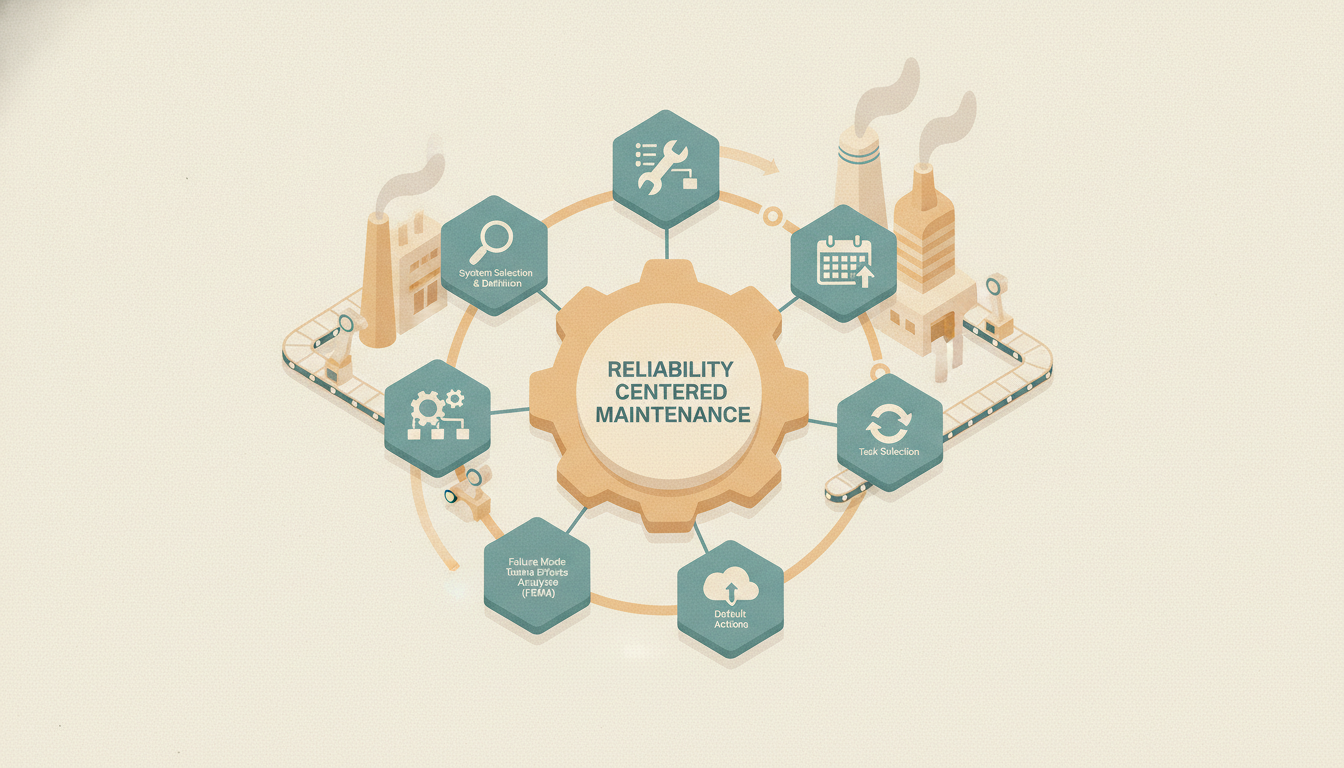
By the end of this guide, you’ll understand the seven practical steps to implement reliability centered maintenance in manufacturing. You’ll learn how to prioritize equipment, analyze failure modes, choose the right maintenance tasks, and continuously improve. No theory, no fluff,just a clear pathway to higher OEE, lower costs, and a maintenance culture that becomes a profit driver instead of a cost center.
Step 1: Select Systems and Define Functions
Every RCM journey begins with a critical decision: which systems to analyze. Trying to apply RCM to every pump, conveyor, and PLC in your plant is overwhelming and inefficient. Instead, use the 80/20 rule,roughly 20% of your equipment causes 80% of your downtime. Those are the systems you need to disassemble first.
How to Prioritize Critical Equipment
Start by pulling historical failure records, work order data, and incident logs. Rank your equipment based on three criteria:
- Safety impact – Could a failure cause injury or environmental release?
- Production impact – Does a failure stop the line completely or just slow it down?
- Cost impact – What are the total cost of downtime, repair, and lost quality?
Create a simple matrix. Any piece of equipment that scores “high” in two or more categories should be on your shortlist. For example, a critical stamping press that halts the entire production cell and has a long lead time for spare parts would be a prime candidate. Conversely, a backup air compressor that runs only during peak loads and has a low consequence of failure might be deferred.
Quick win: Don’t guess,use your CMMS to generate a Pareto chart of downtime events. The top 10 equipment types by frequency or duration are your first RCM targets.
Define Functions and Performance Standards
Once you’ve selected a system, define its primary function in clear, measurable terms. For a centrifugal pump, the function isn’t “pump water”,it’s “deliver 200 GPM of cooling water at 50 PSI continuously.” Without that specification, you can’t know when the system is actually failing.
Document all functions, including secondary ones (e.g., containment of fluid, noise limitation) and protective functions (e.g., emergency shutdown). For each function, define a performance standard:
- What must the equipment do? (flow, pressure, speed, temperature)
- Under what conditions? (ambient temperature, duty cycle, product type)
- For how long? (× hours per day, × years before overhaul)
Finally, use a decision tree to prioritize systems. Only 10–15% of your equipment needs full RCM analysis in the first year. Focus on the systems where a failure would most impact your goals. Document everything in a system selection register.
Step 2: Identify Failure Modes and Effects
After defining functions and performance standards, you now need to ask: How can this system fail to perform its function? This is where Failure Mode and Effects Analysis (FMEA) comes into play. FMEA is the heart of RCM,it systematically lists every conceivable failure mode, its cause, and its immediate effect.
Common Failure Modes in Manufacturing Equipment
While every system is unique, manufacturing equipment tends to fail in predictable patterns. Watch for these common modes:
| Failure Mode | Example | Typical Cause |
|---|---|---|
| Wear | Bearing spalling in a motor | Abrasive contamination, lack of lubrication |
| Corrosion | Pipe thinning in a chemical line | Chemical attack, improper material selection |
| Misalignment | Shaft misalignment causing vibration | Poor installation, foundation settling |
| Contamination | Hydraulic valve sticking | Particulate ingress, degraded fluid |
| Human error | Operator presses wrong button | Poor training, unclear labeling |
For each failure mode, you’ll also need to identify the cause (root, not proximate) and the effect at the local system level and the plant level. For example, a worn impeller in a cooling pump may cause reduced flow, which leads to overheating of downstream equipment, eventually stopping the production line. Document these in an FMEA worksheet,either spreadsheet or dedicated software.
Practical tip: Don’t try to list every possible failure mode in one sitting. Assemble a cross-functional team: operators, maintenance technicians, engineers, and safety specialists. Operators often know failure modes that rarely appear in work orders. Use a structured brainstorming session with a facilitator. Focus on each function one at a time.
Conduct a Structured Analysis
The FMEA should include:
- Failure mode – The specific way the failure occurs.
- Cause – The underlying reason.
- Effect – Consequence at the system and plant level.
- Current controls – Do you already have detection or prevention measures?
- Criticality – Use a simple 1–5 scale for Severity, Occurrence, and Detection.
After the analysis, you’ll have a prioritized list of failure modes that need action. This directly feeds into the next step,determining consequences.
Step 3: Determine Failure Consequences
Not all failures are created equal. A seized fan on a non-critical cooling unit might cause a minor production slowdown, while a failed safety interlock could put an operator’s life at risk. RCM categorizes consequences into four types:
- Safety and environmental – could cause injury, fatality, or environmental harm.
- Operational – directly impacts throughput, quality, or customer delivery.
- Non-operational – does not affect production but incurs repair costs (e.g., a backup pump that’s already offline).
- Hidden – a failure that’s not evident during normal operations, such as a failed emergency stop button or a fire suppression system that won’t activate.
Hidden vs Evident Failures
Hidden failures deserve special attention because they represent a ticking time bomb. Your safety devices,pressure relief valves, gas detectors, emergency stops,might be completely non-functional, yet the equipment appears to run fine. When the real emergency happens, these devices fail to protect. The maintenance strategy for hidden failures must focus on finding the failure before it’s needed, through periodic testing or online monitoring.
For evident failures, the consequence is immediate. A conveyor belt rips, and the line stops. For such failures, you can weigh the cost of prevention against the cost of the failure itself. If the failure causes a safety risk, you must take proactive action regardless of cost.
Example: In a food processing plant, a metal detector’s hidden failure (it stops detecting contaminants) has a massive safety consequence if it goes unnoticed. RCM dictates a frequent functional test (e.g., daily with a test piece) rather than simply inspecting the sensor.
Quantify the Impact
Don’t rely on gut feelings. Use historical data to estimate:
- Average downtime per failure (hours)
- Lost profit per hour
- Repair and parts cost
- Probability of injury (use incident logs)
Combine these into a risk score for each failure mode. This score will guide you in selecting the right maintenance task in the next step.
Step 4: Select Maintenance Tasks
Now that you understand how each failure mode affects your plant, you need to choose what to do about it. RCM uses a decision logic to answer: “Is a proactive task technically feasible and worth doing?” If yes, you choose from predictive, preventive, or proactive actions. If no, you accept run-to-failure or redesign.
Run-to-Failure: When Is It Acceptable?
Run-to-failure (RTF) is not a dirty word in RCM,it’s a deliberate strategy for failures with low consequences. If a failure doesn’t affect safety, environment, or production, and the cost of a preventive task exceeds the cost of repair, RTF is the most cost-effective choice.
For example, a small LED indicator light on a control panel might fail. It costs $5 to replace and causes no operational impact. Spending $500 annually on preventive replacement is wasted money. But this only works if you have a spare part on hand and the failure doesn’t cascade.
Decision Logic
RCM provides a series of yes/no questions for each failure mode:
- Is the failure hidden? (Yes → need a scheduled on-condition or failure-finding task)
- Is a predictive task (condition monitoring) technically feasible and worthwhile? (e.g., vibration analysis for bearing wear)
- If not, is a scheduled restoration or replacement task feasible? (e.g., change oil every 500 hours)
- If not, consider redesign (modify the system) or accept RTF.
Table: Common maintenance task types and when to use them
| Task Type | Example | Best For |
|---|---|---|
| Predictive (condition-based) | Vibration analysis, thermography, oil analysis | Failures that show warning signs before catastrophe |
| Scheduled restoration | Rebuild a pump every 5,000 hours | Failures with a predictable wear-out pattern |
| Scheduled replacement | Replace a belt every year | Known lifetime components with low cost |
| Failure-finding | Test fire alarm weekly | Hidden failures where testing is feasible |
| Redesign | Change bearing type to handle higher load | When proactive tasks are not possible or cost-effective |
Consider Condition-Based Maintenance
Thanks to declining sensor costs, condition-based maintenance is now accessible even for small manufacturers. Install vibration sensors on motors, thermal imaging on electrical panels, and oil analysis for gearboxes. Set thresholds for alarms. When a parameter exceeds the threshold, a work order is automatically generated. This is the most cost-effective proactive strategy because you only intervene when data shows impending failure,eliminating unnecessary preventive work.
Stat: According to the U.S. Department of Energy, implementing predictive maintenance can reduce breakdowns by 70–75% and maintenance costs by 25–30%.
Step 5: Implement Maintenance Strategies
Selecting the right tasks is half the battle,you still need to put them into practice. This means building a detailed implementation plan, assigning responsibilities, and training your people.
Change Management Tips
RCM often feels threatening to maintenance teams. “What,you mean the old way was wrong?” The key is to involve operators and technicians early. Start with a pilot area,choose one production cell or system that everyone already knows causes headaches. Complete steps 1–4 for that pilot, then show results.
- Communicate the “why.” Explain that RCM will reduce firefighting, not increase workload.
- Share early wins. After three months, present metrics: reduced downtime, fewer emergency calls, lower repair costs. Let the data speak.
- Train, don’t dictate. Everyone needs basic RCM awareness. Maintenance planners need advanced training on the decision logic. Operators need to understand their new role in condition monitoring (e.g., daily vibration checks).
Develop Maintenance Plans and Schedules
Translate each selected task into a concrete work order:
- Task description (e.g., “Check vibration on motor M-101 using portable analyzer, record in CMMS.”)
- Frequency (e.g., weekly, monthly, per 500 hours)
- Required skill level (e.g., Level I Vibration Analyst)
- Estimated duration
- Required parts or tools
Load these into your CMMS and link them to the equipment. Set up a weekly maintenance schedule that balances proactive work with production demands. Aim for 85% planned maintenance adherence in the first year.
Document Procedures
Standard operating procedures (SOPs) for each task are non-negotiable. Without them, work quality varies and critical steps get missed. Use clear language and include photos where helpful. Make them accessible on the shop floor via tablets or work order screens.
Step 6: Monitor and Measure Effectiveness
You can’t manage what you don’t measure. After implementing your RCM plan, you need to track whether it’s actually working. This means moving beyond “maintenance cost per unit” to more meaningful lagging and leading indicators.
Benchmarking Your RCM Success
Industry benchmarks give you a reality check. A well-run RCM program typically delivers:
- Overall Equipment Effectiveness (OEE) above 85%
- Mean Time Between Failure (MTBF) improvement of 30–50% in the first year
- Planned Maintenance Percentage rising from 20% (reactive) to 80%+ (proactive)
- Maintenance Cost as % of Replacement Asset Value (RAV) dropping from 8–12% to 3–5%
Set targets based on your own baseline. For example, if your current OEE is 60%, aim for 70% after one year of RCM on critical assets.
Track Key Performance Indicators
Create a dashboard with these essential RCM metrics:
| KPI | Formula | Target |
|---|---|---|
| OEE | Availability × Performance × Quality | >85% |
| MTBF | Total operating hours / Number of failures | Increase by 30% YoY |
| MTTR | Total downtime / Number of failures | Decrease by 20% YoY |
| Planned Maintenance % | Planned hours / Total maintenance hours | >80% |
| Backlog (weeks) | Total open work orders / Weekly capacity | 2–4 weeks |
Review these metrics monthly during a maintenance review meeting. Compare actuals to targets. If a KPI is off, dig into the details,is a particular failure mode recurring? Did you miss a condition? Then adjust your RCM tasks accordingly.
Real-Time Visibility
Invest in a simple dashboard (even Excel-based) that pulls data from your CMMS. Color-code assets: green (within thresholds), yellow (warning), red (critical failure). This helps managers and operators spot trends before they become crises.
Step 7: Continuously Improve
RCM is not a one-and-done project. Equipment changes, production demands shift, and new failure modes emerge. The final step is to institutionalize a loop of continuous improvement.
Leveraging IoT for Proactive Maintenance
The most forward-thinking manufacturers are embedding Internet of Things (IoT) sensors into their critical assets. These sensors stream real-time data to a cloud platform, where algorithms detect anomalies. For example, a vibration spike on a motor in a remote location triggers an alert to the maintenance team’s smartphone,before the bearing fails.
- Vibration sensors – Detect imbalance, misalignment, bearing wear.
- Thermal imaging – Monitors electrical panels, motor winding temperature.
- Oil analysis – Identifies contamination, particle count, viscosity breakdown.
- Acoustic sensors – Picks up ultrasonic leaks in compressed air or steam.
Stat: McKinsey reports that predictive maintenance enabled by IoT can reduce machine downtime by 30–50% and extend asset life by 20–40%.
Schedule Periodic RCM Reviews
Set a calendar reminder every six months to revisit your FMEA for each critical asset. Ask:
- Have we had any new failure modes since the last review?
- Have production demands changed the function or performance standards?
- Are our current tasks still cost-effective? (e.g., condition monitoring data may show that a scheduled replacement at 5,000 hours is too early,push it to 7,000 hours)
- Did any safety incidents occur that require a redesign?
Incorporate New Technologies
Stay alert to new tools like machine learning, AI-driven failure prediction, and digital twins. Even if you can’t adopt them immediately, start small with free or low-cost tools. For example, use free anomaly detection scripts on your PLC data to flag unusual temperature patterns.
Continuously improve means updating your FMEA based on actual failure history. If you find that a particular failure mode never materializes after two years, consider downgrading its criticality or extending the task interval. This is the essence of RCM optimization,never stop refining.
Frequently Asked Questions
1. What is the difference between RCM and TPM (Total Productive Maintenance)?
RCM is a decision-making framework for selecting maintenance tasks based on failure consequences, while TPM is a broader cultural and operational strategy that aims for zero breakdowns, zero defects, and zero accidents through involvement of all employees. RCM answers “what to do” for each failure mode; TPM provides the organizational structure (autonomous maintenance, focused improvement, etc.) to execute those tasks. Many manufacturers combine both,RCM to identify the right tasks, and TPM to sustain a proactive culture.
2. How long does it take to implement RCM in a manufacturing plant?
A full-scale RCM implementation for a mid-size plant (50–100 critical assets) typically takes 12–18 months for the initial rollout. The first pilot on 5–10 assets can be completed in 6–8 weeks. However, continuous improvement never ends. The most common pitfall is trying to analyze too many assets too quickly,stick to the 80/20 rule and expand gradually.
3. Do I need special software for RCM?
Not necessarily. You can start with spreadsheets, a whiteboard, and your CMMS. Basic FMEA worksheets can be created in Excel. However, as you scale, dedicated RCM software (like Reliability Workbench, Prometheus, or even modules within modern CMMS/CMMS) will save time by linking failure modes to tasks and generating reports. The key is the methodology, not the tool.
Conclusion
Reliability Centered Maintenance isn’t a maintenance program,it’s a mindset shift. By systematically evaluating each failure mode and choosing the most cost-effective task, you stop wasting resources on unnecessary maintenance and start preventing the failures that hurt your bottom line. The result: higher OEE, longer mean time between failures, and a maintenance team that works smarter, not harder.
Key takeaway: RCM transforms maintenance from a cost center to a profit driver by systematically preventing downtime that matters.
Ready to get started?
Download our free RCM implementation checklist to guide your team through each step,from system selection to continuous improvement. No sign-up required, just practical tools. [Get the checklist now]
Written with LLaMaRush ❤️