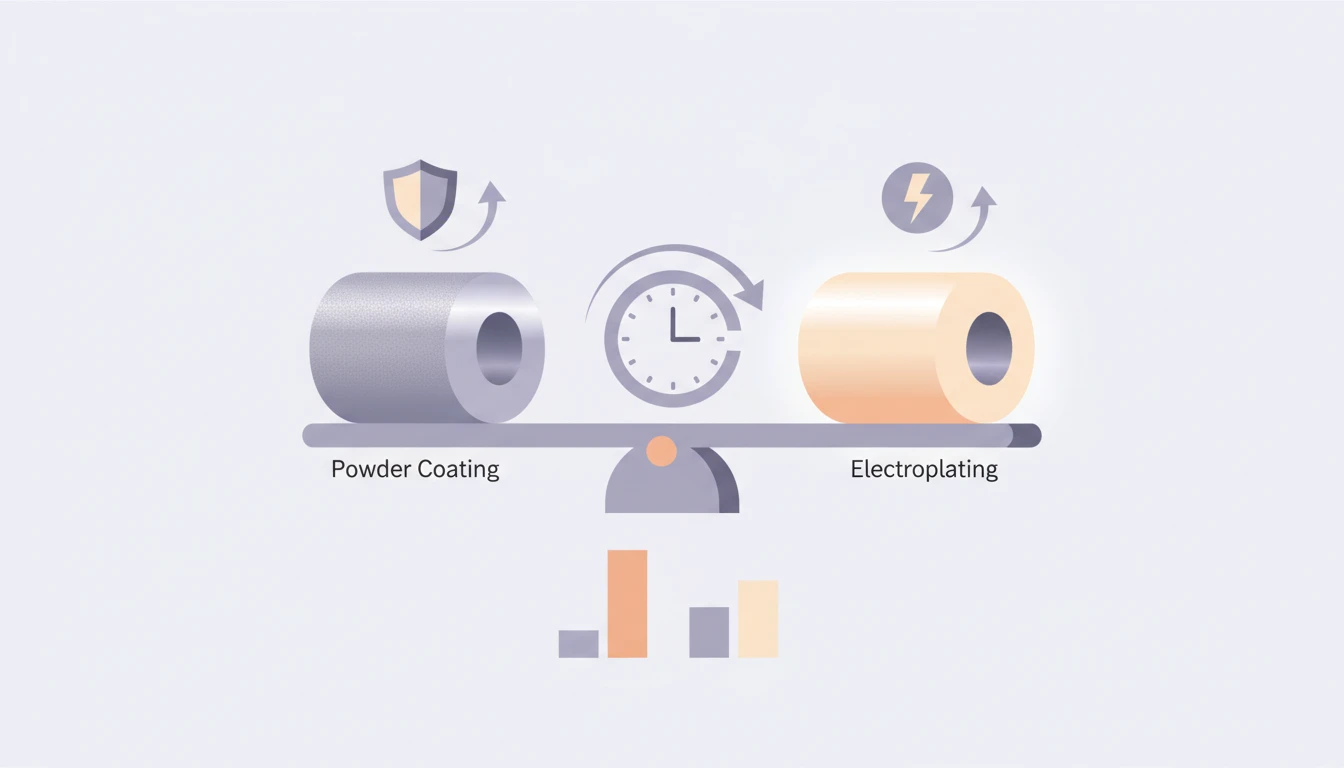
Choosing the right protective finish for a metal part isn't just about color or price. For engineers, designers, and manufacturers, the most critical question is: Which one will last? You might love the smooth, thick look of a powder coat or the hard, conductive sheen of chrome plating, but if it fails in two years under your specific conditions, you've made an expensive mistake. Most online comparisons get bogged down in upfront costs or superficial traits, ignoring the hard, test-backed data on long-term performance. This article cuts through the noise. We’re going beyond opinions to examine the science of adhesion, corrosion resistance, and wear performance. By the end, you'll have a clear, evidence-based framework to decide whether powder coating or electroplating will deliver the longevity your part demands in its specific battle against the elements.
How Longevity Is Measured: Key Testing Standards
In manufacturing, hope is not a strategy. You can't install a part and "wait and see" if the coating lasts. This is why standardized tests exist. They create controlled, repeatable conditions that predict how a coating will perform in the real world, allowing for apples-to-apples comparisons between different finishes. Relying on supplier claims like "highly durable" is meaningless without the data to back it up. The true measure of a coating's mettle comes from a battery of industry-standard tests.
The most famous of these is the salt spray test, standardized as ASTM B117. A part is placed in a sealed chamber where a fine, salty mist is continuously sprayed at a constant temperature. Technicians then record the number of hours it takes for white, corrosive rust (for zinc) or red rust (for steel substrate) to appear. A finish rated for 500 hours will, on average, outperform one rated for 250 hours under the same test. However, a critical point engineers must understand is that 500 hours in a salt spray chamber does not equal 500 hours on a car in Minnesota. The test is an accelerated, constant-stress environment. Real life involves dry periods, rain, mechanical abrasion, and UV exposure. Its true value is as a reliable comparative benchmark, not a literal calendar.
To better simulate real-world cycles, cyclic corrosion testing (like ASTM G85) was developed. This is a more sophisticated torture test. A part might undergo a sequence of salt spray, high humidity, a drying period, and sometimes even sub-freezing temperatures. This "wet-dry" cycle more accurately replicates the conditions that cause coatings to fail, as it allows corrosive elements to concentrate during evaporation and stresses the coating's adhesion.
Beyond corrosion, other key tests define different aspects of durability. Pencil hardness (scratch resistance) and impact resistance (ASTM D2794) measure a coating's mechanical toughness. For outdoor applications, UV/weathering exposure in a QUV chamber simulates years of sunlight damage, checking for gloss loss, chalking, and fading. For parts that experience rubbing or abrasion, the Taber abrasion test quantifies wear resistance by measuring weight loss after a set number of cycles under abrasive wheels. A comprehensive longevity profile requires looking at this entire suite of coating durability standards.
What the Numbers Really Mean
When a plating shop says their zinc coating lasts "120 hours to red rust," or a powder coater claims "1,000+ hours salt spray," they are speaking the language of ASTM B117 salt spray. It’s a universal, if imperfect, dialect. The key is to understand what the number represents: it's a measure of the coating's ability to act as a barrier. A higher number indicates a thicker, denser, or more chemically resistant barrier against chloride ions.
For electroplating, especially thin layers like zinc, the number also reflects whether the coating is sacrificial. Zinc will corrode preferentially to protect the underlying steel, so its "lifespan" in the test is the time it takes to fully consume that thin zinc layer. A powder coating, being a thick, inert polymer, provides a pure physical barrier. Its failure point is when that barrier is breached by a scratch, a weak edge, or through gradual chemical permeation. Therefore, comparing the raw corrosion test hours between a sacrificial zinc plate (e.g., 120 hours) and a barrier powder coat (e.g., 1000 hours) is less about direct equivalence and more about understanding their fundamentally different protective mechanisms. The test is invaluable for comparing two powder coatings or two plating chemistries against each other.
Powder Coating Durability: The Thick, Tough Shield
Think of powder coating as putting a durable plastic shell over your metal part. The process involves applying a dry, electrostatically charged powder (composed of polymer resins, pigments, and additives) and then baking it in an oven to melt and cure it into a continuous film. Its greatest strength is its powder coating thickness, typically ranging from 60 to 250 microns (2.4 to 10 mils). For perspective, this is often 5 to 10 times thicker than most electroplated layers. This substantial thickness is the foundation of its legendary durability.
In salt spray performance, a standard polyester powder coating can reliably achieve 500–1,000+ hours before red rust appears at a scribe. High-performance epoxies can exceed 1,500 hours. This outstanding performance stems from that thick, non-porous barrier that chloride ions struggle to penetrate. The impact and chip resistance of powder coating is also excellent. The cured polymer has a degree of flexibility, allowing it to absorb impacts (like from road stones) that would chip a more brittle finish. Its chemical resistance is generally very good against a wide range of acids, alkalis, and solvents, making it a top choice for industrial equipment and chemical handling components.
However, powder coating has its Achilles' heel: sunlight. Not all powders are created equal for outdoor use. Polyester and polyurethane-based powders have excellent UV resistance, retaining their color and gloss for years. Epoxy powder coating, while championing chemical and corrosion resistance, degrades rapidly in sunlight (chalking and fading), limiting it to indoor applications. Therefore, specifying the correct resin chemistry for the environment is as crucial as the coating process itself.
Edge Coverage and the Faraday Cage Effect
One of the celebrated advantages of powder coating is its excellent edge coverage. Because the charged powder particles are attracted to the grounded part, they tend to wrap around corners, providing protection where liquid paints might drip away. However, a phenomenon called the Faraday cage effect can challenge this on complex parts. On a part with deep recesses or sharp, enclosed corners, the electrostatic field can become so concentrated that it repels the powder, leading to thin coverage or "back ionization."
The result? While powder wraps around an exposed edge well, it can thin dangerously on the sharp interior corner of a bracket or inside a deep channel. This thin spot becomes the failure point where corrosion begins. Proper application technique is the mitigator. Experienced coaters will use a combination of gun voltage/current adjustments, specialized gun tips, and part racking orientation to ensure even coverage. The lesson for engineers: design parts with slightly rounded edges (a radius of at least 1-2mm) where possible, and always specify a minimum required thickness on all surfaces, including edges.
Electroplating Longevity: Thin, Hard, and Conductive
Electroplating is an electrochemical process where metal ions in a solution are deposited onto a conductive substrate. It creates an extremely thin, metallurgically bonded layer, measured in microns. Typical electroplating thickness ranges from a mere 5 microns for decorative chrome up to 25 microns or more for engineering finishes like hard chrome. Its durability comes not from thickness, but from hardness, density, and chemical nature.
Salt spray performance varies dramatically by plating type. A standard clear trivalent zinc plating might offer 72–120 hours to white rust, acting as a sacrificial anode. More advanced zinc-nickel alloy plating can push this to 500+ hours. Decorative nickel-chrome systems provide a brilliant barrier finish, while hard chrome plating, renowned for its density, can exceed 1,000 hours in corrosion tests while also being incredibly wear-resistant. The hardness is a key differentiator: hard chrome can reach 800–1,000 HV (Vickers hardness), making it harder than most tool steels. Powder coating, in comparison, is relatively soft.
The corrosion mechanism is fundamental. Zinc plating protects sacrificially,it corrodes first. Nickel and chrome protect as inert barriers. This thinness is a double-edged sword: it preserves precise dimensional tolerances but offers less tolerance for damage. A deep scratch through a plated layer immediately exposes the substrate. Another critical, often overlooked risk for high-strength steels is hydrogen embrittlement. The electroplating process can cause hydrogen atoms to diffuse into the steel, making it brittle and prone to catastrophic cracking under stress. A proper baking cycle post-plating is essential to drive out this hydrogen.
The Role of Underplates and Multi‑Layer Systems
You rarely get just one layer in quality electroplating. The longevity of a plated part is often built on a system of layers, each with a specific function. A common decorative system for automotive trim is copper-nickel-chrome. The copper layer provides excellent leveling (smoothing the substrate), the nickel layer is the main corrosion barrier, and the thin top layer of chrome provides a hard, tarnish-resistant blue-white shine.
In engineering, multi-layer systems are what make electroplating so durable in harsh applications. For instance, plating a steel part with a layer of copper (for adhesion and leveling), then a thick layer of nickel, and finally a functional layer of hard chrome combines the benefits of each metal. The nickel provides excellent corrosion resistance, while the hard chrome top layer delivers unmatched abrasion resistant coating performance. Specifying a single-layer plating is often a recipe for premature failure; the real-world performance hinges on the designed synergy of the complete plating stack.
Head‑to‑Head: Which Lasts Longer by Environment
There is no universal winner. The champion is entirely determined by the battlefield. Asking "which lasts longer?" is like asking "which is better, a raincoat or a suit of armor?",it depends entirely on whether you're walking in the rain or deflecting arrows. Let's break down the performance by environment.
Indoor, Dry Environment: This is a tie. In a climate-controlled office or warehouse, protected from moisture, UV, and chemicals, both a properly applied powder coat and a standard electroplate will last essentially indefinitely. Failure here is almost always due to physical damage, not environmental degradation.
Outdoor, High UV (e.g., Arizona Desert): Polyester powder coating wins decisively. Its excellent UV resistant finish and thick barrier protect against both the sun and occasional rain. Epoxy powder would fail here, chalking and degrading. Most electroplating (like nickel or chrome) will not corrode but can permanently discolor or "fog" under extreme, prolonged UV exposure, though its function remains.
Coastal/Salt Spray Marine Environment: This is a nuanced fight. A thick, high-quality polyester powder coating (rated 1000+ hours salt spray) provides an excellent barrier and scores highly. However, if the part is subject to impact from sand, debris, or frequent handling that can scratch the coating, corrosion can start at those breaches. A robust zinc-nickel plating system, while thinner, offers both sacrificial and barrier protection and can handle minor abrasion better than a soft powder coat in some cases. The choice hinges on the risk of physical damage.
Chemical Exposure (Industrial Fumes, Spills): Powder coating generally wins. Engineered powders like epoxy, polyurethane, or fluoropolymers offer superior, broad-spectrum resistance to acids, alkalis, and solvents compared to most plated metals, which may be susceptible to specific chemicals.
High Wear/Abrasion (Piston Rods, Gears, Moving Parts): Hard chrome plating wins unequivocally. Its extreme hardness and low coefficient of friction make it the gold standard for parts that see constant sliding contact, grit, or abrasive dust. No powder coating can match its abrasion resistant coating performance in these severe duty cycles.
High Heat (>200°C / 392°F): Electroplating wins. Most polymer-based powder coatings will begin to soften, discolor, or degrade at sustained temperatures above this point. Metallic platings like chrome or nickel retain their integrity and appearance at much higher temperatures, making them the only choice for engine components or high-temperature tooling.
Comparison Table
| Environment / Threat | Powder Coating Performance (1-5) | Electroplating Performance (1-5) | Typical Lifespan Estimate & Notes |
|---|---|---|---|
| Indoor, Dry | 5 - Excellent | 5 - Excellent | 10+ years for both. Failure is from damage, not environment. |
| Outdoor, High UV | 5 - Excellent (Polyester) | 3 - Fair (Decorative) | Powder: 7-15 years. Plating: May discolor in 2-5 years but won't corrode. |
| Coastal / Marine | 4 - Very Good | 3-4 - Good to Very Good | Powder: 5-10 years if undamaged. Plating (Zn-Ni): 5-8 years; handles minor abrasion well. |
| Chemical Exposure | 5 - Excellent (Epoxy/PU) | 2-3 - Poor to Fair | Powder: 5-10+ years with correct resin. Plating: Highly chemical-specific; can corrode rapidly. |
| High Wear / Abrasion | 2 - Poor | 5 - Excellent (Hard Chrome) | Powder: May wear through in <1 year. Hard Chrome: 10-20+ years in severe service. |
| High Temperature | 1-2 - Poor (>200°C) | 5 - Excellent | Powder: Softens/degrades rapidly. Plating: Unaffected; standard choice for engine parts. |
The Hidden Factor: Substrate Preparation and Application Quality
You can specify the best coating in the world, but if it's applied to a dirty, poorly prepared surface, it will fail prematurely. In fact, surface preparation accounts for at least 50% of a coating's performance and longevity. This is the most common point of real-world failure and cost-cutting.
For powder coating, the substrate must be absolutely clean and oil-free, typically via a multi-stage wash. More importantly, it needs a physical profile,microscopic roughness for the coating to mechanically grip onto. This is achieved through abrasive blasting or, more commonly for steel, a zinc or iron phosphate conversion coating. This phosphate layer also provides additional corrosion inhibition.
For electroplating, the requirement for cleanliness is even more absolute. The surface must be chemically clean and "activated." Any trace of oil, rust, or passive oxide film will prevent the atomic-level metallic bonding, leading to coating adhesion failure, blistering, or peeling. The plating bath chemistry itself is designed to etch and activate the surface, but prior cleaning is non-negotiable.
Common failure points to audit include under-cured powder (brittle, poor adhesion), thin edges on powder-coated parts, hydrogen embrittlement in plated high-strength steel that wasn't baked, and contamination during handling between cleaning and coating. This is why third-party certifications matter. Look for applicators certified to standards like Qualicoat for powder coating or ASTM B633 for zinc plating. These certifications mandate strict process controls for preparation, application, and testing, giving you independent assurance of quality.
Case Studies: When Each Coating Exceeds Expectations
Real-world performance is the ultimate test. Here are documented scenarios where each technology delivered exceptional longevity.
Powder Coating on Outdoor Architectural Railings: A coastal condominium in Florida specified a high-grade, UV-resistant polyester powder coating (1000+ hour salt spray rating) for its balcony railings. After 10+ years of constant exposure to intense sun, salt air, and high humidity, the railings show only minor fading and no signs of corrosion or coating breakdown, demonstrating the power of a thick, properly specified barrier coat in a marine environment.
Zinc-Nickel Plating on Automotive Brake Components: A manufacturer of brake caliper brackets switched from standard zinc plating to a zinc-nickel alloy process. These components face road salt, heat, and brake dust. Field data and controlled audits showed that the zinc-nickel plating provided 15 years of service without the appearance of red rust, far exceeding the life of the vehicle model and validating the use of advanced alloy plating for critical, salt-exposed automotive parts.
Hard Chrome on Hydraulic Piston Rods: In the mining industry, hydraulic cylinder rods are subjected to extreme abrasion from rock dust, constant movement, and high pressure. A hard chrome plating thickness of 0.002-0.004 inches (50-100 microns) applied to these rods has demonstrated service life exceeding 20 years in these brutal conditions. The chrome's hardness resists scratching from grit, and its natural lubricity reduces seal wear.
Epoxy Powder on Chemical Plant Valves: Valves in a chemical processing plant handling acidic fumes were coated with a chemical-resistant epoxy powder. After 8 years of continuous exposure, the valves showed no signs of coating degradation, blistering, or loss of integrity. The valves were removed for mechanical servicing, not coating failure, proving the superior chemical resistance of engineered powder in an aggressive industrial setting.
Decision Framework: How to Choose for Your Part
With all this data, making a final choice requires a systematic approach. Don't start with the coating; start with the part's mission and its operating environment. Follow this five-step framework.
Step 1: Identify the Primary Threat. Is it corrosion from salt or humidity? Abrasion and wear? Constant UV exposure? Chemical splashes? High temperature? Thermal cycling? Rank these threats in order of severity. The coating must be optimized to defeat threat #1.
Step 2: Determine Required Thickness and Tolerances. Does your assembly have tight clearances that a thick coating would compromise? Electroplating adds negligible dimension (microns). Powder coating adds significant dimension (mils). If you can't afford to lose 4-8 mils (100-200µ) of clearance, plating may be your only option.
Step 3: Consider Electrical & Aesthetic Needs. Does the part need to conduct electricity or be welded? Electroplating conducts; powder coating is an insulator. What is the desired final appearance? Powder offers limitless colors and textures (matte, glossy, wrinkled). Plating offers a specific metallic luster (zinc's blue-bright, chrome's mirror, brass's gold).
Step 4: Factor in Repairability and Maintenance. Can the part be easily touched up in the field? Powder coating repair is challenging; it usually requires sanding, priming, and spraying with a compatible liquid paint. Damaged plating requires complete stripping and re-plating of the component, which is often more complex.
Step 5: Compare Total Cost of Ownership, Not Just Upfront Cost. A cheaper coating that fails in 3 years is more expensive than a costlier one that lasts 10. Calculate an estimated cost per year of service. Include the cost of the coating process, potential downtime for replacement, and labor for refinishing.
Analogy: Coating Choice Is Like Choosing a Marketing Strategy
This final analysis mirrors a critical business decision. Just as a medical practice would meticulously evaluate whether investing in a foundational Google Business Profile setup or a broader digital marketing campaign yields a better patient acquisition ROI, an engineer must evaluate powder coating versus electroplating based on specific environmental threats and lifespan requirements,not just the initial price on the quote. The goal isn't the cheapest option; it's the option that delivers the required performance over the part's entire service life at the lowest total cost. Choosing a coating solely for its low upfront cost is like a doctor choosing a marketing tactic solely because it's free, without considering if it actually reaches new patients. Both are strategic investments in longevity and performance.
Key Takeaway: Powder coating generally lasts longer in corrosive or UV‑rich outdoor environments due to its thick, resilient barrier. Electroplating (especially hard chrome or zinc‑nickel) wins in applications demanding high wear resistance, high heat tolerance, electrical conductivity, or dimensional precision. The final, correct answer always depends on your specific environment and part function.
Written with LLaMaRush ❤️