Imagine your production line grinding to a halt because a cylinder fails to deliver enough force to press a component, or a robot arm stuttering because its movements aren't smooth enough. Often, the root of such inefficiency isn't the machine itself, but the fundamental power system driving it. Choosing between pneumatic and hydraulic systems is a critical engineering decision that directly impacts your bottom line, safety, and productivity. Yet, confusion persists, leading to costly mismatches where a system is either over-engineered and expensive or underpowered and unreliable.
This guide cuts through that confusion. We'll break down the core principles, compare them across five essential dimensions, and provide you with a clear, actionable framework to select the optimal system for your specific application. By the end, you’ll be equipped to make an informed choice that balances technical requirements, operational costs, and long-term performance.
What Are Pneumatic and Hydraulic Systems?
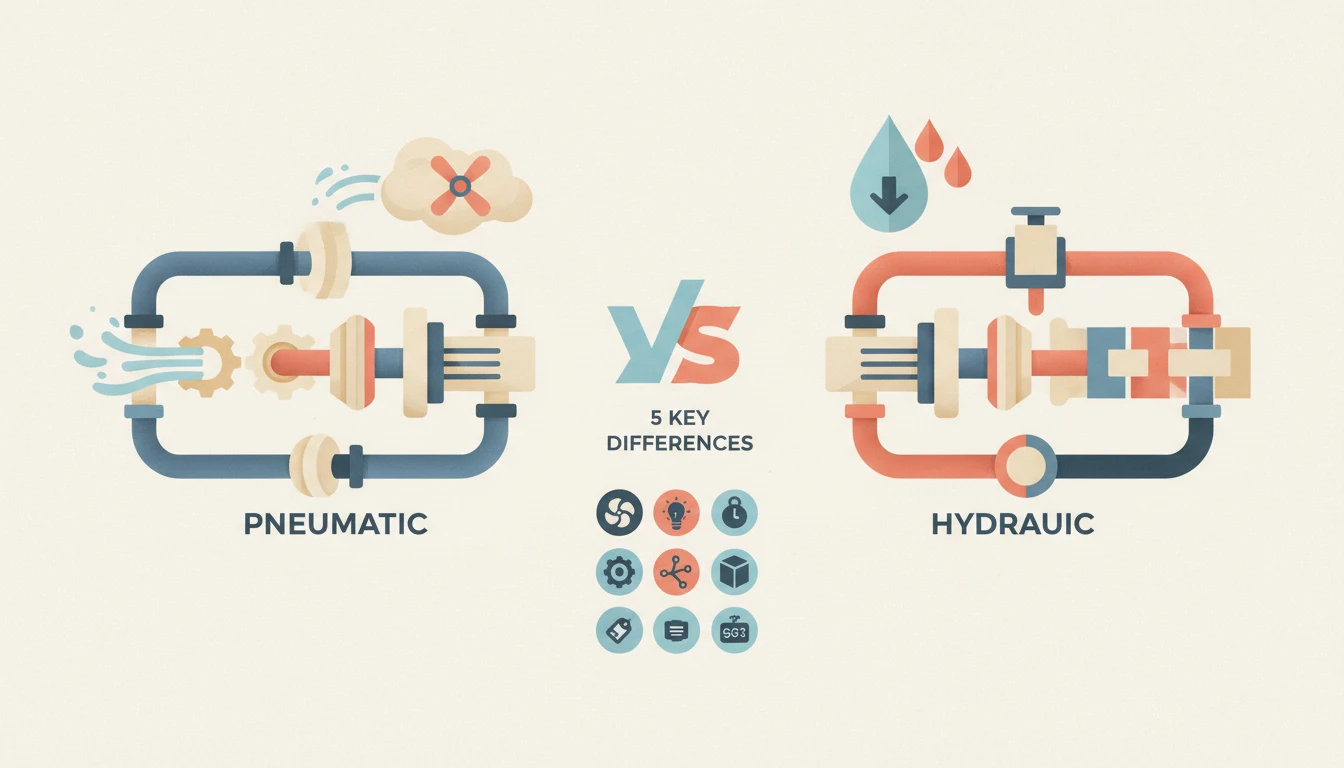
At their core, both pneumatic systems and hydraulic systems are forms of fluid power technology. They use a pressurized fluid to transmit and control power to perform mechanical work. The critical difference lies in the type of fluid used: one uses gas (air), and the other uses liquid (oil). This fundamental distinction cascades into every aspect of their design, capability, and application.
Pneumatic Systems: How They Work
A pneumatic system operates using compressed air as its working medium. The process begins with an air compressor, which draws in ambient air and compresses it to a usable pressure, typically ranging from 80 to 120 pounds per square inch (psi) for general industrial use, though some specialized applications may go higher.
This compressed air is then stored in a receiver tank, dried and filtered to remove moisture and contaminants,a crucial step, as clean, dry air ensures component longevity. From the tank, the air travels through a network of pipes and valves. Directional control valves, often solenoid-operated, precisely route the air to actuators like pneumatic cylinders or air motors. When the pressurized air enters a cylinder, it pushes against a piston, creating linear motion. This motion can be used to push, pull, lift, clamp, or eject. Exhaust air is simply released back into the atmosphere. The system’s simplicity, speed, and cleanliness make it a staple in industrial automation.
Hydraulic Systems: How They Work
In contrast, a hydraulic system uses an incompressible liquid, usually a specialized hydraulic fluid or oil. The system’s heart is a hydraulic pump, driven by an electric motor or combustion engine, which creates flow. This pump forces the fluid from a reservoir into the system under high pressure, which can range from 1,500 psi to over 10,000 psi in heavy machinery.
The high-pressure fluid is directed by control valves to a hydraulic cylinder or motor. Because liquids are nearly incompressible, virtually all the energy transferred by the pump is converted into motion and force at the actuator. A piston inside a hydraulic cylinder moves with immense, precisely controllable force. After performing its work, the fluid returns through a filter to the reservoir to be used again in a closed-loop circuit. This ability to generate enormous, controlled force makes hydraulic systems indispensable for high-pressure operations where sheer power is non-negotiable.
5 Key Differences: Pneumatic vs Hydraulic
Understanding the theoretical principles is one thing; comparing them head-to-head on practical metrics is what enables smart decision-making. Here are the five most critical distinctions.
Power Source: Air vs Fluid
This is the most fundamental key difference. Pneumatics uses air, which is free, abundant, and readily available. However, it must be compressed, dried, and cleaned, requiring an upfront investment in a compressor and air preparation units. Leaks, while wasteful of energy, are not environmentally hazardous.
Hydraulics uses oil-based fluid, which is a consumable cost. This fluid must be contained within a sealed system. Leaks pose serious problems: they create environmental contamination hazards, safety risks (slippery floors), and system failure due to loss of pressure and fluid. The fluid itself also requires management,it must be kept at the proper viscosity and cleanliness level to prevent damage to components.
Actionable Insight: If your facility has strict environmental and housekeeping standards, pneumatics' clean, leak-safe nature is a major advantage. If your operation already handles fluids and has containment protocols, hydraulics becomes more feasible.
Force and Speed Differences
This is where the efficiency comparison becomes stark. Hydraulic systems excel in generating high force. Their use of incompressible fluid allows them to develop tremendous pressure, making them capable of lifting thousands of tons (think car crushers or forging presses). This force is delivered smoothly and with fine control. However, moving this dense fluid through valves and hoses inherently limits operational speed.
Pneumatic systems are the sprinters. Compressed air moves quickly, allowing for very high cycle speeds,think of a bottling plant filling hundreds of containers per minute. The trade-off is lower force. Because air is compressible, it can "spring" or "cushion," which is great for absorbing shock in applications like clamping delicate parts, but it means you cannot achieve the same levels of brute force as with hydraulics. A pneumatic system may stall under a heavy load where a hydraulic system would slowly and steadily push through.
Rule of Thumb: Need high speed and moderate force for repetitive tasks? Choose pneumatics. Need immense, controlled force, even if slower? Hydraulics is the answer.
Cost and Maintenance Analysis
A thorough cost analysis must consider both initial capital expenditure (CapEx) and long-term operational expenditure (OpEx).
- Initial Setup: Basic pneumatic systems generally have a lower entry cost. A central air compressor can power multiple machines through a simple network of pipes. Components like cylinders and valves are relatively inexpensive.
-
Operational & Maintenance: Pneumatics have higher ongoing energy costs, as compressors are notoriously inefficient, converting a large portion of electrical input into wasted heat. Maintenance requirements are typically simpler, involving filter changes, lubricator refills, and seal replacements to address air leakage.
-
Initial Setup: Hydraulic systems often have a higher initial cost. They require a dedicated pump, a high-pressure reservoir, more robust valves and hoses, and a more complex control system.
- Operational & Maintenance: While potentially more energy-efficient in transmitting power, they have significant maintenance requirements. Fluid must be monitored for contamination and degradation, filters changed regularly, and the entire system kept meticulously clean. The consequences of failure,catastrophic leaks or pump failure,are more severe and expensive.
Safety and Environmental Impact
Safety considerations and environmental footprint are increasingly vital decision factors.
- Pneumatic Systems: Their primary safety risks are related to pressure. A ruptured hose can whip dangerously, and high-pressure air injection into the skin is a serious injury risk. However, they pose minimal fire risk and, as mentioned, leaks are not toxic. They are naturally explosion-proof, making them ideal for hazardous environments like paint booths or grain handling.
- Hydraulic Systems: The major risks are high-pressure fluid injection injuries (which can cause severe tissue damage) and fire hazards if the fluid is flammable and leaks onto a hot surface. Fluid contamination and spills are the main environmental concerns, requiring spill containment plans and proper fluid disposal procedures.
Pros and Cons of Pneumatic Systems
Understanding the complete profile of each system allows you to weigh its suitability against your specific needs.
Advantages of Pneumatic Systems
- Clean Operation: Exhaust air is simply released, making them ideal for clean operation in food & beverage, pharmaceuticals, and electronics manufacturing where oil contamination is unacceptable.
- Simplicity and Low Cost: System design, installation, and component costs are generally lower. They are easier for technicians to understand and troubleshoot.
- High Speed and Lightweight: Perfect for fast-cycling, light-to-medium duty applications like packaging, sorting, and pick-and-place robots.
- Safe and Reliable in Harsh Conditions: Insensitive to temperature swings and intrinsically safe in flammable atmospheres.
- Overload Safety: If a pneumatic actuator is blocked, it will simply stall without damaging itself, as the air compresses,a built-in safety feature.
Disadvantages of Pneumatic Systems
- Lower and Less Consistent Force: The compressibility of air makes precise force control difficult, and maximum force is limited by practical air pressure limits (~120-150 psi).
- Noise: Air exhaust can be loud, often requiring mufflers, which represents an added cost and maintenance point.
- Energy Inefficiency: Air compressors are only about 10-20% efficient at point-of-use. Generating compressed air is one of the most costly utilities in a plant.
- Preparation Requirements: Air must be dried and filtered. Moisture in lines leads to rust and ice in valves, causing failure.
- Leakage Issues: Air leaks are common and waste significant energy, but they can be hard to detect audibly.
Frequently Asked Questions: Pneumatics
- Q: How often should I drain my air compressor tank?
- A: Daily. Draining removes accumulated condensate that causes corrosion and contaminates your air lines.
- Q: Why is my pneumatic cylinder moving erratically or "jerking"?
- A: This is often caused by insufficient lubrication, a clogged or poorly adjusted flow control valve restricting air speed, or moisture in the lines causing icing or blockage.
- Q: Can I use pneumatics for precise positioning?
- A: For simple end-to-end positioning (fully extended/retracted), yes. For precise mid-stroke positioning, it's very difficult due to air compressibility. Electric actuators or hydraulics are better for that.
Pros and Cons of Hydraulic Systems
Advantages of Hydraulic Systems
- Extremely High Force in a Compact Package: The key advantage. They can generate forces far exceeding pneumatic or electric systems of comparable size, enabling heavy lifting and massive pressing operations.
- Precise and Smooth Control: Incompressible fluid allows for extremely accurate control of position, speed, and force. This precision control is critical in machine tools, aircraft control surfaces, and injection molding.
- High Durability and Reliability: When maintained properly, hydraulic components can withstand years of punishing use in harsh environments like construction and mining.
- Self-Lubrication: The hydraulic fluid itself lubricates pumps, valves, and cylinders, reducing internal wear.
- Constant Force or Torque: Can maintain a constant force or hold a position indefinitely without consuming extra energy (assuming no leaks).
Disadvantages of Hydraulic Systems
- Potential for Leaks and Contamination: The biggest drawback. Fluid contamination from dirt or water is the leading cause of hydraulic system failure. Leaks are messy, hazardous, and environmentally damaging.
- Higher Complexity and Cost: Systems involve more精密 components (pumps, relief valves, accumulators), require more engineering expertise to design, and have higher material costs.
- Slower Operating Speeds: Fluid viscosity and flow resistance limit cycle speeds compared to pneumatics.
- Temperature Sensitivity: Fluid viscosity changes with temperature, affecting performance. May require heaters or coolers in extreme environments.
- Fire Risk: Most mineral-based hydraulic fluids are flammable, a risk mitigated by using fire-resistant (and more expensive) synthetic fluids.
Industrial Applications: Where to Use Each System
Matching the system to the task is the ultimate goal. Here’s where each one shines.
Pneumatic Applications in Manufacturing
Pneumatics dominate applications requiring speed, cleanliness, and lower cost in manufacturing uses.
* Assembly & Packaging Lines: Driving screwdrivers, nut runners, stamping, clamping workpieces, and operating valves on bottling lines.
* Material Handling: Operating grippers and suction cups on pick-and-place robots, activating diverters on conveyor systems.
* Automation & Robotics: Providing fast, lightweight actuation for non-critical movements in automated cells.
* Pneumatic Tools: Impact wrenches, nail guns, sanders, and drills used on production floors.
Hydraulic Applications in Heavy Industry
Hydraulics are the powerhouse for applications demanding immense force, precise control, and durability.
* Construction & Heavy Machinery: The lifeblood of excavators, bulldozers, backhoes, and cranes,providing the force to dig, lift, and move massive loads.
* Metal Forming: Injection molding machines, hydraulic presses (stamping, forging), and metal shears.
* Aerospace: Operating landing gear, flight control surfaces (ailerons, rudders), and brakes on commercial and military aircraft.
* Automotive: Hydraulic brakes (though being supplemented by electric), car lifts in repair shops, and suspension systems in high-performance vehicles.
To make the selection process visual, here is a quick-reference applications comparison table:
| Application Characteristic | Recommended System | Primary Reason |
|---|---|---|
| High-Speed, Repetitive Motion (e.g., packaging) | Pneumatic | Faster cycle times, lower cost per unit. |
| Extremely High Force (e.g., press, crane) | Hydraulic | Ability to generate and control immense power. |
| Cleanroom or Food-Safe Environment | Pneumatic | No risk of fluid contamination; exhaust is clean. |
| Precise, Smooth Motion Control (e.g., machine tool) | Hydraulic | Incompressible fluid allows for fine positioning. |
| Explosive or Hazardous Atmosphere | Pneumatic | Intrinsically safe; no sparks from motors. |
| Limited Maintenance Capability | Pneumatic | Generally simpler to maintain and repair. |
| Holding Position Under Load | Hydraulic | Can lock in place without continuous energy use. |
| Budget-Constrained Project | Pneumatic | Lower initial component and installation costs. |
The key takeaway is definitive: Pneumatic systems excel in clean, low-force, and cost-sensitive scenarios where speed is king, while hydraulic systems are superior for high-force, precise, and durable applications where power and control cannot be compromised. There is no universally "better" system,only the right tool for the job.
Your choice ultimately hinges on a clear assessment of your specific requirements for force, speed, precision, operating environment, and total cost of ownership. By applying the framework and comparisons outlined here, you can move beyond guesswork and make a technical decision that optimizes your operations for efficiency, safety, and reliability.
Subscribe to ManufactureNow for more expert guides on manufacturing technologies and stay ahead!
Written with LLaMaRush ❤️