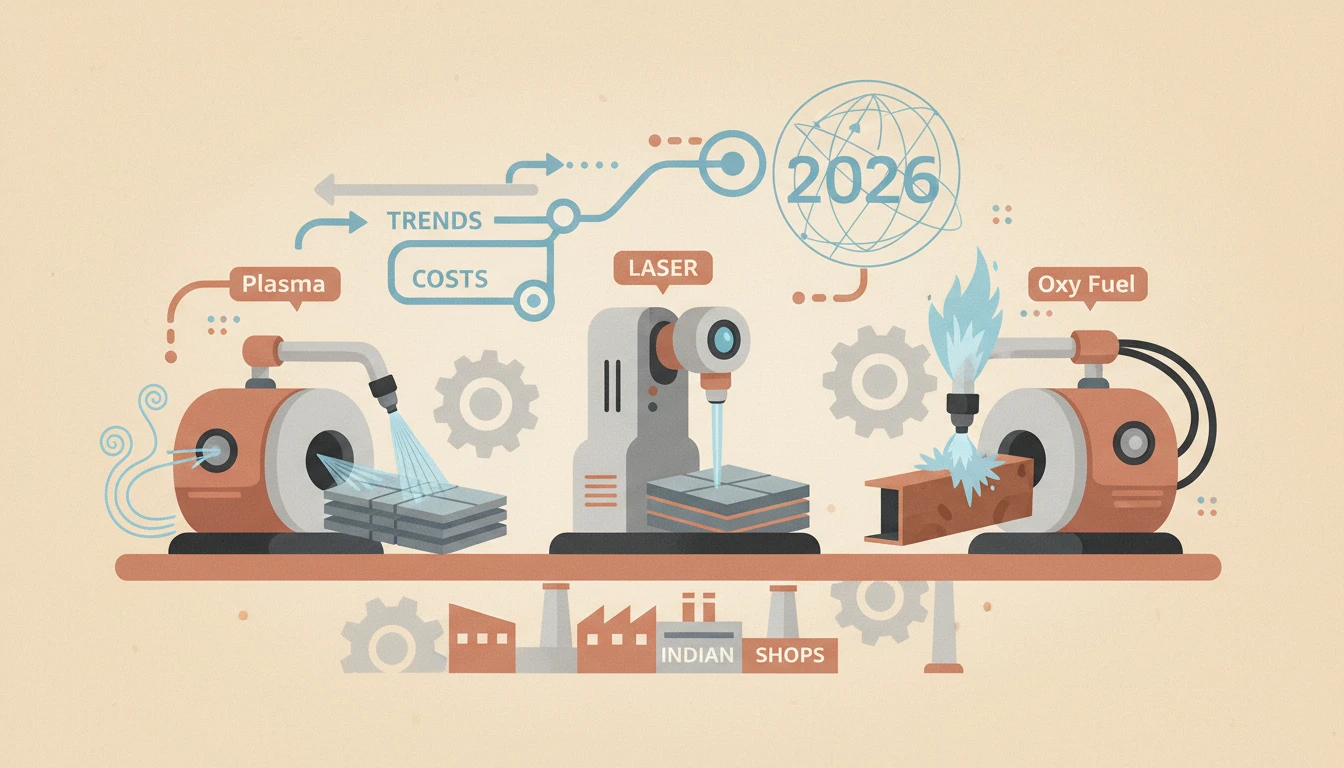
Struggling to choose the right cutting technology for your Indian manufacturing shop? You’re not alone. With rapid advancements in plasma, laser, and oxy fuel cutting, it’s challenging to stay updated and make cost-effective decisions without clear, data-driven insights. The wrong choice can mean lost productivity, wasted capital, and falling behind competitors. This guide cuts through the noise. By reading this comprehensive comparison, you’ll gain a thorough understanding of each technology's latest trends, pros, cons, and economic viability specifically for the Indian market. You’ll learn which method is best for your material, thickness, budget, and desired precision, empowering you to invest with confidence and boost your shop's efficiency and profitability.
Introduction to Cutting Technologies for Indian Manufacturing
At the heart of every fabrication shop, automotive unit, or heavy equipment manufacturer lies a critical process: cutting metal. The efficiency, precision, and cost of this single operation can define your entire production flow, profit margins, and ability to meet stringent deadlines. For India's manufacturing sector, which is projected to be a central pillar of the nation's economic growth, optimizing these foundational processes is not just an operational improvement,it's a strategic necessity. In a landscape teeming with global competition and rising domestic demand, the choice of your primary cutting technology directly impacts your competitiveness.
Why Cutting Technology Matters in Indian Manufacturing
Efficient cutting technology is the linchpin for boosting productivity and competitiveness in India's industrial landscape. Consider a typical job shop in Ludhiana or Coimbatore. Inefficient cutting leads to excessive material waste (kerf), slow throughput, and high secondary finishing costs. Each of these erodes the thin margins on which many Indian shops operate. Conversely, a modern, well-chosen cutting system accelerates project turnaround, improves material utilization, and enhances part quality. This allows you to bid more competitively, take on more complex and higher-margin work, and build a reputation for reliability. It's a direct driver of "Make in India" initiatives, enabling local manufacturers to produce components that meet international quality standards at viable costs, reducing reliance on imports.
Current Market Landscape
The Indian cutting technology market is characterized by dynamic adoption rates and evolving demands. There's a clear, accelerating shift from manual and traditional methods towards automated, digitally controlled systems. Fiber laser cutting machines are seeing explosive growth in Tier-I and progressive Tier-II cities, driven by their unmatched speed and precision for sheet metal work in industries like electronics enclosures, automotive components, and architectural fabrication. Plasma cutting remains the dominant force for medium-to-thick plate cutting, especially in shipbuilding, structural fabrication, and agricultural equipment manufacturing, thanks to its balance of speed and affordability. Oxy fuel cutting has not disappeared; it has found a solidified niche in heavy industries dealing with extremely thick sections (over 150mm), salvage operations, and in remote locations where electricity supply or equipment portability is a primary concern. A key trend shaping the integration of IoT and data analytics into cutting systems, allowing for predictive maintenance and real-time process optimization, a feature now becoming standard in mid-to-high-end models available in India.
Plasma Cutting: Trends, Advantages, and Applications
Plasma cutting remains a workhorse technology, especially where cost-effective cutting of conductive metals over 6mm thick is required. The core principle is elegant: an electrically conductive gas (plasma) is forced through a constricted nozzle at high speed, reaching temperatures hot enough to melt the metal, while the high-velocity gas stream blows the molten material away, creating the cut.
Plasma Cutting Process Explained
The mechanics involve a power supply, an arc starting circuit, a torch, and a supply of gas (often air, oxygen, nitrogen, or argon/hydrogen mixtures). The process starts by creating a pilot arc inside the torch between the electrode and the nozzle. When this arc contacts the conductive workpiece, it transfers to form the cutting arc. The power supply then delivers a sustained, high-energy current through this conductive plasma channel. Significant innovations are focused on high-definition plasma systems. These use a more tightly constricted plasma arc and advanced gas controls, yielding cut quality that rivals laser on thicker materials, with significantly reduced bevel and a finer kerf. Another trend is the proliferation of compact, CNC-based portable plasma cutters, making automated cutting accessible to smaller Indian workshops.
Advantages and Limitations for Indian Shops
For Indian shops, the advantages are compelling. Speed on materials over 10mm thick is typically faster than laser at a fraction of the machine investment. The initial cost of a quality CNC plasma table is substantially lower than a laser of comparable cutting capacity for thick plate. It handles a wide range of conductive materials,mild steel, stainless steel, and aluminum,effectively.
However, limitations exist. Precision and edge quality, while excellent with HD plasma, generally do not match a laser's finesse, especially on intricate contours or thin sheets. The kerf (cut width) is wider than laser, leading to more material waste. The process generates significant heat, causing a larger Heat-Affected Zone (HAZ), which can affect the material properties near the cut edge and lead to more pronounced thermal distortion, requiring additional straightening work.
Best use cases in Indian fabrication shops include: cutting structural I-beams and plates for building frames, producing parts for mining and construction machinery, creating blanks for heavy industrial equipment, and any application where cutting speed on thick (10-50mm) mild steel is the primary driver over micron-level precision.
Laser Cutting: Latest Innovations and Economic Viability
Laser cutting represents the pinnacle of precision and automation in sheet metal fabrication. A focused beam of high-power light vaporizes or melts material along a programmed path, assisted by a high-pressure assist gas (oxygen or nitrogen) to eject molten material and create an incredibly clean cut.
Laser Cutting Technology Deep Dive
The two primary types dominate the market: CO2 lasers and Fiber lasers. CO2 lasers use a gas mixture excited by electrical discharges and are excellent for cutting, engraving, and marking non-metals and metals. However, the landscape is overwhelmingly favoring fiber laser technology. In a fiber laser, the lasing medium is an optical fiber doped with rare-earth elements. This leads to fundamental advantages: higher electrical efficiency (often 2-3x more efficient than CO2), virtually maintenance-free operation (no mirrors, gases, or turbines to align), superior cutting speed on thin to medium-thickness metals, and exceptional beam quality for piercing and cutting reflective materials like copper and brass. For Indian shops, this means lower electricity bills and higher uptime.
Cost-Benefit Analysis for Indian Businesses
The initial setup cost is the biggest hurdle. A 2-3 kW fiber laser cutting machine from a reputable brand can start from ₹25-40 lakhs, with larger, more automated systems running into crores. This is a significant capital expenditure. However, the operational cost analysis tells a different story. Consumable costs are low (primarily focus lenses and nozzles). Energy consumption is lower than comparable CO2 or thick-plate plasma systems. The real economic advantage lies in throughput and reduced secondary operations.
Consider a shop producing electrical cabinet panels. A laser cuts with such precision and edge quality that parts often require no further milling, grinding, or deburring. Nesting software maximizes material usage, minimizing waste. The speed allows for more jobs per day. Over a 3-5 year period, the total cost of ownership and return on investment (ROI) for a busy shop can be very favorable. For a job shop processing primarily sheets under 12-15mm, a fiber laser is increasingly not a luxury but a necessity to remain competitive on quality and turnaround time.
Oxy Fuel Cutting: Tradition Meets Modern Trends
Oxy fuel cutting, or oxyacetylene cutting, is one of the oldest thermal cutting processes. It relies on the chemical reaction of pure oxygen with heated metal. The metal is preheated to its ignition temperature (around 870-980°C for steel) using a fuel gas flame (acetylene, propane, or LPG). A high-purity oxygen stream is then directed at the hot spot, rapidly oxidizing the iron and blowing the molten oxide away.
Oxy Fuel Cutting Fundamentals
The equipment is simple, portable, and relatively inexpensive: gas cylinders (oxygen and fuel), regulators, hoses, and a torch. Its simplicity is its strength, but it demands skilled operation for straight, bevel, or shape cutting. Safety is paramount due to the use of high-pressure flammable gases and the intense heat and sparks generated. Proper storage, handling, flashback arrestors, and personal protective equipment (PPE) are non-negotiable in any Indian shop. Common use cases have traditionally been straight-line cutting of steel plates, scrap separation, and weld preparation.
Evolving Role in Manufacturing
Oxy fuel is not the technology for high-volume, precision fabrication. However, its evolving role is one of specialized necessity. It holds immense value for cutting extremely thick steel plates (150mm and beyond) where even plasma struggles with edge squareness and laser is impractical due to cost and capability. It is indispensable in shipyards, heavy casting cleanup, and structural steel fabrication for very large sections.
Its second major advantage is portability and energy independence. For demolition, onsite construction, or repair work in remote locations without robust three-phase power, an oxy fuel setup is the only viable thermal cutting option. The trend here is the integration of basic CNC gantries or shape-cutting machines with oxy fuel torches, bringing a level of automation to this traditional process for shops that specialize in ultra-heavy work but want to improve accuracy and repeatability over manual tracing.
Comparative Analysis: Plasma vs Laser vs Oxy Fuel
Choosing the right technology requires a direct, data-driven comparison across key metrics relevant to your shop's daily reality.
Cost Comparison for Indian Context
This table breaks down the key financial considerations for a medium-scale Indian fabrication shop.
| Cost Factor | Plasma Cutting | Laser Cutting (Fiber) | Oxy Fuel Cutting |
|---|---|---|---|
| Machine Investment | ₹8-20 Lakhs (CNC Table) | ₹25-70+ Lakhs (CNC Fiber) | ₹0.5-2 Lakhs (Manual) / ₹5-10 Lakhs (CNC) |
| Operating Cost (per hour) | Moderate (Electricity, Consumables, Gas) | Low-Moderate (Electricity, Consumables) | High (Gas Consumption) |
| Consumables Cost | Nozzles, Electrodes, Swirl Rings | Nozzles, Lenses, Reflectors (rare) | Oxygen & Fuel Gas Cylinders |
| Energy Consumption | High | Low (High Efficiency) | N/A (Chemical Energy) |
| Best for Budget | Best balance of capability & entry cost for thick plate. | High-volume shops where ROI via speed/quality is clear. | Lowest entry cost; high op cost. Best for intermittent, very thick cuts. |
Performance on Various Materials
| Performance Metric | Plasma Cutting | Laser Cutting (Fiber) | Oxy Fuel Cutting |
|---|---|---|---|
| Max Practical Thickness (Mild Steel) | Excellent (Up to 50mm) | Good (Up to 20-25mm) | Excellent (100mm+) |
| Cutting Precision & Tolerance | Good (±0.5mm) | Excellent (±0.1mm) | Poor (±1mm+) |
| Cut Edge Quality | Good (Some bevel, dross) | Excellent (Square, smooth) | Poor (Slag, heavy bevel) |
| Heat Affected Zone (HAZ) | Large | Very Small | Very Large |
| Material Flexibility | All conductive metals. | Metals, plastics, wood, ceramics. | Carbon steel only. |
| Cutting Speed (on 10mm MS) | Very Fast | Fast | Slow |
Suitability Guide for Indian Shops:
* Small Job Shop (Tier-II City): A CNC plasma table is often the ideal first automation step, handling diverse job work on plates.
* Sheet Metal Specialist (Pune, Chennai, Delhi NCR): A fiber laser is a competitive essential for precision parts in electronics, automotive, or appliances.
* Heavy Engineering (Vadodara, Kolkata, Hyderabad): Maintain both oxy fuel for massive sections and HD plasma for plates up to 50mm for flexibility.
* Maintenance & Repair Workshop: Portable plasma or manual oxy fuel, depending on power availability and material thickness.
Future Trends and Recommendations
The evolution of cutting technology is moving beyond raw cutting capability towards integrated, intelligent manufacturing ecosystems.
Predictions for Cutting Technology Evolution
We will see a deepening of current automation trends. Lights-out manufacturing for laser cutting will become more common, with automated material loading/unloading and part sorting. AI and machine learning will move from buzzwords to practical tools, optimizing cutting paths in real-time to prevent collisions, predict nozzle wear, and adjust parameters for perfect edge quality consistently. Sustainability pressures will grow, favoring fiber lasers for their energy efficiency and systems that optimize nest layouts to near-zero material waste. For plasma, expect further refinement in Hybrid systems that combine plasma and laser heads on one machine for unmatched flexibility. Crucially, for India, we anticipate more robust localized service networks and financing options from manufacturers to ease adoption.
Guidance for Decision-Making
Follow this step-by-step framework to evaluate your needs:
1. Analyze Your Work: For the next 12 months, list your primary materials, thickness ranges, required precision, and average batch sizes.
2. Calculate True Cost: Don't just look at sticker price. Estimate operational costs (power, gas, consumables), potential revenue increase from faster turnaround, and savings from reduced post-processing.
3. Prioritize Your Needs: Is it raw speed on thick plate (Plasma), flawless precision on sheet metal (Laser), or capability on massive, low-volume sections (Oxy Fuel)?
4. Plan for the Future: Choose a technology and a machine with a software ecosystem that can grow. Can it integrate with your CAD/CAM? Does the brand offer strong local technical support?
5. Take an Informed Trial: Before investing, send sample parts to service bureaus using different technologies. Compare the finished quality, lead time, and cost.
Actionable steps for implementation: Start by digitizing your design workflow. Train your team on CAD/CAM software. Then, partner with a reputable supplier who offers training and has a proven service track record in your region. Consider starting with a used or leased machine to validate the technology's impact on your workflow before a full capital commitment.
The landscape of cutting technology offers powerful options for every Indian manufacturer. Plasma cutting delivers unbeatable cost-effectiveness and speed for thick metals, laser cutting provides transformative precision and efficiency for sheet metal, and oxy fuel cutting retains vital relevance for specialized, heavy-duty applications. The overarching trend is clear: integration, automation, and data-driven optimization are no longer futuristic concepts but present-day tools for staying competitive.
Key takeaway: Plasma cutting offers cost-effectiveness for thick metals, laser cutting provides high precision, and oxy fuel remains viable for specific applications, trends emphasizing automation and efficiency in Indian manufacturing.
To stay updated on the latest manufacturing insights and get personalized advice for your shop, subscribe to the Manufacturenow.in newsletter or contact our expert team. We're here to help you navigate your manufacturing journey with practical, actionable knowledge.
Written with LLaMaRush ❤️