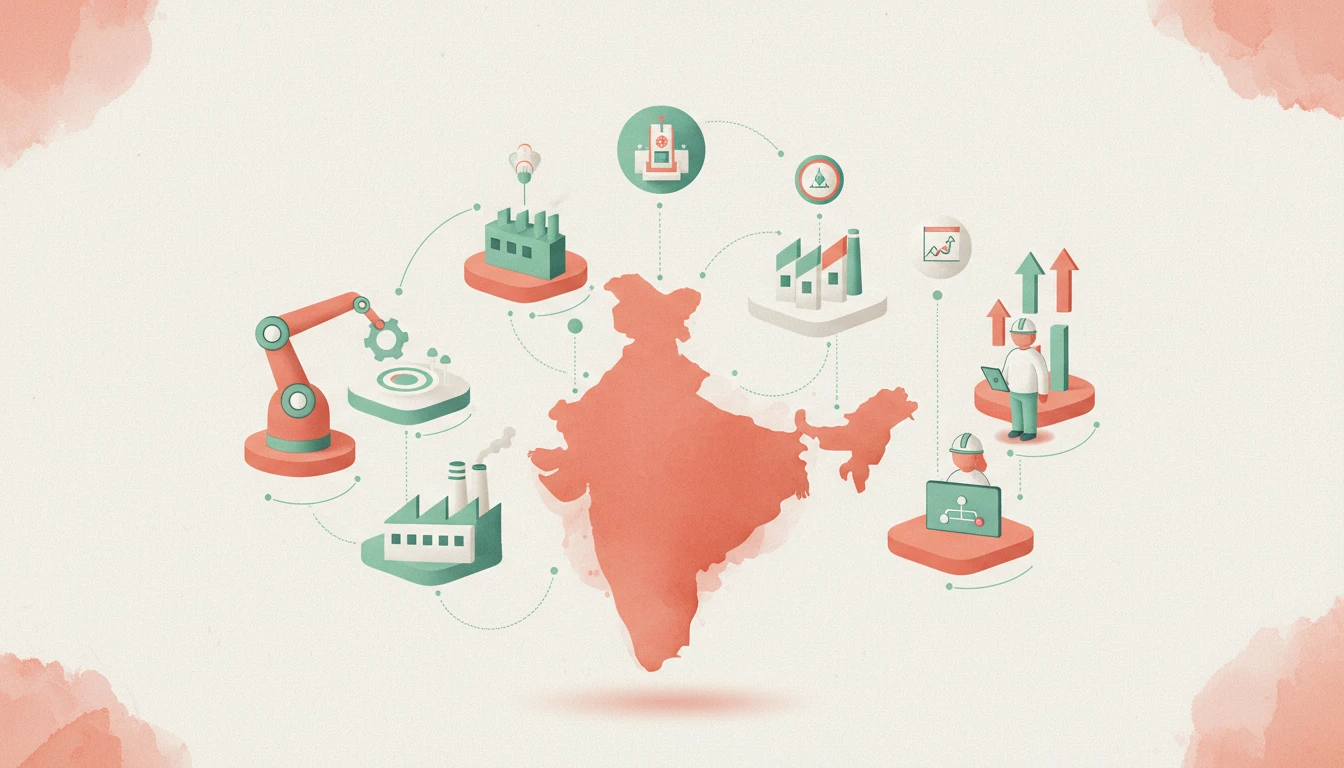
India is no longer just an emerging market; it is rapidly cementing its position as a cornerstone of the global manufacturing landscape. The sector is being reshaped by powerful technological currents, ambitious policy frameworks, and a global push for sustainability. Yet, navigating this dynamic environment can feel overwhelming. This guide cuts through the noise to deliver a clear, actionable analysis of the key manufacturing trends in India, the real-world challenges you’ll face, and the most promising opportunities on the horizon.
Key Manufacturing Trends in India: What's Driving Change
The Indian manufacturing floor will look fundamentally different from its predecessor. The convergence of technology, supportive policy, and environmental consciousness is creating a new industrial paradigm. Stakeholders who understand and adapt to these drivers will be best positioned for success.
Technological Advancements: AI and Automation
The integration of artificial intelligence (AI) and automation is moving beyond pilot projects into the core of production strategy. In Indian factories, this is no longer about simple robotic arms; it's about intelligent systems that learn and optimize.
- Predictive Maintenance: AI algorithms analyze data from sensors on machinery (vibration, temperature, acoustics) to predict failures before they happen. For an automotive parts manufacturer, this can reduce unplanned downtime by up to 30-40%, directly boosting Overall Equipment Effectiveness (OEE).
- Computer Vision for Quality Control: High-resolution cameras powered by AI are performing real-time, millisecond-level inspections on assembly lines. In electronics manufacturing, where a microscopic solder defect can scrap an entire device, this technology is reducing defect rates dramatically while freeing human inspectors for more complex tasks.
- Generative AI in Design & Planning: AI is now assisting in designing lighter, stronger components and optimizing factory floor layouts for maximal material and labor flow, reducing waste and cycle times from the very first step.
The result is not just cost reduction but a fundamental increase in precision, scalability, and the ability to handle complex, customized production runs,a key demand of modern markets.
Policy Support: Make in India 2.0
Government policy has evolved from a broad vision to a targeted, incentive-driven engine for growth. Make in India 2.0 focuses on strategic sectors with high employment and technological value.
- Production Linked Incentive (PLI) Schemes: This is the flagship program. It provides financial incentives on incremental sales from products manufactured in India across 14 key sectors like Advanced Chemistry Cell (ACC) batteries, electronics, and pharmaceuticals. For example, a company manufacturing mobile phones in India can receive a 4-6% cashback on their incremental sales over a five-year period. This directly improves competitiveness and profitability.
- PM GatiShakti National Master Plan: This digital platform integrates infrastructure planning across 16 ministries (like Railways, Roads, Ports). For a manufacturer, this means reduced logistics planning time, clearer visibility into upcoming connectivity projects, and ultimately, lower and more predictable shipping costs.
- Ease of Doing Business 2.0: Reforms continue with the single-window clearance portal, decriminalization of minor legal provisions under the Companies Act, and faster corporate insolvency resolutions. These measures reduce the bureaucratic friction that has historically slowed down operations.
Sustainability and Circular Economy
Sustainability has transitioned from a corporate social responsibility (CSR) item to a core business and regulatory imperative. The push for eco-friendly manufacturing is being driven by both global supply chain demands and domestic policy.
- Renewable Energy Integration: Manufacturers are increasingly investing in captive solar and wind power to hedge against grid instability and reduce their carbon footprint. Many states offer additional incentives for "green" manufacturing units.
- Resource Efficiency & Circular Models: The focus is on designing waste out of the system. This includes using recycled materials (like scrap steel in automotive manufacturing), implementing water recycling plants in textile units, and designing products for easier disassembly and recycling at end-of-life.
- Extended Producer Responsibility (EPR): Regulations now hold manufacturers responsible for the post-consumer stage of their products, particularly in plastics, electronics, and batteries. This is forcing innovation in packaging, material choice, and reverse logistics networks.
Major Challenges Facing Manufacturing in India: Overcoming Barriers
Recognizing the immense potential is only half the battle. A pragmatic view requires an honest assessment of the persistent hurdles that can derail operations and impact profitability.
Infrastructure and Logistics Bottlenecks
While improving, physical infrastructure remains a mixed bag. Poor transportation and energy infrastructure create unpredictable costs and delays.
- The Last-Mile Problem: While major highways are world-class, connectivity to industrial clusters or ports can involve congested local roads, increasing transit times and damage risks.
- Power Reliability: Despite a national grid, fluctuations and outages are common, necessitating expensive backup systems like diesel generators or captive power plants, which erode the cost advantage.
- Mitigation Strategy: A dual approach is key. First, factor in buffer time and costs for logistics in your financial model. Second, strategically locate your unit. Consider industrial corridors like the Delhi-Mumbai Industrial Corridor (DMIC), which are being developed with integrated infrastructure (power, water, logistics parks) or states with more reliable power grids and port access.
Regulatory and Compliance Issues
The regulatory landscape is complex and multi-layered (Central, State, Local), leading to common legal and bureaucratic challenges.
- Multiple Clearances: Setting up a factory requires approvals from pollution control boards, fire departments, factories inspectorates, and local municipalities, often with overlapping jurisdictions.
- Interpretation Variations: Rules can be interpreted differently by officials at various levels, creating uncertainty.
- Tips for Smoother Operations: Engage a local legal and compliance expert from day one. They understand the nuances and can navigate the paperwork efficiently. Digitization is a friend here,many states now offer online portals for applications and tracking. Maintain meticulous records and conduct regular internal compliance audits to avoid last-minute surprises.
Workforce and Talent Management
The shortage of skilled labor is perhaps the most critical long-term challenge. The existing workforce often lacks training in advanced manufacturing technologies.
- The Skills Mismatch: There is a gap between academic curricula and industry needs, particularly in areas like robotics programming, data analytics for maintenance, and operating CNC machines.
- Bridging the Gap: Proactive partnership is the solution. Engage with Industrial Training Institutes (ITIs) and engineering colleges to design tailored curriculum modules or offer apprenticeship programs. Invest in continuous upskilling of your existing workforce through partnerships with technology vendors (like Siemens or Fanuc for automation training). The government's SAMARTH Udyog initiative is also a resource for Industry 4.0 training.
Lucrative Opportunities in Indian Manufacturing: Where to Invest
The confluence of trends and the active addressing of challenges is unlocking specific, high-potential avenues for investment and growth.
High-Growth Sectors: Electronics and Automotive
These sectors are at the epicenter of India's manufacturing ambition, driven by massive domestic demand and export potential.
- Consumer Electronics & Semiconductor Assembly: With PLI schemes attracting global giants, a robust ecosystem for mobile phones, wearables, and IT hardware is forming. Opportunities exist not just in final assembly but in component manufacturing,batteries, displays, PCBs, and mechanics.
- Electric Vehicles (EVs) & Automotive Components: India's EV revolution is creating a brand-new supply chain. Opportunities abound in:
- Battery Packs and Management Systems: The heart of the EV.
- Power Electronics: Chargers, inverters, and converters.
- Lightweight Materials: Aluminum castings and composites to improve range.
- Traditional Auto Components: With India becoming a key export hub, manufacturers of precision engine parts, transmission systems, and interiors are seeing sustained demand.
Export and Global Trade Advantages
India's strategic geography and evolving trade policy are creating a compelling export story.
- Strategic Location: India offers access to the Middle East, Africa, and Southeast Asia with competitive shipping times.
- Trade Agreements: Preferential access under agreements with the UAE, Australia, and ASEAN countries reduces tariffs for made-in-India goods. The ongoing negotiations with the UK, EU, and Canada promise to further open doors.
- China+1 Strategy: Global corporations are actively diversifying their supply chains away from over-reliance on China. India, with its scale, democratic systems, and improving infrastructure, is a prime beneficiary of this strategic shift. Manufacturers who can meet international quality and compliance standards are well-placed to become part of these new global supply chains.
Innovation and Startup Ecosystem
Manufacturing innovation is no longer confined to large corporate R&D labs. A vibrant startup ecosystem is providing agile solutions.
- Opportunities for Collaboration: Startups are offering solutions in additive manufacturing (3D printing) for rapid prototyping and custom tooling, IoT platforms for factory monitoring, AI-based visual inspection software, and digital twins for simulation and optimization.
- Driving Innovation: Corporations can partner with or acquire these startups to accelerate their digital transformation. Government initiatives like the Startup India Seed Fund Scheme and technology incubators at IITs are nurturing this ecosystem, making it easier to find and collaborate with innovative partners.
Actionable Strategies for Success in Manufacturing in India
Knowledge is power, but execution is key. Here is a practical roadmap to translate insight into action.
Step-by-Step Guide to Business Setup
Navigating the setup process methodically can save significant time and resources.
- Market & Feasibility Study: Validate your product demand, analyze competition, and choose your location based on sector-specific clusters (e.g., pharmaceuticals in Hyderabad, textiles in Tiruppur).
- Legal Entity Formation: Register as a Private Limited Company or Limited Liability Partnership (LLP) with the Ministry of Corporate Affairs. This is your foundational step.
- Land & Infrastructure Acquisition: Secure land in an approved industrial area. Apply for necessary utilities (power, water) connections. This is often the most time-consuming step.
- Regulatory Approvals: Apply for key clearances: Factory License, Environmental Clearance (EC), Consent to Establish (CTE) from the State Pollution Control Board, and Fire NOC.
- Tax Registrations: Obtain a Permanent Account Number (PAN), Tax Deduction and Collection Account Number (TAN), and register for Goods and Services Tax (GST).
- Import-Export Code (IEC): If you plan to import raw materials or export finished goods, obtain an IEC from the Director General of Foreign Trade (DGFT).
- Commence Production: After final inspections and the Consent to Operate (CTO), you can begin manufacturing.
Optimizing Operations with Digital Tools
Leveraging technology is non-negotiable for competitive operations.
- Enterprise Resource Planning (ERP): Implement a robust ERP system (like SAP, Oracle, or indigenous solutions like Tally) to integrate finance, inventory, procurement, and production planning on a single platform.
- Manufacturing Execution System (MES): For shop-floor control, an MES provides real-time visibility into production orders, machine status, and labor productivity, enabling data-driven decision-making.
- Cloud-based Analytics: Use platforms like Microsoft Power BI or Tableau to create dashboards that track Key Performance Indicators (KPIs) like OEE, production yield, and maintenance costs, identifying bottlenecks and improvement areas.
Networking and Community Engagement
Building a local network is invaluable for navigating challenges and spotting opportunities.
- Join Industry Associations: Bodies like the Confederation of Indian Industry (CII), Federation of Indian Chambers of Commerce & Industry (FICCI), or sector-specific associations (e.g., Automotive Component Manufacturers Association - ACMA) offer networking events, policy advocacy updates, and collective bargaining power.
- Attend Trade Shows: Events like IETF (India Engineering Trade Fair), IMTEX (Machine Tool Expo), or sector-specific expos are excellent for connecting with suppliers, technology partners, and potential customers.
- Engage with Clusters: Many states have Cluster Development Programs that offer shared facilities (testing labs, common effluent plants) and collective training programs, reducing costs for SMEs.
Key Sectors for Investment in Indian Manufacturing (2024-2026)
| Sector | Key Drivers | Specific Opportunities | Potential Hurdles |
| :--- | :--- | :--- | :--- |
| Electronics & Semiconductors | PLI Scheme, Digital India, Domestic Demand | Component Manufacturing (PCBs, Displays), Consumer Electronics Assembly, Semiconductor Packaging | Global Supply Chain Volatility, High Capital Investment |
| Electric Vehicles & Components | FAME-II Policy, Rising Fuel Costs, Sustainability Goals | Battery Packs & Cells, Power Electronics, Charging Infrastructure, Lightweight Materials | Evolving Technology Standards, Charging Network Gaps |
| Renewable Energy Equipment | 500 GW Renewable Target by 2030, PLI for Solar Modules | Solar PV Cells & Modules, Wind Turbine Components, Balance of System (BoS), Green Hydrogen Electrolyzers | Land Acquisition, Grid Integration Challenges |
| Medical Devices & Pharmaceuticals | PLI Scheme, Post-Pandemic Focus on Health, Aging Population | High-End Medical Equipment (Scanners), Disposables, APIs (Active Pharmaceutical Ingredients), Drug Formulations | Stringent Regulatory Approvals (CDSCO), Import Dependency for Raw Materials |
| Technical Textiles & Apparel | PLI for Man-Made Fibers, Global Diversification (China+1) | Protective Gear (Geotextiles, Meditech), Sportswear, High-Fashion Garment Manufacturing | Fragmented Supply Chain, Need for Automation in Garmenting |
FAQs: Manufacturing in India
1. Is India still a cost-competitive destination for manufacturing?
Yes, but the equation has evolved. While labor costs remain competitive compared to the West, the real advantage now lies in scale, a growing skilled talent pool, and government incentives (like PLI) that can offset other operational costs. The focus is shifting from being the cheapest to being a resilient, high-quality, and integrated supplier.
2. What is the single biggest challenge for a foreign company setting up manufacturing in India?
Navigating the regulatory and compliance landscape across three tiers of government (Central, State, Local) is often cited as the most complex initial hurdle. Partnering with a reliable local consultant or legal firm with on-the-ground experience is the most effective way to manage this.
3. Which Indian state is the best for manufacturing?
There is no single "best" state; it depends entirely on your sector. Gujarat and Maharashtra are industrial powerhouses with excellent ports. Tamil Nadu is a hub for automotive and electronics. Karnataka is strong in aerospace and IT hardware. Telangana and Andhra Pradesh are aggressively attracting pharmaceuticals and renewables. Your feasibility study should dictate the location.
4. How critical is adopting Industry 4.0 technologies for success?
For medium and large enterprises, it is transitioning from a "nice-to-have" to a competitive necessity to ensure quality, traceability, and efficiency. For small businesses, a phased approach,starting with cloud-based ERP and basic automation,is a pragmatic path to begin the digital journey.
5. Are the government incentives (like PLI) reliable and long-term?
The PLI schemes are designed with a 5-6 year window and are tied to clear, measurable production targets. The government has demonstrated commitment by disbursing funds to companies meeting their milestones. They are a central pillar of India's industrial policy and are considered a stable, performance-based incentive structure.
The journey to manufacture in India is paved with undeniable momentum, targeted opportunities, and navigable challenges. Success will belong to those who strategically align with technological trends like AI and automation, leverage policy frameworks like the PLI schemes, and embed sustainable practices into their core operations. It requires a mindset of adaptation, local partnership, and long-term commitment.
Key Takeaway: Manufacturing in India presents a dynamic mix of trends, challenges, and opportunities, requiring strategic adaptation to technology, policy, and market shifts for long-term success.
Stay ahead in the evolving manufacturing landscape by subscribing to ManufactureNow for more insights, tutorials, and expert analyses on global and Indian manufacturing trends.
Written with LLaMaRush ❤️