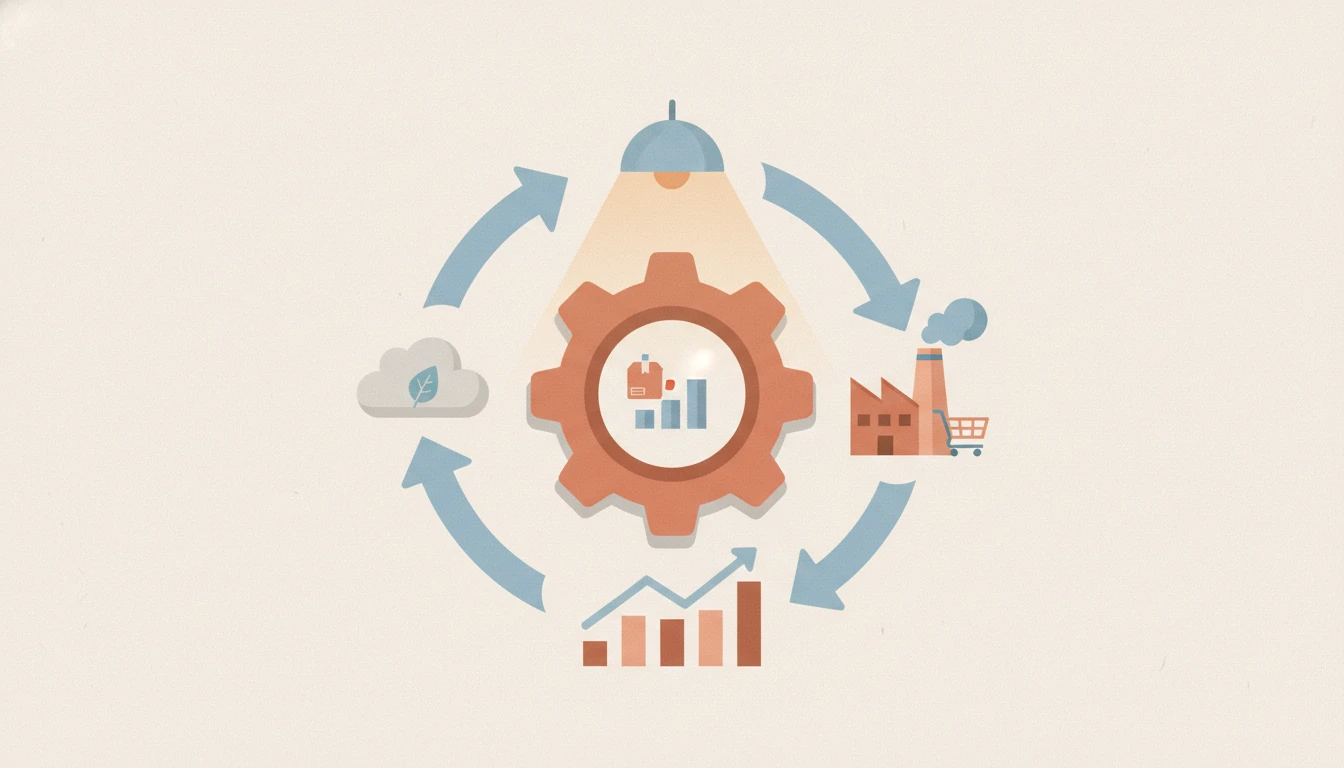
Imagine you’re a factory manager. A major client just asked for the carbon footprint of your flagship product for their ESG report. An investor is questioning the environmental impact of your supply chain. New regulations are looming that will tax emissions from your primary manufacturing process. In each scenario, your ability to respond hinges on one critical, systematic process: the Life Cycle Assessment (LCA).
Many manufacturers see LCA as a complex, academic exercise,overwhelming in its data demands and vague in its immediate ROI. This perception creates a costly gap: without a clear understanding of your product's environmental impact from cradle to grave, you’re flying blind into a future where sustainability is directly tied to compliance, cost, and competitive advantage.
This guide cuts through the complexity. By the end, you’ll have a practical, actionable framework for conducting a comprehensive Life Cycle Assessment tailored to the realities of a manufacturing floor. We’ll translate the theory into concrete steps, proven tools, and real-world strategies to turn environmental accountability into a strategic asset.
What is Life Cycle Assessment and Its Importance in Manufacturing
A Life Cycle Assessment (LCA) is a systematic, data-driven method for evaluating the environmental impacts of a product, process, or service throughout its entire life cycle. Think of it as a full environmental audit that tracks everything from the extraction of raw materials, through manufacturing and transportation, to its use by the consumer, and finally, to its disposal or recycling. For manufacturers, this holistic view is non-negotiable. You can't manage,or improve,what you don't measure.
The core power of LCA lies in its ability to pinpoint environmental "hotspots." You might assume the biggest impact comes from your factory's energy use, but an LCA could reveal that the embedded carbon in a specific aluminum alloy, or the emissions from long-haul logistics, are the true culprits. This shifts sustainability efforts from guesswork to targeted, impactful action.
Core Components of LCA
An LCA is not a linear checklist but an iterative process of four interlinked phases, where findings from one phase often require revisiting an earlier one. For a manufacturer producing industrial pumps, the process would unfold like this:
- Goal and Scope Definition: You start by asking, "Why are we doing this?" The goal might be to compare two different casting methods for a pump housing to find the more sustainable option. You define the functional unit (e.g., "the housing for one Model X pump over a 10-year service life"), set the system boundaries (Will we include the mining of iron ore? The maintenance during use?), and state any assumptions.
- Life Cycle Inventory (LCI): This is the exhaustive data collection phase. For the pump housing, you quantify every input and output: kilograms of molten iron and sand for molding, kilowatt-hours of electricity for the furnace and machining, liters of coolant, grams of waste sent to landfill, and all related emissions to air and water. This creates a massive inventory of flows.
- Life Cycle Impact Assessment (LCIA): Here, you translate the inventory data into environmental impacts. Using scientific models, you calculate contributions to categories like global warming potential (carbon footprint), acidification, water scarcity, and resource depletion. The data showing 'X kg of CO2 equivalent' from the furnace now tells you its specific contribution to climate change.
- Interpretation: You analyze the LCIA results to draw conclusions. Which phase,material sourcing, casting, or machining,has the highest impact? Are the results significant and reliable? You then provide actionable recommendations: "Switching to a recycled iron feedstock could reduce the global warming impact of the housing by 15%." This phase often feeds back to the Goal and Scope, prompting a refined assessment.
Why Manufacturers Should Prioritize LCA
Prioritizing LCA is no longer just about "being green",it's a core business strategy. Firstly, it directly addresses consumer and B2B demand. Major corporations like Apple, Toyota, and Siemens now require environmental disclosures from their suppliers. Having a verified LCA can be a prerequisite for entering lucrative supply chains.
Secondly, it's a shield against regulatory penalties. Governments worldwide are implementing carbon pricing, extended producer responsibility (EPR) schemes, and stricter emissions standards. An LCA provides the data needed to comply, report accurately, and avoid fines. Proactively using LCA can also identify efficiency gains, turning compliance from a cost center into a source of cost savings through reduced energy and material waste.
Ultimately, LCA enables informed eco-design. By understanding impacts early in the product development phase, engineers can make choices that enhance sustainability without compromising performance,selecting alternative materials, designing for disassembly, or optimizing logistics. This aligns perfectly with global trends like the circular economy and provides the robust data required for credible ESG (Environmental, Social, and Governance) reporting, attracting conscientious investors.
Step-by-Step Process to Conduct a Life Cycle Assessment
Moving from theory to practice, let's break down the four phases of LCA into a concrete, step-by-step workflow you can apply on your factory floor. This is your playbook for turning a complex concept into a managed project.
Phase 1: Goal and Scope Definition
This phase is the blueprint for your entire assessment. A poorly defined scope leads to useless or misleading results.
- Define Clear Objectives: Be specific. Is the goal to achieve an Environmental Product Declaration (EPD) for marketing? To find cost-saving opportunities in your packaging line? To compare the impacts of an in-house process versus outsourcing? Your objective dictates everything that follows.
- Define the Functional Unit: This is the quantified reference to which all inputs and outputs are normalized. For a manufacturer, it must reflect the product's function. For example, "providing 10,000 hours of illumination" for an LED light fixture, not just "one light fixture." This allows fair comparisons between different products or processes that serve the same function.
- Set System Boundaries: Decide what's in and what's out of your study. A common framework is "cradle-to-gate" (raw materials to factory gate) for internal analysis, or "cradle-to-grave" (raw materials to disposal) for full product disclosure. For a CNC-machined component, you must decide whether to include the manufacturing of the CNC machine itself (usually excluded, as its impact is allocated over its lifetime of parts).
- Document Assumptions and Limitations: Transparency is key. Note if you used industry-average data for a certain material, assumed a specific transportation distance, or excluded minor packaging. This builds credibility for your final report.
Phase 2: Life Cycle Inventory (LCI)
The LCI phase is often the most resource-intensive, but organization is key.
- Map the Process Flow: Create a detailed flowchart of every step in your defined system. For a simple welded assembly, this might be: Steel coil storage -> Laser cutting -> Bending -> Welding -> Surface finishing -> Packaging.
- Collect Data for Each Flow: For each process step, collect data on:
- Material Inputs: Mass of raw materials (steel, welding wire, paint).
- Energy Inputs: Electricity (kWh) for machines, natural gas (MJ) for heating.
- Water Inputs: Liters used in cooling or cleaning.
- Emissions & Waste Outputs: Scrap metal weight, used coolant volume, VOC emissions from painting.
- Gather Data Sources: Use a mix of:
- Primary Data: Measured directly from your operations (utility meters, purchase invoices, waste manifests).
- Secondary Data: From commercial LCA databases (like Ecoinvent or GaBi databases) for upstream impacts of materials (e.g., the energy used to produce the steel coil) or downstream impacts like waste treatment.
Practical Tip: Start with a "screening LCA" using mostly secondary data to identify hotspots. Then, focus your primary data collection efforts on those high-impact areas for a more accurate, refined assessment.
Phase 3: Life Cycle Impact Assessment (LCIA)
Here, your inventory of flows is translated into environmental impacts using characterization models. You don't need to create these models; you apply established ones.
- Select Impact Categories: Choose categories relevant to your goal and industry. Common ones include:
- Climate Change (Global Warming Potential - kg CO₂ eq)
- Resource Depletion (e.g., fossil fuels, metals)
- Water Scarcity
- Human Toxicity
- Acidification
- Apply Characterization Factors: LCA software automates this using factors that convert inventory data into impact category results. For example, it will multiply the kg of methane emitted from your process by its factor (e.g., 25 kg CO₂ eq per kg of methane) to calculate its contribution to global warming.
- Normalization and Weighting (Optional): These optional steps put results into context. Normalization shows how significant your product's impact is compared to a regional or global baseline (e.g., per capita emissions). Weighting applies values to different impacts based on societal priorities, but it's subjective and used cautiously.
Phase 4: Interpretation and Improvement
The final phase is where insight becomes action.
- Identify Hotspots: Analyze the LCIA results to see which life cycle stages or processes contribute the most to each impact category. A chart might show that 70% of your product's carbon footprint comes from the "Materials" phase.
- Check Consistency and Sensitivity: Verify that your data and methods align with your goal. Perform a sensitivity analysis to see how changing a key assumption (e.g., increasing the recycled content of aluminum) affects the overall results.
- Draw Conclusions and Make Recommendations: Provide clear, actionable insights. For example: "The powder coating process is the largest contributor to human toxicity impact. Recommendation: Pilot a switch to a water-based coating system and assess performance and new LCA results."
- Report Transparently: Document everything according to standards like ISO 14040/14044. A good report allows a third party to understand and potentially reproduce your assessment.
Tools and Software for Effective LCA in Manufacturing
You wouldn't machine a precision part with a hand file; don't attempt a complex LCA with spreadsheets alone. Specialized software streamlines data management, provides access to vast background databases, and automates complex calculations.
Top LCA Software Options
Here’s a comparison of leading tools used in manufacturing:
| Software | Best For | Key Features | Pros | Cons |
|---|---|---|---|---|
| SimaPro | Comprehensive, detailed assessments for large enterprises and consultants. | Vast database library, highly customizable, strong support for ISO compliance and EPD creation. | Industry standard, extremely powerful and flexible, excellent reporting. | Steep learning curve, high cost for licenses and databases. |
| GaBi | Process-heavy industries like automotive, chemicals, and energy. | Deep focus on industrial processes, integrated with proprietary GaBi database, strong visualization. | Robust process modeling, trusted in heavy industry, good technical support. | Can be complex, also a significant investment. |
| openLCA | Startups, academics, and organizations on a tight budget. | Open-source and free core software, modular with many free and paid databases/plugins. | Zero licensing cost, highly customizable, active user community. | Requires more technical setup, user support is community-based. |
| One Click LCA | Manufacturers focused on construction products or needing quick EPDs. | Cloud-based, streamlined for building materials, integrates with BIM, automated EPD generation. | User-friendly, fast setup for specific applications, subscription model. | Less customizable for non-construction products, database scope can be limiting. |
How to Choose the Best Tool for Your Needs
Selecting software is a strategic decision. Consider these criteria:
- Budget: Factor in not just the initial license (or subscription) but also costs for necessary background databases and annual maintenance.
- Scale and Complexity: A small job shop making custom parts may thrive with openLCA, while a global automotive parts supplier will likely need the power and support of SimaPro or GaBi.
- Integration Capability: Can the software import data from your ERP, MES (Manufacturing Execution System), or energy management systems? Smooth data flow is critical for efficiency.
- User Expertise: Assess your team's LCA knowledge. Some tools demand expert-level understanding, while others offer more guided workflows.
- Industry-Specific Data: Ensure the tool's databases are strong in your sector. A tool strong in agricultural data may lack deep inventories for specialty alloys or electronics components.
Real-World Case Studies and Best Practices
Case Study: Automotive Parts Manufacturing
A European manufacturer of aluminum alloy wheels conducted a cradle-to-gate LCA. The initial assessment revealed that the highest environmental impact (over 60%) came from the primary aluminum production (the smelting process), not from their own energy-intensive casting and machining.
Action Taken: The company worked with suppliers to progressively increase the percentage of post-consumer recycled aluminum in their feedstock. They also optimized their own in-house melting furnaces for greater efficiency.
Quantifiable Results: Within three years, they achieved a 25% reduction in the global warming potential of their wheels. This data became a powerful marketing tool, helping them secure contracts with EV manufacturers focused on reducing embedded carbon in their vehicles. The LCA also identified that switching to a different, locally sourced polishing compound could reduce water toxicity impacts, which they implemented in the next product revision.
Best Practices for Data Collection and Validation
- Start with a Process Map: You can't measure what you haven't mapped. A detailed visual map involving cross-functional teams (engineering, production, procurement) ensures no process is overlooked.
- Collaborate with Your Supply Chain: Engage suppliers early. Request primary data for the materials and components they provide. Frame it as a collaborative effort to reduce collective impact, which can also strengthen your partnership.
- Leverage Automation and Sensors: For energy data, use sub-metering on high-consumption equipment like injection molding machines or industrial ovens. IoT sensors can provide real-time data on water use, compressed air leaks, or solvent emissions, creating a more accurate and dynamic inventory.
- Validate with Hybrid Data: Use measured primary data for your core processes and reputable secondary data for background systems. Always check secondary data for geographical and technological relevance,using European grid mix data for a factory in India will skew results.
- Implement Continuous Improvement: Treat LCA not as a one-time report but as a living analysis. Integrate it into your Stage-Gate product development process. Re-run assessments when you change a material, process, or supplier to quantify the improvement.
Overcoming Common LCA Challenges in Manufacturing
Data Availability and Quality Issues
The Challenge: Incomplete supplier data, lack of metering on older equipment, and the sheer variety of materials used can make LCI feel impossible.
Practical Solutions:
* Use Tiered Data: For a first-pass assessment, use generic database data. For critical/high-impact materials, invest in getting specific supplier data.
* Estimate Intelligently: For missing data, use engineering calculations (e.g., based on machine power ratings and runtime) or proxy data from similar processes. Always document these estimations clearly.
* Focus on Hotspots: Don't let the quest for perfect data paralyze you. The 80/20 rule applies: 80% of your impact likely comes from 20% of your inputs. Find those hotspots with available data and refine them first.
* Build a Data Culture: Start simple. Track your top 5 materials and total facility energy use this year. Next year, add transportation data. Gradual improvement is far better than no assessment at all.
Interpreting Results Effectively for Decision-Making
The Challenge: A complex LCA report full of charts and numbers sits on a shelf, failing to drive change because decision-makers don't understand it or trust it.
How to Avoid This:
* Tailor the Communication: For the engineering team, provide detailed process-level breakdowns. For the C-suite, create a one-page summary linking key findings to strategic goals: risk, cost, revenue, and brand reputation.
* Conduct a Peer Review: Before finalizing, have the assessment reviewed internally by a different engineer or externally by a consultant. This validates methodology and builds internal credibility.
* Frame Results Around Alternatives: Present findings not as a static scorecard, but as a comparison: "Option A (current design) vs. Option B (redesign with biopolymer)." This directly supports decision-making.
* Address the "So What?": Clearly state the actionable next step from every major conclusion. Instead of "Material phase has high impact," say "We recommend forming a supplier taskforce to source recycled-content steel, projected to reduce our product carbon footprint by 18%."
Frequently Asked Questions (FAQ)
-
Q: Is LCA only for large manufacturers?
A: Absolutely not. While large firms have more resources, the principles of LCA are scalable. Small and medium-sized enterprises (SMEs) can start with a simplified, focused assessment on their most important product or biggest process. Free tools like openLCA and simplified guidelines make it increasingly accessible. -
Q: How much does a full LCA cost?
A: Costs vary wildly. A simple in-house screening LCA might only cost staff time. A detailed, third-party verified LCA for an EPD can range from $10,000 to $50,000+ depending on product complexity. The investment should be weighed against the value of risk mitigation, cost savings identified, and market opportunities unlocked. -
Q: How long does it take to complete an LCA?
A: A screening LCA can be done in a few weeks. A comprehensive, ISO-compliant assessment for a complex product can take 6 to 12 months, largely due to data collection cycles. Starting with a clear goal and scope is the best way to control the timeline. -
Q: Can LCA help us reduce costs, or is it just an environmental tool?
A: LCA is a powerful cost-identification tool. By meticulously tracking material and energy flows, it almost always reveals inefficiencies,excessive scrap rates, energy-intensive processes, or under-utilized materials,that, when addressed, directly improve the bottom line. -
Q: We have an ISO 14001 Environmental Management System. How does LCA fit in?
A: LCA is a perfect complement to ISO 14001. Your EMS provides the framework for managing environmental responsibilities. LCA provides the deep, product-specific data that feeds into that system, helping you set meaningful objectives, track performance, and make informed design and procurement decisions.
Key Takeaway: Conducting a Life Cycle Assessment is a strategic imperative for modern manufacturers. It is the definitive method to transform sustainability from a vague aspiration into a quantifiable, manageable, and profitable pillar of your business. It empowers you to enhance environmental performance, ensure regulatory compliance, unlock cost savings, and secure a powerful competitive edge in an increasingly eco-conscious market.
The path forward is clear. Start your LCA journey today by convening a small cross-functional team to define the goals for assessing your most strategic product. Explore one of the recommended software tools with a free trial or demo. The insights you gain will illuminate the path to a more efficient, resilient, and sustainable manufacturing operation.
For ongoing, practical insights and updates on manufacturing technology and best practices, subscribe to the ManufactureNow newsletter. We break down the complex so you can build what's next.
Written with LLaMaRush ❤️