Imagine discovering that nearly a third of every dollar spent on materials, labor, and time in your workshop is wasted. For small manufacturers operating on tight margins, these inefficiencies are often the difference between profit and loss, between growth and stagnation. The pressure of high operational costs, inconsistent productivity, and the constant battle against waste can make competing in today's market feel overwhelming.
You’re not alone. Many small business owners feel trapped in reactive cycles, fixing problems as they arise rather than building a streamlined, resilient operation. The solution isn't always about working harder or buying expensive new equipment. It’s about working smarter through a philosophy of relentless efficiency. This is where lean manufacturing comes in.
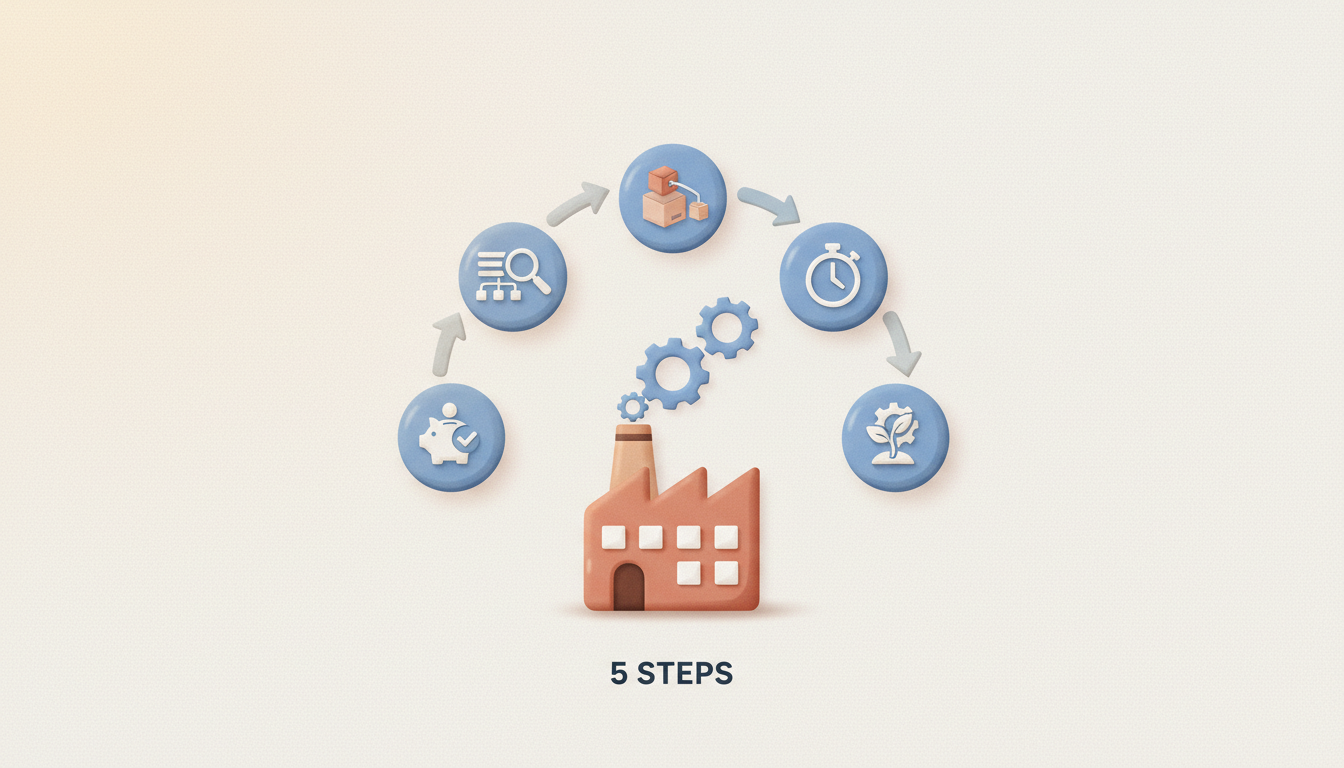
By the end of this guide, you’ll have more than just theory. You’ll have a clear, actionable 5-step plan to implement lean manufacturing principles in your small business. We’ll break down complex ideas into simple, practical strategies you can apply immediately to reduce waste, enhance efficiency, and directly improve your bottom line.
Understanding Lean Manufacturing for Small Businesses
For a small manufacturer, every resource is precious. Lean manufacturing is the systematic, strategic approach to making the most of them.
What is Lean Manufacturing?
At its core, lean manufacturing is a philosophy and set of practices focused on maximizing customer value while minimizing waste. Simply put, it’s about creating more value for your customers with fewer resources.
The concept originated in post-World War II Japan, most famously within Toyota’s production system. Faced with limited capital and resources, Toyota had to find a way to compete with giant American automakers. They developed a method that did not rely on massive inventories or economies of scale, but on relentless efficiency, flexibility, and respect for people. This system became the blueprint for modern lean thinking.
For a small business, this history is particularly relevant. Lean was born from the constraints of a smaller player in a giant's market. It’s not about having the biggest budget; it’s about being the most agile, responsive, and efficient. The goal is to identify and eliminate all activities that do not add value from the customer’s perspective,activities they wouldn’t want to pay for.
Why Small Businesses Need Lean
While large corporations use lean to defend market share, small businesses use it to survive and carve out their own. The urgency is different, and the advantages are profound.
Consider this: studies across industries suggest that non-lean operations can have a process efficiency as low as 5-30%, meaning 70-95% of activities are non-value-added. For a small shop, even a 10% reduction in material waste or a 15% improvement in labor efficiency can be transformative for cash flow.
The unique advantages for small businesses include:
* Agility and Speed: Smaller teams can communicate faster, make decisions quickly, and implement changes without navigating complex corporate bureaucracy. A lean mindset amplifies this natural agility.
* Direct Impact on Survival: In a small operation, inefficiencies are felt immediately. Reducing waste isn't just an operational KPI; it directly increases the owner's take-home pay and the business's ability to invest in growth.
* Easier Cultural Shift: Instilling a culture of continuous improvement is often easier in a tight-knit team where everyone sees the direct results of their efforts. You can foster a "problem-solving" mindset more readily than in a large, siloed organization.
Adopting lean manufacturing for small businesses is not a luxury for the future; it’s a necessity for present-day competitiveness. It provides a structured framework to tackle the high operational costs and quality inconsistencies that plague many small workshops, turning constraint into a strategic advantage.
Core Lean Principles to Master
To implement lean effectively, you must first understand its foundational pillars. These principles are the lenses through which you will view every process in your business.
The 8 Wastes in Manufacturing (Muda)
Waste, or Muda in Japanese, is any activity that consumes resources but creates no value. Lean identifies eight specific types. Spotting these in your own shop is the first step to elimination.
| Waste Type (DOWNTIME Acronym) | Description | Small Business Example |
|---|---|---|
| Defects | Producing faulty products that require rework or scrap. | A batch of parts is drilled off-spec, requiring time to either rework each one or scrap the entire lot, wasting material and labor. |
| Overproduction | Making more than is needed or before it is needed. | Producing 100 widgets because the machine is set up, when the customer order is only for 50. The extra 50 tie up cash in inventory and storage space. |
| Waiting | Idle time created when people, machines, or materials are not ready. | An operator waiting for approval on a drawing, a machine waiting for material delivery, or a finished part waiting for the next process. |
| Non-utilized Talent | Underusing the skills, creativity, and problem-solving abilities of your team. | Not asking the experienced machinist for ideas on fixture improvement, or having an employee only perform repetitive tasks without engaging their mind. |
| Transportation | Unnecessary movement of materials or products between processes. | Moving raw materials from a distant storage unit to the shop floor, or carrying semi-finished parts across the workshop multiple times. |
| Inventory | Excess raw materials, work-in-progress (WIP), or finished goods. | Buying a 6-month supply of a specialized fastener because it was "on sale," tying up capital and risking obsolescence. |
| Motion | Unnecessary movements by people, such as walking, reaching, or searching. | A worker walking 50 feet to retrieve a tool multiple times a day, or searching through disorganized bins for the right component. |
| Extra-Processing | Doing more work or using more expensive resources than the customer requires. | Performing a high-tolerance polish on a surface that will never be seen, or using an overly complex CAD/CAM process for a simple part. |
Implementing Value Stream Mapping
Once you can identify waste, you need a tool to see it flowing through your entire process. That tool is Value Stream Mapping (VSM).
A Value Stream Map is a simple, visual diagram that illustrates every step in your process,from the moment you receive a customer order or raw material to the moment the product is shipped. It maps both the flow of materials and the flow of information.
How to create a basic VSM for your small operation:
- Pick a Product Family: Choose one of your most common or problematic products to map.
- Go to the Gemba: This Japanese term means "the real place." Walk the actual shop floor and trace the product's journey. Don't map from memory.
- Draw the Current State: Use simple icons to represent processes (boxes), inventory (triangles), and information flows (arrows). For each process box, note down key data: cycle time, changeover time, uptime, and number of operators.
- Identify Waste: This is where the map comes alive. The distances between process boxes show transportation waste. Large inventory triangles show inventory waste. Long cycle times or wait times become visible. You’ll literally see where the flow stops.
- Draw a Future State: Now, envision the ideal flow. How can you reduce inventory between steps? Can you combine processes? Can you improve information flow to trigger production only when needed? This future state map becomes your lean implementation blueprint.
For a small manufacturer, a VSM doesn't need to be a complex digital diagram. A hand-drawn map on a whiteboard, created with your team, can be incredibly powerful. It creates a shared understanding of the entire process and rallies everyone around a common goal: eliminating the bottlenecks and waste you’ve just made visible.
Step-by-Step Implementation Guide
Theory is vital, but action creates results. Here is a practical, five-step plan to start your lean journey without disrupting your entire operation.
Step 1: Assess Your Current Processes
You can't improve what you don't measure. Start with a structured assessment.
- Conduct a Waste Walk: Take the list of 8 Wastes and walk through your shop with a notepad. For 30 minutes, just observe. Don't judge or fix, just document. You'll be shocked at what you see when you're looking for it specifically.
- Set Baseline Metrics: Choose 2-3 simple Key Performance Indicators (KPIs). For most small shops, these are perfect starters:
- Overall Equipment Effectiveness (OEE): Availability x Performance x Quality. A score below 85% indicates significant room for improvement.
- First Pass Yield: The percentage of products made correctly and to specification the first time through the process, without rework.
- Average Lead Time: The total time from customer order to delivery.
- Engage Your Team: Your employees see waste every day. Hold a short meeting and ask: "What is the most frustrating waste of time or material in your daily work?" Their answers will give you your first project list.
Step 2: Set Up a Pilot Project
Don't try to overhaul everything at once. Start small to learn, build confidence, and create a success story.
- Choose the Right Area: Pick a process that is:
- Contained: It has a clear start and end within a specific area.
- Problematic: It's known for delays, defects, or frustration.
- Visible: Success here will be noticeable to the whole team.
- Example: The deburring and cleaning station, or the raw material receiving and storage process.
- Define Clear Goals: Use the SMART framework. For example: "Reduce the changeover time on the CNC Mill #1 from 45 minutes to 25 minutes within the next 6 weeks."
- Allocate Minimal Resources: Assign a small team (2-3 people) and give them a few hours per week to work on it. The constraint of limited resources fosters creativity.
Step 3: Execute with 5S and Kaizen
With your pilot area chosen, apply two foundational lean tools.
- Implement 5S: This is a system for organizing your workspace. It’s the perfect, tangible starting point.
- Sort: Remove everything not needed for the current work from the pilot area.
- Set in Order: Organize and label everything that remains. "A place for everything, and everything in its place."
- Shine: Clean the area and equipment thoroughly.
- Standardize: Create rules to maintain the first three S's (e.g., daily 5-minute cleanup).
- Sustain: Make it a habit through regular audits and team accountability.
- Run a Kaizen Event: Kaizen means "continuous improvement." A Kaizen event is a focused, short burst of team-based problem-solving on your pilot project,often just 2-3 days. The team analyzes the process, brainstorms solutions, implements the best one immediately, and standardizes the new method.
Step 4: Monitor and Adjust for Continuous Improvement
Lean is not a "set it and forget it" project. It’s a cycle of constant refinement.
- Track Your Metrics: Re-measure your KPIs (OEE, Yield, Lead Time) for the pilot area. Compare them to your baseline. Use a simple dashboard,a whiteboard or a shared spreadsheet,so the whole team can see the progress.
- Establish Feedback Loops: Hold a 10-minute daily stand-up meeting at the pilot area. What worked yesterday? What didn't? What's the plan for today? This keeps the focus sharp and allows for quick adjustments.
- Iterate: If a solution isn't working, don't be afraid to pivot. The goal is improvement, not adhering to a predetermined plan. Use the Plan-Do-Check-Act (PDCA) cycle as your guide for every change.
Step 5: Standardize and Scale
Once your pilot project is successful and stable, it’s time to build momentum.
- Document the New Standard: Create a simple one-page work instruction or checklist for the new, improved process. This ensures the gains are locked in, even if personnel change.
- Celebrate and Share: Publicly recognize the pilot team's effort. Share the results (e.g., "We saved 4 hours per week in search time!") with the entire company. This builds buy-in for the next project.
- Select the Next Project: Let the success of the first project fuel the second. Use your Value Stream Map to identify the next biggest bottleneck, and repeat the cycle.
Essential Lean Tools for Small Manufacturers
Beyond 5S and VSM, several other lean tools are highly adaptable and cost-effective for small-scale operations.
Visual Management Tools
Visual management makes the state of your operations immediately understandable to anyone, reducing questions and errors. You don't need expensive digital systems.
- Andon Lights: A simple, three-color light (green, yellow, red) at a workstation. Green = running smoothly. Yellow = operator needs assistance (e.g., a technical question). Red = production stopped (e.g., a breakdown). This creates instant, non-verbal communication.
- Process Boards (Kanban Boards): A physical board with columns like "To Do," "In Process," and "Done." Use sticky notes to represent work orders. This visualizes workflow and limits Work-in-Progress (WIP), preventing overloading.
- Shadow Boards: Outline tools on a pegboard. At a glance, you can see if a tool is missing or if it's been put back in the wrong place. This tackles the waste of Motion and Searching.
Quality Control Techniques
For small businesses, a reputation for quality is critical. These tools help build it in from the start.
- Standardized Work: This is the documented, agreed-upon best way to perform a task. It’s not meant to stifle creativity but to ensure consistency, safety, and quality until a better way is found. It’s the baseline for all improvement.
- Poka-Yoke (Error-Proofing): Designing processes to make mistakes impossible or immediately detectable. A simple example is a fixture that only allows a part to be loaded in the correct orientation, preventing a costly machining error.
- Root Cause Analysis (The 5 Whys): When a defect occurs, don't just fix the symptom. Ask "Why?" repeatedly (aim for five times) to drill down to the fundamental, systemic cause.
- Problem: A part was shipped with the wrong finish.
- Why 1? The work order was misread.
- Why 2? The handwriting on the traveler was unclear.
- Why 3? The traveler is a handwritten carbon-copy form.
- Why 4? We've never updated to a digital or printed system.
- Why 5? We assumed it wasn't a big enough problem to fix.
- Root Cause: An outdated, error-prone information system. The solution is to implement clear, printed work instructions.
Overcoming Common Implementation Hurdles
Knowing the challenges ahead allows you to prepare and overcome them.
Dealing with Employee Resistance
Change can be unsettling. The key is to lead with respect and involve, not dictate.
- Communicate the "Why": Don't just announce a new procedure. Explain the business reasons: "We're doing this 5S project so you spend less time searching for tools and more time on skilled work, which helps us win more jobs and provide more stable employment."
- Involve Them from the Start: Employees are process experts. Ask for their ideas during the waste walk and Kaizen events. Implement their suggestions where possible. An idea implemented is the strongest form of buy-in.
- Provide Training, Not Just Instructions: Invest time in showing how to use the new tools and why they matter. Frame it as skill development.
Managing Costs and Resources
Lean, done right, saves money. The initial investment should be minimal.
- Start with Low/No-Cost Solutions: 5S, process mapping, and daily stand-up meetings cost nothing but time. The most powerful lean tools are often principles, not products.
- Leverage Digital Freeware: Use free versions of cloud-based whiteboards (like Miro) for digital VSM, or simple spreadsheets for tracking metrics.
- Focus on Cash Flow, Not Just Cost: A successful lean project that reduces your inventory from 60 days to 30 days' worth doesn't just save storage costs; it frees up significant cash that was tied up on your shelves. This is a game-changer for small business liquidity.
Key Takeaways and Moving Forward
The journey of lean manufacturing for small businesses is not a destination but a direction. It offers a proven, practical framework to systematically eliminate waste, enhance efficiency, and drive sustainable growth through the power of continuous improvement. You don't need a large budget or a team of consultants; you need a commitment to seeing your processes clearly and the courage to make them better, one small step at a time.
Remember, the goal is to build a business that is not just busy, but effective,where every action creates value for your customer and strengthens your operation.
Ready to take the first step? We’ve created a Free Lean Manufacturing Starter Checklist specifically for small shop owners and managers. It breaks down the first 30 days of your lean journey into simple, daily tasks. [Download your free copy here] and start transforming your operations today.
Have questions or want to share your lean journey? Join the conversation at Manufacturenow.in. Subscribe to our newsletter for more practical guides, case studies, and insights to help you navigate the evolving world of modern manufacturing.
Frequently Asked Questions (FAQ)
Q1: Is lean manufacturing only for high-volume production?
A: Absolutely not. In fact, its origins at Toyota were about achieving efficiency without mass production scale. Lean principles are highly effective for low-volume, high-mix environments common in small job shops. The focus on flexibility, quick changeovers, and eliminating waste between unique jobs is where lean truly shines for small businesses.
Q2: How long does it take to see results from lean implementation?
A: You can see tangible results from a single, well-run Kaizen event in a matter of days (e.g., a cleaner, more organized workspace from 5S). Meaningful financial impacts, like reduced inventory costs or improved on-time delivery, typically become evident within the first 3-6 months of sustained effort on a few key pilot projects.
Q3: We're too busy fighting daily fires to work on lean projects. What should we do?
A: This is the most common paradox. The daily fires are the waste you need to eliminate. Start by using the "5 Whys" on one of those recurring fires (e.g., a frequent machine stoppage). Getting to its root cause and fixing it permanently is a lean project. It frees up future time, creating capacity to tackle the next fire. You must invest time to save time.
Q4: Do I need to hire a lean consultant?
A: For most small businesses, it's not necessary to start. The core principles and tools are accessible and can be self-taught and applied by a committed owner/manager with their team. A consultant can be valuable later to tackle complex bottlenecks or for advanced training, but the initial culture of improvement must come from within.
Q5: Can lean principles be applied to non-manufacturing areas like office administration?
A: Yes, this is called "lean administration." The same wastes exist: waiting for approvals (Waiting), excessive email cc's (Overprocessing), searching for files (Motion), and underutilizing employee skills (Non-utilized Talent). Applying 5S to digital files, visual management for order tracking, and value stream mapping for a quoting process can yield dramatic efficiency gains.
Written with LLaMaRush ❤️