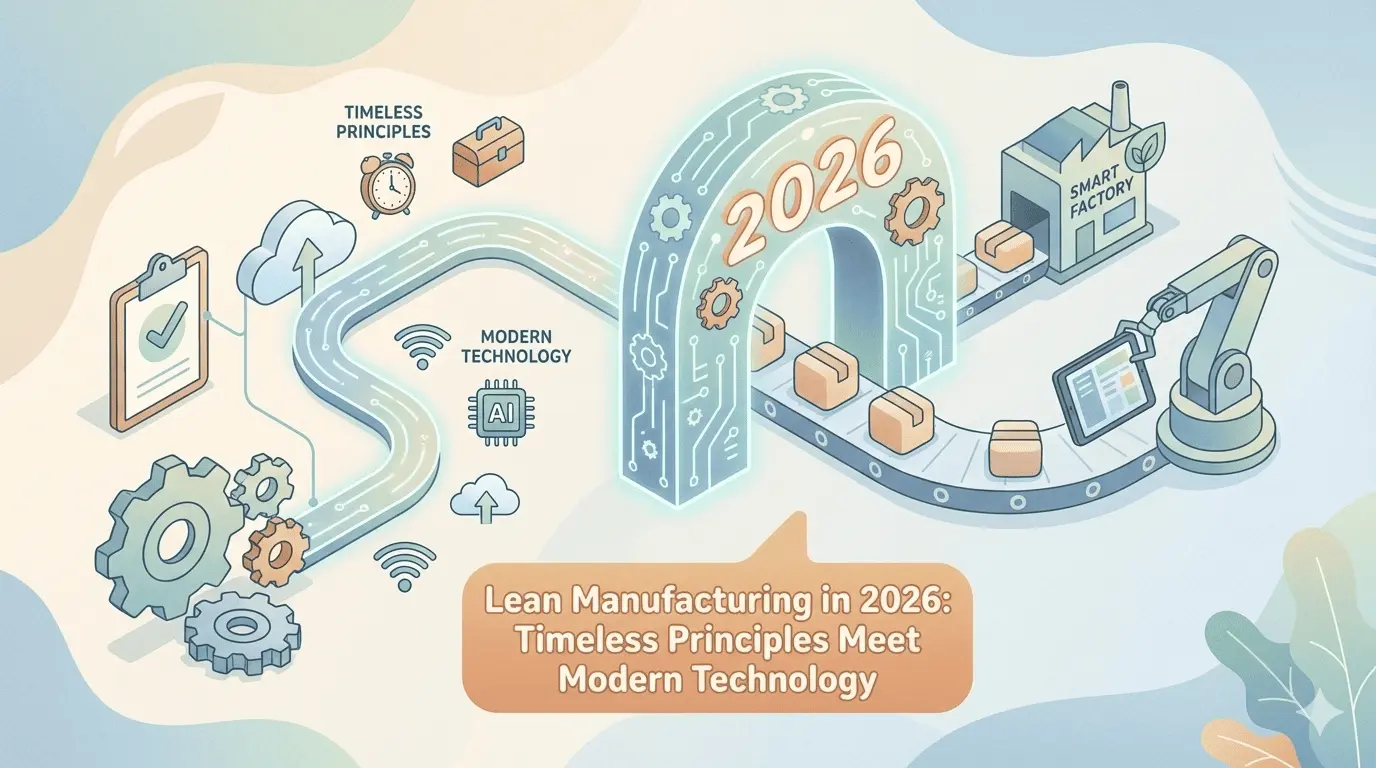
In an era dominated by headlines about artificial intelligence, robotics, and smart factories, it might seem that the principles developed on Toyota's shop floors in the 1950s have been superseded. Nothing could be further from the truth. Lean manufacturing remains the foundational philosophy underpinning world-class operations—and its relevance has only intensified. Today's most successful manufacturers aren't choosing between lean and technology; they're using technology to execute lean principles with precision that Taiichi Ohno could only have dreamed of. This is the story of how timeless ideas meet modern tools, and why mastering both is the key to operational excellence.
The Enduring Philosophy: What Lean Really Means
At its core, lean manufacturing is not a set of tools or a cost-cutting program. It is a way of thinking—a relentless focus on delivering value to the customer while systematically eliminating everything that doesn't contribute to that value. The philosophy rests on two pillars: continuous improvement (Kaizen) and respect for people. Every tool, technique, and metric in the lean toolkit serves these principles.
Understanding this distinction is critical. Many organizations have "implemented lean" by installing kanban boards or running 5S events, only to see improvements fade within months. They adopted the tools without embracing the thinking. True lean transformation requires a cultural shift—one where every employee, from the factory floor to the C-suite, is empowered and expected to identify problems and drive solutions.
The Five Foundational Principles
The lean framework is built on five interconnected principles, originally articulated by James Womack and Daniel Jones. Together, they form a systematic approach to operational excellence.
1. Define Value from the Customer's Perspective
Everything begins with a deceptively simple question: What is the customer actually paying for? Value is defined exclusively by the end customer's needs—the specific product or service, delivered at the right time, at an appropriate price. Any activity that doesn't directly contribute to this value is, by definition, waste.
This principle forces a critical reorientation. Internal metrics like machine utilization or labor efficiency are meaningless if they don't translate into customer value. A machine running at 100% capacity producing inventory that sits in a warehouse for months is not creating value—it's creating cost.
Modern Application: Today's manufacturers use voice-of-customer analytics, real-time demand sensing, and customer journey mapping to define value with far greater precision than ever before.
2. Map the Value Stream
Once value is defined, the next step is to trace every action—every process, movement, and decision—required to bring a product from raw material to the customer's hands. This is Value Stream Mapping (VSM), and it is the diagnostic tool of lean.
A thorough value stream map reveals the truth that most organizations prefer not to see: typically, 95% or more of total lead time is non-value-adding. Products spend the vast majority of their journey waiting—waiting for processing, waiting for transport, waiting for decisions.
Modern Application: Digital value stream mapping tools now integrate with MES and ERP systems, providing real-time visibility into flow. Some manufacturers use process mining software to automatically generate value stream maps from system logs, revealing bottlenecks that manual mapping might miss.
3. Create Flow
With waste identified, the goal becomes creating uninterrupted flow. Ideally, products move continuously from one value-adding step to the next without batching, waiting, or backtracking. Flow is the antidote to the hidden factory—the rework loops, expediting, and firefighting that consume resources without creating value.
Achieving flow often requires challenging deeply held assumptions. It may mean breaking up functional departments in favor of product-focused cells. It almost always means reducing batch sizes—often dramatically. The transition can feel counterintuitive, but the results are transformative: lead times measured in hours instead of weeks, quality problems surfaced immediately instead of discovered downstream.
Modern Application: IoT sensors and real-time production monitoring systems now make flow visible at a granular level. Digital andon systems alert teams to flow interruptions instantly, while AI-powered scheduling optimizes flow across complex, multi-product environments.
4. Establish Pull
In a traditional "push" system, production is driven by forecasts and schedules. Parts are made because a plan says to make them, regardless of actual downstream demand. The result is inevitable: excess inventory, obsolescence, and the bullwhip effect amplifying demand variability up the supply chain.
Pull systems invert this logic. Production is triggered only by actual consumption. When a customer buys a product, that signals the final assembly to build one more. That signal cascades upstream, pulling components through the system. The result is a synchronized, demand-driven operation with minimal inventory.
The kanban system—visual cards or signals authorizing production—is the classic pull mechanism. But pull is a principle, not just a tool. It applies to information flow, decision-making, and resource allocation, not just physical materials.
Modern Application: Electronic kanban (e-kanban) systems now integrate with supplier portals, triggering replenishment signals across the supply chain in real time. Advanced manufacturers use demand-driven MRP (DDMRP), which combines pull principles with strategic inventory buffers, optimized by machine learning algorithms.
5. Pursue Perfection
The final principle is both a destination and a journey: the relentless pursuit of perfection. In lean thinking, there is no end state. Every process, no matter how optimized, contains hidden waste waiting to be discovered. Every standard is a baseline to be improved upon.
This principle is operationalized through Kaizen—continuous improvement. It can take the form of rapid improvement events (Kaizen blitzes) or daily incremental improvements suggested by frontline workers. The key is constancy: improvement is not a project with an end date; it is the daily work of everyone in the organization.
Modern Application: AI and machine learning now augment human problem-solving. Algorithms can analyze thousands of process variables to identify improvement opportunities invisible to the human eye. Digital suggestion systems capture and track Kaizen ideas, while simulation tools allow teams to test improvements virtually before implementation.
The Eight Wastes: Knowing Your Enemy
Waste (Muda) is the central target of lean. The original Toyota Production System identified seven categories of waste; an eighth—unused human potential—has since been added. Understanding these categories is essential for any improvement effort.
1. Transportation
Unnecessary movement of materials, parts, or products. Every time something is moved, there is cost, time, and risk of damage—with zero value added.
Example: Raw materials stored in a warehouse across the facility, requiring forklift transport to the production floor.
2. Inventory
Excess raw materials, work-in-progress, or finished goods beyond what is needed to meet immediate demand. Inventory ties up capital, consumes space, and hides problems.
Example: Three months of safety stock held "just in case," masking unreliable supplier performance.
3. Motion
Unnecessary movement of people—walking, reaching, bending, searching. Distinct from transportation, motion waste focuses on human ergonomics and efficiency.
Example: Operators walking across the cell to retrieve tools that should be within arm's reach.
4. Waiting
Idle time when people, machines, or materials are not being processed. Waiting is often the largest component of lead time.
Example: Operators waiting for the previous batch to complete, or for maintenance to repair a machine.
5. Overproduction
Producing more than the customer needs, or producing it earlier than needed. Overproduction is considered the most serious waste because it triggers all the others—more inventory, more transportation, more defects.
Example: Running large batches to "maximize efficiency," creating weeks of inventory.
6. Over-processing
Performing more work or using more resources than necessary to meet customer requirements. This includes redundant inspections, unnecessary precision, and features the customer doesn't value.
Example: Polishing a surface that will be hidden in the final assembly.
7. Defects
Products or services that fail to meet specifications, requiring rework, scrap, or warranty claims. Defects consume resources twice: once to create them, and again to correct them.
Example: Dimensional errors requiring parts to be scrapped and remanufactured.
8. Unused Human Potential
Failing to leverage the skills, ideas, and creativity of employees. This waste is often invisible but enormously costly. Disengaged workers don't just fail to improve processes—they actively resist change.
Example: Frontline operators with deep process knowledge who are never asked for input on improvement initiatives.
Lean Tools in Practice
The lean philosophy is supported by a robust toolkit. These tools are not ends in themselves—they are means to achieve flow, pull, and continuous improvement.
5S: The Foundation
Sort, Set in Order, Shine, Standardize, Sustain. 5S creates organized, visual workplaces where abnormalities are immediately apparent. It is often the first step in a lean journey because it establishes discipline and makes other improvements possible.
Standard Work
Documented, repeatable best practices for each operation. Standard work is not bureaucratic rigidity—it is the baseline for improvement. You cannot improve a process that isn't defined, and you cannot sustain improvements without standards.
Visual Management
Making the state of production visible at a glance. Andon lights, production boards, kanban cards, and floor markings all contribute to a visual factory where problems are immediately apparent.
Total Productive Maintenance (TPM)
A systematic approach to equipment reliability, engaging operators in routine maintenance and driving toward zero breakdowns, zero defects, and zero accidents.
SMED (Single-Minute Exchange of Dies)
Techniques to dramatically reduce changeover times, enabling smaller batches and greater flexibility. Originally developed for press die changes, SMED principles apply to any setup or transition.
Poka-Yoke (Error-Proofing)
Designing processes and devices so that errors are either impossible or immediately detected. Poka-yoke shifts quality from inspection to prevention.
A3 Problem Solving
A structured approach to problem-solving using a single A3-sized document. The format enforces disciplined thinking: define the problem, analyze root causes, develop countermeasures, implement, and verify.
The Digital Lean Factory: Technology as an Enabler
The question is no longer whether to digitize, but how to digitize in ways that reinforce lean principles rather than undermining them. The most successful manufacturers use technology to:
Achieve Real-Time Visibility
IoT sensors, connected machines, and MES integration provide second-by-second visibility into production status, quality, and equipment health. This visibility enables faster response to problems and more accurate value stream analysis.
Enable Predictive Capabilities
Machine learning models predict equipment failures, quality deviations, and demand fluctuations. This shifts the organization from reactive firefighting to proactive prevention—a core lean aspiration.
Automate Non-Value-Adding Work
Robotic process automation (RPA) handles repetitive data entry and reporting. Collaborative robots (cobots) assist with physically demanding tasks. Automation frees human workers for problem-solving and improvement.
Simulate and Optimize
Digital twins—virtual replicas of physical production systems—allow teams to test process changes, validate layouts, and optimize flow without disrupting actual production.
Scale Continuous Improvement
Digital Kaizen platforms capture improvement ideas from across the organization, track implementation, and measure impact. Analytics identify patterns across thousands of suggestions, surfacing systemic opportunities.
Quantifying the Impact: What Lean Delivers
Organizations that successfully implement lean consistently report transformative results:
- Lead Time Reduction: 50-90% reductions in end-to-end lead time are common, enabling faster response to customer demand.
- Inventory Reduction: 30-70% reductions in raw material, WIP, and finished goods inventory, freeing working capital.
- Productivity Improvement: 15-40% increases in labor productivity through waste elimination and flow improvements.
- Quality Improvement: 50-90% reductions in defect rates as problems are surfaced and addressed at the source.
- Space Reduction: 25-50% reductions in floor space requirements through layout optimization and inventory reduction.
- Cost Reduction: 15-30% reductions in manufacturing costs, driven by all of the above.
These results are not theoretical. They have been demonstrated across industries—automotive, aerospace, electronics, medical devices, food and beverage, and beyond.
The Implementation Roadmap
Lean transformation is a multi-year journey, not a quick fix. A proven approach includes:
Phase 1: Foundation (Months 1-6)
- Executive alignment and commitment
- Lean awareness training for all levels
- Selection of a pilot area (a complete value stream, not just one process)
- Current-state value stream mapping
- 5S implementation in the pilot area
Phase 2: Flow and Pull (Months 6-18)
- Future-state value stream design
- Cell redesign and line balancing
- Setup time reduction (SMED)
- Implementation of pull systems (kanban)
- Standard work development
- Visual management deployment
Phase 3: Stability and Reliability (Months 12-24)
- Total Productive Maintenance implementation
- Quality at the source (poka-yoke, in-station quality)
- Problem-solving capability building (A3 training)
- Supplier integration and development
Phase 4: Enterprise Expansion (Months 18-36+)
- Replication to additional value streams
- Integration with support functions (engineering, supply chain, finance)
- Advanced analytics and digital lean tools
- Lean product development
- Cultural institutionalization
Sustaining the Gains
The greatest risk in lean is backsliding. Sustaining improvements requires:
- Leadership gemba walks (going to the actual workplace)
- Regular audits against standards
- Recognition and celebration of improvement
- Continuous refreshment of goals and targets
Common Pitfalls and How to Avoid Them
Treating Lean as a Cost-Cutting Program
Lean is about creating value, not just cutting costs. Organizations that approach lean primarily as headcount reduction destroy the trust and engagement needed for continuous improvement.
Tool-Focused Implementation
Implementing 5S or kanban without understanding the underlying principles leads to superficial, unsustainable results. Tools must serve the philosophy, not replace it.
Neglecting the Human Element
Lean requires engaged, empowered workers. Organizations that implement lean "to" people rather than "with" people face resistance and failure.
Insufficient Leadership Commitment
Lean transformation requires visible, sustained leadership commitment. Leaders must model lean behaviors, participate in improvement activities, and hold the organization accountable.
Declaring Victory Too Soon
Initial improvements are often dramatic, creating the temptation to move on. But lean is a journey without end. The most successful organizations treat early gains as proof of concept, not completion.
The Future of Lean: Continuous Evolution
Lean principles remain constant, but their application continues to evolve:
Lean and Sustainability
The elimination of waste aligns naturally with environmental sustainability. Lean organizations are extending waste reduction to energy, water, and materials, pursuing both operational and environmental excellence.
Lean in the Digital Age
AI, IoT, and advanced analytics are becoming integral to lean operations. The goal is "Lean 4.0"—using digital tools to achieve lean objectives faster and more completely.
Lean Beyond Manufacturing
Lean principles are spreading to healthcare, construction, software development, and service industries. The core ideas—value, flow, pull, continuous improvement—are universal.
Conclusion: The Lean Imperative
In a world of accelerating change, intensifying competition, and rising customer expectations, lean manufacturing is not a nice-to-have—it is a strategic imperative. The organizations that master lean principles, continuously improve their operations, and leverage technology to enable human problem-solving will be the ones that thrive.
The journey is demanding. It requires sustained commitment, cultural change, and relentless focus. But the rewards—in efficiency, quality, speed, cost, and employee engagement—are transformative. The principles that revolutionized Toyota's factories remain as powerful today as they were seven decades ago. The only question is whether your organization will embrace them.
The waste is there, waiting to be found. The value stream is ready to flow. The people are capable of more than you imagine. Lean manufacturing offers the philosophy and the tools to unlock that potential. The journey begins with a single step: go to the gemba, observe the process, and ask why.