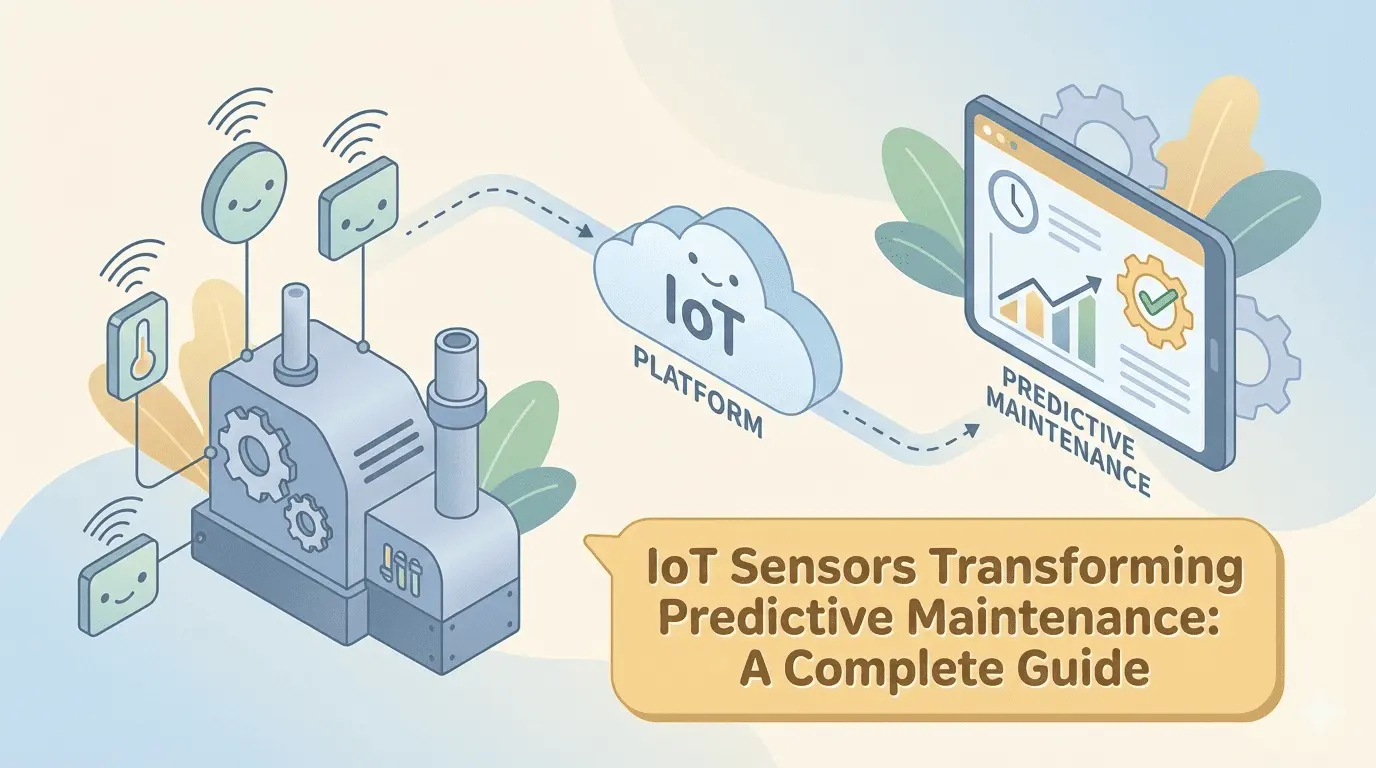
Unplanned equipment downtime costs manufacturers an estimated $50 billion annually. For every hour a production line sits idle, companies lose thousands—sometimes millions—in revenue, rushed repairs, and missed deadlines. But what if you could predict failures before they happen? That's the promise of IoT-powered predictive maintenance, and it's revolutionizing how industries keep their operations running.
The Evolution of Maintenance Strategies
Reactive Maintenance: The Old Way
For decades, the standard approach was simple: run equipment until it breaks, then fix it. This reactive strategy seems cost-effective on paper—why spend money on maintenance when nothing's wrong? But the hidden costs are staggering:
- Emergency repairs cost 3-9 times more than planned maintenance
- Unscheduled downtime disrupts production schedules and supply chains
- Cascading failures can damage adjacent equipment
- Safety risks increase when equipment operates beyond its limits
Preventive Maintenance: A Step Forward
The next evolution was calendar-based preventive maintenance. Service equipment every 30 days, replace parts every 1,000 hours, regardless of actual condition. This approach reduced unexpected failures but introduced new problems:
- Over-maintenance wastes money replacing parts that still have useful life
- Under-maintenance occurs when intervals don't match actual wear patterns
- Scheduled downtime still disrupts operations, even if planned
- One-size-fits-all intervals ignore equipment-specific variations
Predictive Maintenance: The Smart Approach
Predictive maintenance represents a paradigm shift. Instead of fixed schedules or waiting for failure, you monitor equipment health continuously and intervene only when data indicates a problem is developing. The result? You perform maintenance exactly when needed—not too early, not too late.
How IoT Makes Predictive Maintenance Possible
The Internet of Things (IoT) provides the foundation for predictive maintenance by enabling continuous, real-time monitoring of equipment health. Here's how the ecosystem works:
1. Smart Sensors: The Data Collectors
Modern industrial sensors are remarkably sophisticated and affordable. They can monitor virtually any parameter that indicates equipment health:
Vibration Sensors
Vibration analysis is often called the "heartbeat" of predictive maintenance. Changes in vibration patterns can indicate:
- Bearing wear and degradation
- Shaft misalignment
- Imbalanced rotating components
- Loose mounting or structural issues
- Gear tooth wear
Temperature Sensors
Thermal monitoring reveals problems invisible to other methods:
- Overheating motors and bearings
- Electrical connection issues
- Friction from inadequate lubrication
- Cooling system failures
- Abnormal process conditions
Current and Voltage Sensors
Electrical signature analysis detects:
- Motor winding degradation
- Power quality issues
- Load imbalances
- Starting and stopping stress
- Efficiency degradation
Acoustic/Ultrasonic Sensors
High-frequency sound analysis identifies:
- Compressed air and gas leaks
- Steam trap failures
- Electrical arcing and corona discharge
- Bearing defects before vibration changes
- Valve and pump cavitation
Pressure and Flow Sensors
Hydraulic and pneumatic monitoring reveals:
- Pump performance degradation
- Filter blockages
- Seal and gasket leaks
- Valve malfunctions
- System pressure losses
2. Connectivity: The Data Highway
Sensors are only useful if their data reaches analysis systems. Modern IoT connectivity options include:
- Wired connections for high-bandwidth, low-latency requirements
- Wi-Fi for facilities with existing infrastructure
- Cellular (4G/5G) for remote or mobile assets
- LoRaWAN for long-range, low-power applications
- Bluetooth/BLE for localized sensor networks
Edge computing devices often aggregate data from multiple sensors, perform initial processing, and transmit summarized information to reduce bandwidth requirements.
3. Cloud Platforms: The Brain
Cloud-based analytics platforms provide the intelligence that transforms raw sensor data into actionable insights:
- Data storage for historical analysis and trend identification
- Machine learning models trained to recognize failure patterns
- Real-time alerting when parameters exceed thresholds
- Visualization dashboards for maintenance teams
- Integration APIs connecting to work order systems
4. Analytics: The Intelligence
The real magic happens in the analytics layer. Advanced algorithms analyze sensor data to:
Establish Baselines
Machine learning models learn what "normal" looks like for each piece of equipment, accounting for variations in load, speed, ambient conditions, and operating modes.
Detect Anomalies
Statistical analysis identifies when current behavior deviates from established patterns, even when individual readings remain within acceptable ranges.
Predict Failures
Pattern recognition algorithms compare current trends against historical failure signatures to estimate remaining useful life and probability of failure.
Recommend Actions
Decision support systems suggest appropriate maintenance actions based on predicted failure modes, criticality, and available resources.
Implementing IoT Predictive Maintenance: A Practical Roadmap
Phase 1: Foundation (Months 1-3)
Identify Critical Assets
Not every piece of equipment needs predictive maintenance. Focus first on assets where:
- Downtime has the highest cost impact
- Failures pose safety or environmental risks
- Spare parts have long lead times
- Historical failure data exists for model training
Assess Current State
Document existing maintenance practices, failure history, and available data. This baseline helps measure improvement and identify quick wins.
Build the Business Case
Quantify potential savings from reduced downtime, lower maintenance costs, extended equipment life, and improved safety. Most implementations achieve ROI within 12-18 months.
Phase 2: Pilot Program (Months 4-8)
Select Pilot Equipment
Choose 3-5 critical assets representing different equipment types. Ideal pilot candidates have:
- Known failure modes
- Accessible sensor mounting points
- Cooperative operators and maintenance staff
- Measurable performance metrics
Deploy Sensors and Connectivity
Install appropriate sensors based on dominant failure modes. Ensure reliable data transmission to your analytics platform.
Establish Baselines
Collect several weeks of normal operation data before expecting predictive insights. Machine learning models need sufficient examples of healthy operation.
Validate Predictions
When the system predicts a problem, verify through inspection. Both correct predictions and false alarms provide valuable feedback for model refinement.
Phase 3: Scale and Optimize (Months 9-18)
Expand Coverage
Roll out to additional equipment based on pilot learnings. Standardize sensor configurations and deployment procedures.
Integrate with Maintenance Systems
Connect predictive insights to your CMMS (Computerized Maintenance Management System) for automatic work order generation and parts ordering.
Refine Models
Continuously improve prediction accuracy using feedback from maintenance activities. Document confirmed failure modes to enhance training data.
Train Personnel
Ensure maintenance teams understand how to interpret predictive alerts and integrate them into daily workflows.
Phase 4: Advanced Capabilities (Ongoing)
Prescriptive Maintenance
Move beyond predicting failures to recommending optimal maintenance actions, scheduling, and resource allocation.
Digital Twins
Create virtual replicas of physical assets that simulate behavior and predict outcomes of different operating scenarios.
Autonomous Response
Implement automated responses to certain conditions, such as adjusting operating parameters or initiating controlled shutdowns.
Real-World Results: What Companies Are Achieving
Organizations implementing IoT predictive maintenance report remarkable improvements:
Reduced Maintenance Costs
- 25-30% reduction in overall maintenance spending
- 35-45% decrease in maintenance labor hours
- 20-25% savings on spare parts inventory
Improved Equipment Performance
- 70-75% reduction in unexpected breakdowns
- 35-45% decrease in total downtime
- 20-25% extension of equipment useful life
Enhanced Operations
- 10-20% improvement in production capacity
- Significant reduction in safety incidents
- Better planning for capital expenditure
Industry Examples
Manufacturing Plant
A food processing facility reduced unplanned downtime by 82% on critical packaging equipment. Annual savings exceeded $2.3 million, with full ROI achieved in 11 months.
Oil & Gas
An offshore platform implemented vibration monitoring on rotating equipment. Early detection of a developing pump failure prevented a $4 million production loss and potential environmental incident.
Transportation
A rail operator deployed wheel bearing monitors across their fleet. Catching a failing bearing before derailment prevented an estimated $15 million in damage and potential casualties.
Common Challenges and How to Overcome Them
Data Quality Issues
Challenge: Sensors produce noisy or inconsistent data.
Solution: Implement data validation rules, use redundant sensors for critical measurements, and invest in industrial-grade equipment designed for harsh environments.
Integration Complexity
Challenge: Connecting IoT platforms with legacy systems proves difficult.
Solution: Use middleware platforms designed for industrial integration. Many CMMS vendors now offer native IoT connectivity.
Organizational Resistance
Challenge: Maintenance teams distrust algorithmic recommendations.
Solution: Involve maintenance personnel in system design, validate predictions together, and celebrate successful catches. Trust builds through demonstrated accuracy.
Cybersecurity Concerns
Challenge: Connected equipment creates new attack vectors.
Solution: Implement defense-in-depth strategies including network segmentation, encrypted communications, access controls, and regular security audits.
Skill Gaps
Challenge: Existing staff lack data analytics expertise.
Solution: Partner with technology vendors offering managed services. Gradually build internal capabilities through training and selective hiring.
The Future of Predictive Maintenance
The evolution continues. Emerging technologies are pushing the boundaries of what's possible:
5G Connectivity
Ultra-low latency and massive device support enable real-time control loops and denser sensor deployments.
Artificial Intelligence
More sophisticated models predict complex failure modes and optimize maintenance scheduling across entire facilities.
Augmented Reality
Maintenance technicians receive step-by-step guidance overlaid on equipment, improving repair quality and reducing training time.
Autonomous Maintenance
Robots perform routine inspections and simple repairs, reserving human expertise for complex problems.
Sustainability Integration
Predictive systems optimize not just reliability but also energy efficiency and environmental impact.
Getting Started Today
You don't need a massive budget or years of preparation to begin your predictive maintenance journey. Start with these steps:
- Identify your most painful equipment failures from the past year
- Research sensor options for the dominant failure modes
- Talk to vendors offering industrial IoT platforms
- Calculate potential savings from preventing those failures
- Propose a pilot program targeting quick wins
The technology is mature, the benefits are proven, and the cost of inaction grows every day. The question isn't whether to implement predictive maintenance—it's how quickly you can get started.
The future of maintenance is knowing what will fail before it does. With IoT sensors and intelligent analytics, that future is available today.