Introduction
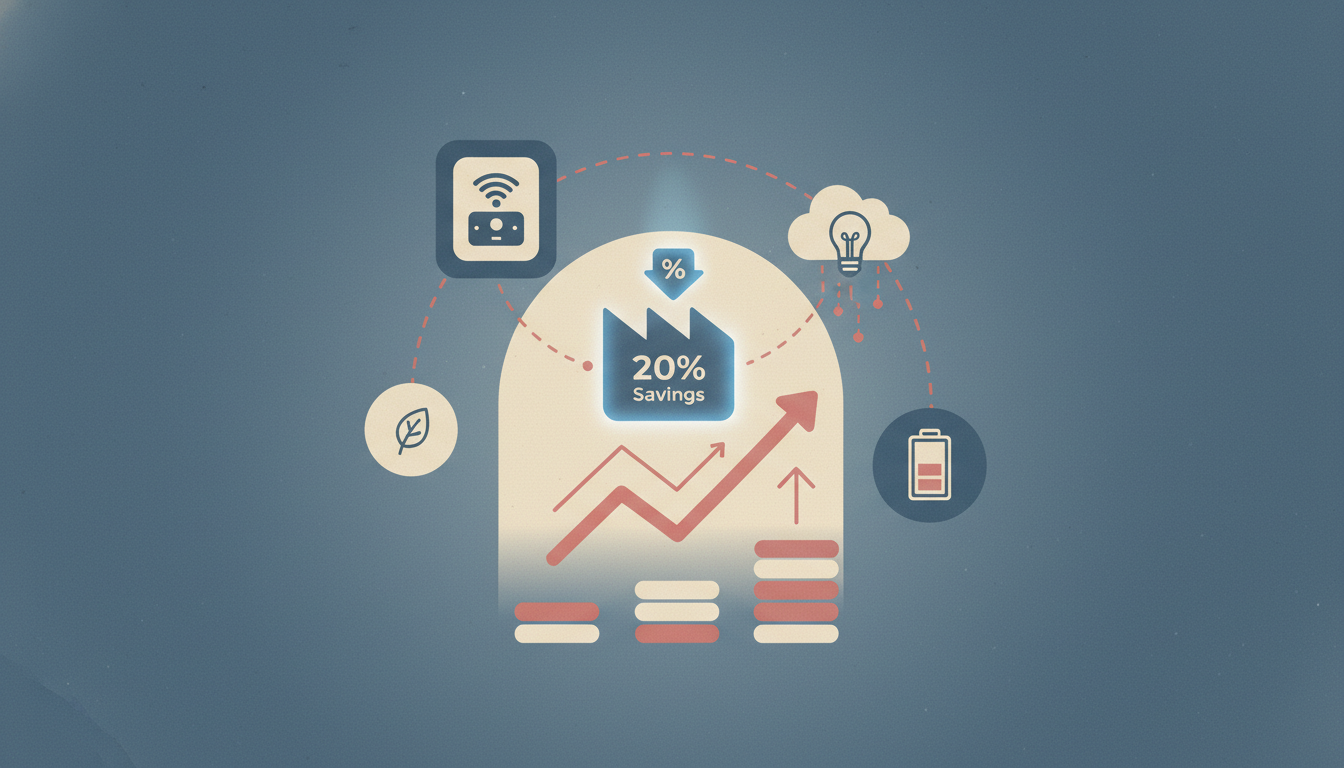
High energy bills are a silent profit killer for manufacturers. Most facility managers know they’re overpaying for electricity and gas, but they can’t pinpoint where the waste is happening. This is the story of a mid-sized manufacturer that stopped guessing and started measuring. By deploying a network of IoT sensors across their factory floor, they cut their annual energy spend by 20% and uncovered operational inefficiencies they didn’t know existed.
Before this transformation, the company faced the same challenge as thousands of other manufacturers: high energy expenses with no real-time visibility into consumption. Monthly utility bills told them how much they spent, but offered no clues about which machines, production lines, or shifts were driving costs. Energy waste was invisible.
By the end of this case study, you’ll understand exactly how this manufacturer moved from blind spending to data-driven control. You’ll see the sensor technologies they used, the implementation steps they followed, and the concrete results they achieved. Most importantly, you’ll get actionable insights you can apply to your own facility.
Company Background and Energy Challenges
The Manufacturer at a Glance
The company is a mid-sized manufacturer of industrial components, operating out of a 150,000-square-foot facility in the Midwest United States. They employed roughly 400 workers across three shifts, running a mix of CNC machining centers, injection molding presses, assembly lines, and a substantial material handling operation. Their annual energy spend was approximately $1.2 million, with electricity accounting for 78% of that total and natural gas covering the remaining 22%.
The pain points were painfully familiar. The plant manager knew energy costs were too high, but had zero visibility into what was driving them. Monthly bills showed total consumption, yet the numbers arrived 30 days after the fact, making it impossible to connect spikes to specific events. When a new production line was added, the energy impact was simply absorbed into the total. There was no mechanism to attribute costs to individual machines, production cells, or even shifts.
The mid-sized manufacturer energy costs were eating into margins, and the company lacked the tools to fight back. They knew inefficiencies existed, but without granular data, they couldn’t prioritize investments or enforce accountability.
Why Traditional Energy Audits Fell Short
Before turning to IoT, the manufacturer had tried conventional energy audits. A consultant visited the facility for a week, walked the floor with a clipboard, and produced a 50-page report with recommendations. The audit was expensive, costing $25,000, and the findings were mostly generic: “Consider LED retrofitting for lighting,” “Check compressed air leaks,” “Optimize HVAC schedules.”
The problem was that the audit provided a snapshot, not a live feed. It could not capture how equipment behaved over time. It could not show that a CNC machine was drawing 40 kW at 2:00 AM when nobody was operating it. It could not reveal that the HVAC system was fighting an open dock door every afternoon. The audit could not track the 15-second idle periods on injection molding presses that, multiplied across thousands of cycles per day, wasted significant energy.
This is a common industrial energy inefficiency issue: traditional audits identify obvious problems, but miss the subtle, cumulative waste that adds up to real money. The manufacturer needed continuous monitoring, not a one-time inspection.
The biggest gap was the manufacturing energy data gaps. The audit could not answer simple questions like: “What is the actual energy cost per part produced on Line 3?” “How much power does the compressed air system consume when the plant is shut down?” “Which shift is more energy efficient?” Without answers, every energy reduction initiative was a guess.
The company realized they needed a scalable, cost-effective solution that could provide real-time visibility at the machine level. That’s when they started exploring IoT.
The IoT Solution: Sensors, Connectivity, and Analytics
Sensor Deployment Strategy
The IoT implementation started with a clear question: “Where does the energy go?” To answer that, the team mapped the factory’s energy consumption into three categories: production equipment, facility systems, and building services.
On the production side, they targeted the biggest power consumers first. IoT energy monitoring sensors were installed on all CNC machines with spindle motors larger than 15 kW, injection molding presses, and the main air compressor system. Each machine received a current transformer (CT) clamp sensor that measured real-time power draw. For the compressed air system, they added pressure sensors and flow meters to detect leaks and inefficiencies.
For facility systems, temperature sensors were placed across the HVAC zones, especially in areas that were chronically too hot or too cold. Lighting circuits got occupancy sensors combined with power monitors to detect lights left on in unoccupied spaces.
The sensor placement was strategic. On each production line, sensors were positioned at the main electrical panel to capture total line consumption, but also at individual machines to isolate high-consumption equipment. This two-tier approach gave them both macro and micro visibility.
They used a mix of sensor types. Current sensors (CT clamps) for power draw, temperature sensors for thermal monitoring, vibration sensors for predictive maintenance insights, and pressure transducers for compressed air systems. All sensors were wireless, using either Wi-Fi for high-density areas or LoRaWAN for spots where Wi-Fi coverage was weak or non-existent.
This wireless sensor network manufacturing architecture was critical. Running cables to every machine would have been prohibitively expensive and caused significant downtime. Wireless sensors could be installed in minutes, commissioning via a mobile app, and immediately start streaming data.
Data Collection and Visualization
Once sensors were deployed, the data needed to flow somewhere useful. The manufacturer chose a cloud-based industrial IoT platform that aggregated all sensor readings into a single dashboard. The platform handled data ingestion, storage, and visualization without requiring on-premise servers or complex IT infrastructure.
The data pipeline was straightforward. Each wireless sensor transmitted readings every 5 to 15 seconds, depending on the criticality of the monitored asset. These readings traveled through a local gateway that aggregated data from multiple sensors before sending it to the cloud via a cellular backup. Once in the cloud, the real-time energy analytics engine processed the data, normalizing it, flagging anomalies, and updating dashboards.
The result was a live view of the entire factory’s energy consumption. The dashboard showed total facility power draw, consumption by production line, individual machine load profiles, and trends over time. Users could drill down from the plant level to a specific motor on a specific press within two clicks.
The granularity was transformative. Previously, the plant manager saw one number: total monthly kWh. Now, they could see that Machine 14 on Line B was drawing 5 kW during lunch break when it should have been idle. They could see that the compressed air system was losing 30% of its output to leaks. They could compare Monday’s shift to Tuesday’s shift in energy efficiency.
The platform also sent automated alerts. If a machine exceeded its normal power draw for more than 15 minutes, the maintenance team received a notification. If the HVAC system was running when exterior temperatures did not require it, an alert was triggered. Energy waste became visible in real-time, enabling immediate corrective action instead of waiting for the monthly bill.
Integration with existing systems was another priority. The IoT platform connected to the factory’s SCADA system to pull production data (running status, cycle times, part counts) and cross-reference it with energy data. This allowed them to calculate energy per part produced, a metric they had never been able to measure before.
Implementation Process and Timeline
Phase 1: Pilot on One Production Line
The manufacturer wisely started small. Instead of rolling out sensors across the entire 150,000-square-foot facility, they selected a single production line for a pilot. This line had six CNC machines, a conveyor system, and dedicated lighting and HVAC. The objective was to validate the technology, prove the ROI, and learn the implementation process before scaling.
The pilot took four weeks from sensor procurement to dashboard deployment. Week one was hardware ordering and network planning. Week two involved physical installation, which took two electricians roughly two working days per machine. Week three was system configuration, connecting sensors to the cloud platform, and building the initial dashboards. Week four was validation, comparing monitored data against the facility’s existing sub-meter readings to ensure accuracy.
The pilot cost approximately $18,000, including hardware, installation labor, and one year of cloud platform subscription. Within the first month of monitoring, the team identified that one CNC machine was running at full power during every break and lunch period, simply because nobody had programmed it to go into standby. Correcting this saved $3,200 annually from that one machine alone.
The pilot gave the team confidence. They could now quantify the waste they had previously only suspected. The IoT implementation timeline included a formal review after the pilot’s second month, where they presented the findings to senior management. The 18-month projected payback on the full deployment was compelling enough to get approval for Phase 2.
Phase 2: Full Factory Deployment
With the pilot validated, the full deployment expanded sensor coverage to all production areas, the warehouse, office spaces, and the facility’s central utility systems. This phase took approximately 20 weeks, broken into overlapping waves.
Wave One focused on remaining production equipment. They installed sensors on all CNC machines, injection molding presses, welding stations, and assembly lines. This covered approximately 120 individual monitoring points across the factory floor.
Wave Two covered facility systems: the main HVAC units, air handling units, lighting panels, and the compressed air system. They added flow meters on compressed air lines to track consumption by zone, and temperature sensors in critical areas.
Wave Three integrated the IoT platform with the factory’s ERP system. This was the most technically challenging step. They needed to map energy consumption data to specific cost centers and production orders, enabling accurate energy cost allocation per product. The ERP integration allowed the finance team to see energy costs at the order level for the first time.
The manufacturing IoT rollout required coordination across multiple teams. Facilities was responsible for sensor installation. IT managed network connectivity and data security. Operations provided input on which machines to prioritize. A change management program was critical, operators needed to understand why sensors were being installed and how the data would be used. The team held short training sessions with shift supervisors and lead operators, explaining that the system was not for surveillance but for identifying waste and optimizing operations.
Integration challenges did arise. Some older machines did not have accessible electrical panels, requiring electricians to install temporary sub-panels. Certain areas had poor wireless connectivity due to metal structures, necessitating additional gateways. Each challenge was addressed case by case, but the phased approach meant they could solve problems on a small scale before they became large-scale issues.
Results: 20% Energy Cost Reduction and Beyond
Quantitative Savings Breakdown
The results were measured and verified over 12 months following full deployment. The manufacturer achieved a total energy cost savings IoT reduction of 20.4% compared to the baseline year. The following table breaks down the savings:
| Category | Baseline (kWh/year) | Post-IoT (kWh/year) | Reduction | Annual Cost Savings |
|---|---|---|---|---|
| Production Equipment | 4,200,000 | 3,570,000 | 15% | $63,000 |
| Compressed Air System | 950,000 | 570,000 | 40% | $38,000 |
| HVAC & Facility Systems | 1,800,000 | 1,530,000 | 15% | $27,000 |
| Lighting | 450,000 | 360,000 | 20% | $9,000 |
| Total Electrical | 7,400,000 | 6,030,000 | 18.5% | $137,000 |
| Natural Gas Consumption (therms) | 112,000 | 100,800 | 10% | $11,200 |
| Combined Total | 20.4% | $148,200 |
The 20% reduction came from multiple sources, not a single silver bullet. The compressed air system provided the biggest percentage improvement. The IoT sensors revealed that the system was running 24/7, even when the plant was shut down on weekends. By installing a solenoid valve on the main line and programming the compressors to shut down during non-production hours, they eliminated 300,000 kWh of waste annually.
Peak demand charges also dropped significantly. The ROI of industrial IoT became clear when the dashboard showed that starting all injection molding presses simultaneously caused a 30-minute spike in demand. By staggering startup sequences, they reduced peak demand by 12%, saving $24,000 annually in demand charges alone.
The payback period was under 18 months. The total project cost for the full deployment was approximately $210,000, including $160,000 in hardware and installation, and $50,000 for platform subscription and integration. With annual savings of $148,200, the investment paid for itself in 17 months.
Qualitative Operational Improvements
Beyond the numbers, the IoT system delivered operational benefits that were harder to quantify but equally valuable.
One example: the system identified that a large HVAC unit was running at full capacity every night, even though only the security team occupied the building after 7:00 PM. Investigation revealed that a schedule setting had been overwritten months ago and never corrected. Fixing it saved energy and extended the equipment’s lifespan.
Another discovery was related to predictive maintenance energy efficiency. A vibration sensor on a cooling tower fan detected abnormal readings two weeks before the fan bearing failed. The maintenance team replaced the bearing during a planned shutdown, avoiding an emergency breakdown that would have halted production for at least one shift.
The real-time visibility also changed behavior. Shift managers started competing on energy efficiency when they could see daily consumption per shift displayed on a monitor in the break room. Simple changes, like turning off conveyor belts during lunch breaks and shutting down idle machines, became standard practice.
The data also improved production scheduling. By knowing the energy cost per machine per hour, the production planner could route orders to more efficient machines when lead times allowed. This was particularly effective for CNC machining, where newer machines were significantly more power-efficient than older models.
Key Takeaways for Manufacturers
Common Pitfalls to Avoid
The journey was not without mistakes. Two common pitfalls emerged that other manufacturers should watch for.
The first was sensor placement errors. In the pilot phase, the team initially placed current sensors upstream of distribution panels instead of at individual machines. This provided total line data but could not isolate specific machine consumption. It took an additional week to reposition sensors for machine-level granularity. Lesson learned: go down to the machine level from the start. Aggregate data is only marginally better than a utility bill.
The second pitfall was data overload without actionable alerts. In the first month after full deployment, the dashboard showed hundreds of data points, but operators did not know what to look for. The team realized they needed to configure automated alerts that triggered only on meaningful deviations. They spent two weeks defining thresholds for each machine: normal operating range, warning zone, and critical limit. Once alerts were set, the system became useful. Before that, it was just noise.
From these experiences came lessons learned IoT energy projects: always start with a pilot to test your assumptions, configure alerts before you go live, and involve operators in defining what “normal” looks like for their equipment.
Importance of Data Granularity and Real-Time Visibility
The single biggest factor in the project’s success was data granularity. Monthly utility bills could not have identified the 2:00 AM CNC machine waste. Hourly data would have shown the anomaly but not pinpointed the source. Only machine-level, 15-second data made the waste visible.
Granularity also enabled accountability. When each machine had an energy consumption profile, the team could assign costs directly to production lines and shifts. This transparency drove behavior change in a way that aggregate data never could.
Scaling IoT manufacturing from one line to the full facility was possible because the architecture was designed to scale from day one. The cloud-based platform handled growth without requiring additional infrastructure beyond new sensor hardware.
Integration with business systems multiplied the value. Connecting energy data to the ERP system turned energy from a fixed overhead into a variable cost that could be managed per product. This insight enabled pricing decisions, process improvement prioritization, and capital investment justification.
FAQs
1. How much does an IoT energy monitoring system cost for a mid-sized factory?
The cost depends on factory size and monitoring density. For the 150,000-square-foot facility in this case study, the total project cost was approximately $210,000, including hardware, installation, and the first year of cloud platform subscription. Smaller factories with fewer machines could expect costs in the $50,000 to $100,000 range. The key is to start with a pilot on one line or zone to validate the investment before scaling.
2. How long does it take to see a return on investment from IoT energy monitoring?
In this case study, the payback period was 17 months. Most industrial IoT energy projects achieve payback within 12 to 24 months. The fastest ROI often comes from low-hanging fruit improvements like shutting down equipment during idle periods, fixing compressed air leaks, and staggering machine startups to reduce peak demand charges.
3. Do IoT sensors require special wiring or cause production downtime during installation?
Modern IoT sensors are wireless and use non-invasive CT clamps that can be installed without cutting or re-wiring electrical cables. Installation typically requires less than 30 minutes per machine and can be performed during planned downtime or off-shift hours. For older machines with enclosed electrical panels, some minor wiring modifications may be necessary, but most installations cause zero production downtime.
4. Can IoT energy monitoring integrate with my existing SCADA or BMS system?
Yes. Most industrial IoT platforms offer API integrations and native connectors for common SCADA systems and building management systems. The key is to choose a platform that supports standard communication protocols like Modbus, BACnet, or OPC-UA. Involving your IT team early in the planning process helps ensure smooth integration and avoids compatibility issues.
Next Steps: Building a Smart Energy Strategy
The manufacturer is now expanding their IoT deployment to two additional facilities. The lessons from the first site are being applied directly: start with a pilot, prioritize machine-level monitoring, and integrate with existing business systems from day one.
The next frontier is combining IoT data with AI for dynamic load optimization. The current system provides real-time visibility, but humans still make the decisions. With AI, the system could automatically adjust machine schedules based on real-time energy pricing, weather forecasts, and production demand. This is the logical next step in a smart energy strategy manufacturing.
Setting energy reduction targets has become a formal process. The manufacturer now tracks energy per unit produced as a key performance indicator, reviewed monthly by the plant manager. They aim for a 5% annual reduction through a combination of operational efficiency, equipment upgrades, and behavioral changes.
The most important takeaway from this case study is that continuous energy improvement is not a project with an end date. It is an ongoing practice enabled by technology. The IoT system gave the manufacturer visibility, and visibility gave them control. The 20% reduction was just the beginning. Every month, the system reveals new opportunities, and every quarterly review sets a new target.
The question for your facility is not whether IoT energy monitoring works; it has been proven in thousands of factories worldwide. The question is when you will start your own pilot project.
Contact us to discuss how IoT can transform your factory’s energy management. Whether you are a facilities manager overwhelmed by rising utility costs or a plant engineer looking to build a data-driven energy strategy, we can help you take the first step.
Written with LLaMaRush ❤️