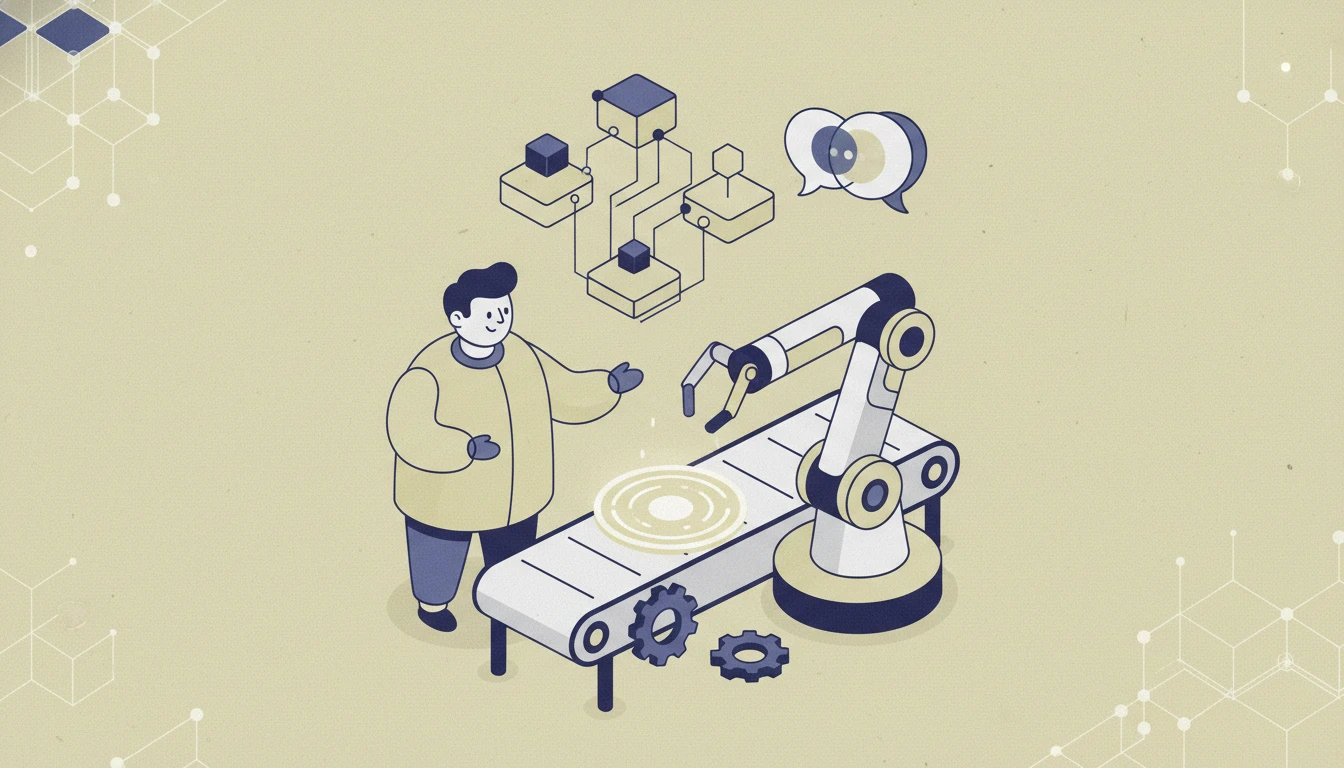
The Future of Human-Robot Collaboration in Manufacturing
Picture a Tesla assembly line, where a robotic arm hands a delicate component to a technician, adjusting its grip based on the worker’s subtle gesture. This seamless teamwork is no longer science fiction; it’s the reality of modern manufacturing, fundamentally altering how we build things. Yet, for many industry professionals, integrating these sophisticated systems with a human workforce remains a complex puzzle of cost, safety, and workflow disruption. This article demystifies that process by bringing you direct insights from leading experts in robotics and manufacturing systems.
You will gain a clear, practical understanding of how human-robot collaboration is being implemented today, from the shop floor to the executive strategy meeting. We’ll explore the tangible benefits, navigate the common challenges, and examine the future trends,like adaptive AI and IoT integration,that are set to redefine the factory of tomorrow. This knowledge will equip you to make informed decisions about automation in your own operations, whether you’re planning an initial pilot or scaling an existing system.
Understanding Human-Robot Collaboration in Modern Assembly Lines
The traditional image of industrial automation features massive, caged robots performing repetitive tasks in isolation, separated from human workers for safety. Human-robot collaboration shatters this model, creating a shared workspace where humans and machines combine their unique strengths. This paradigm shift is centered on collaborative robots, or cobots, which are designed from the ground up to work safely alongside people.
What are Cobots?
Unlike their traditional counterparts, cobots are engineered with intrinsic safety features. Key design elements include force sensing and torque-limited joints. If a cobot encounters an unexpected obstruction,like a human arm,its built-in sensors detect the spike in force and immediately stop or retract, preventing injury. This is complemented by safety-rated monitored stops and rounded, soft edges to minimize impact.
Their ease of use is another cornerstone. Many cobots feature hand-guiding programming, where a technician physically moves the robot arm through the desired task, which the robot then memorizes. This intuitive method eliminates the need for complex coding, allowing line workers and technicians, not just robotics engineers, to deploy and reprogram tasks quickly. This flexibility makes them ideal for mixed-model assembly lines where production runs change frequently.
Evolution and Adoption Trends
The journey toward collaboration began with simple machine tending applications and has rapidly accelerated. The International Federation of Robotics reports that the installation of collaborative robots has seen a compound annual growth rate of over 30% in recent years. While the automotive industry was an early adopter, the most significant growth is now in sectors like electronics assembly, where precision and flexibility are paramount, and in small-to-medium-sized enterprises (SMEs) for which traditional automation was once cost-prohibitive.
The core technology enabling this shift goes beyond physical safety. Advanced vision systems, voice recognition, and real-time data exchange allow robots to understand context. For instance, a robot equipped with computer vision can identify that a worker is reaching for a tool and momentarily pause its motion, or it can adapt its task based on the specific component presented to it. This move from pre-programmed rigidity to adaptive, sensor-driven interaction is what defines modern collaborative robotics.
Expert Perspectives: Technological and Human Factors
To move beyond theory, it is valuable to examine insights from practitioners shaping the future of the factory floor, focusing on both the technological frontier and the human element of this transformation.
Technological Integration
Industry leaders emphasize that the true breakthrough isn't the robot alone, but the ecosystem it operates within. "The cobot is the actor, but AI and sensor fusion are the directors." The focus is on creating systems where data flows seamlessly between human, machine, and the digital twin of the production line.
A concrete example from a gearbox assembly line helps illustrate this. In one implementation, a cobot was integrated with a high-resolution 3D vision system. The robot doesn't just pick and place; it scans each gear, compares it to a perfect digital model in milliseconds, and identifies minor casting flaws invisible to the human eye. It then presents the gear to the human operator at the exact orientation needed for the next manual step, all while logging the defect data for process improvement. This synergy leverages human ingenuity for complex fitting and validation, while the robot handles precision inspection, heavy lifting, and tedious presentation tasks, boosting overall line quality by 15%.
Future Workforce Dynamics
Looking at collaboration through a human lens, the narrative of robots replacing jobs is often considered outdated. "The real story is job transformation." Research indicates that human-robot interaction on the assembly line is creating new hybrid roles, such as "robot coordinator" or "collaborative cell technician."
There is a significant shift in skills requirements. Technical skills remain crucial—understanding basic programming, maintenance, and data interpretation from these systems. But there is a higher premium on problem-solving, adaptability, and communication skills. The worker is becoming a supervisor and troubleshooter for a team that includes machines. Manufacturers are advised to invest in continuous, hands-on training programs that start long before a cobot is installed, focusing on co-working dynamics rather than just operational procedures. This proactive approach mitigates resistance and unlocks the full productivity potential of the human-robot team.
Benefits and Challenges of Human-Robot Teams
Adopting human-robot collaboration is a strategic decision with compelling advantages, but it requires honest assessment and planning to overcome inherent hurdles.
Productivity and Efficiency Gains
The most immediate impact is on the bottom line. By taking over ergonomically poor, repetitive, or highly precise tasks, cobots free human workers to focus on value-added activities like final assembly, quality control, and problem-solving. A Deloitte case study on an electronics manufacturer showed that introducing cobots for circuit board testing and cable installation reduced cycle times by 25% and virtually eliminated repetitive strain injuries in those stations.
Efficiency gains are amplified through optimized workflow. A human-robot team can operate in parallel. While a worker performs a delicate wiring operation, a cobot can be simultaneously fetching the next component, applying adhesive, or driving screws. This parallel processing minimizes idle time. Furthermore, cobots work with consistent precision 24/7, drastically reducing errors and scrap rates. MIT research found that human-robot teams can be approximately 85% more productive than either working alone, as they balance each other's weaknesses.
Overcoming Implementation Hurdles
Despite the benefits, implementation is not plug-and-play. The primary hurdle is often the initial investment, which includes not just the robot, but end-effectors (grippers, tools), safety assessments, and integration engineering. A clear ROI in robotics calculation is essential, factoring in labor cost redistribution, quality improvement, and output increase over a 3-5 year period.
Employee apprehension is another common challenge. Transparency is key. Involve floor staff from the planning stages, demonstrate the cobot's safety features firsthand, and frame it as a tool to augment and assist, not replace. Comprehensive, practical training is non-negotiable. Finally, system compatibility with existing Manufacturing Execution Systems (MES) and Enterprise Resource Planning (ERP) software must be vetted. Starting with a single, well-defined pilot project on a non-critical line allows teams to learn, adapt, and demonstrate success before a full-scale rollout.
Future Trends in Collaborative Robotics
The cobots of today are just the beginning. The next wave of innovation is focused on making these systems more perceptive, connected, and autonomous within their collaborative role.
AI and Adaptive Systems
Future cobots will move beyond pre-defined collaboration to true contextual adaptation. Artificial intelligence and machine learning are central to this. Through computer vision, a robot will not only see a worker but understand their intent,distinguishing between a routine movement and a gesture for assistance. Natural language processing will enable voice commands for complex instructions, like "hand me the red connector from bin three."
More importantly, AI will enable predictive adaptation. By analyzing historical data, a collaborative system could predict that a human worker's precision decreases after two hours on a specific task and could proactively adjust its role,for example, taking over the fine alignment step during that period. This level of fluid, adaptive robotics creates a resilient production system that optimizes itself in real-time based on human performance and environmental factors.
IoT and Data Integration
The true power of collaborative systems is unlocked when they are nodes in a connected smart factory. IoT connectivity via sensors on tools, workpieces, and the cobots themselves creates a continuous data stream. This data flows to a cloud platform where it can be analyzed to optimize the entire collaborative process.
For instance, force sensor data from a cobot's gripper, combined with vibration data from a tool used by a human worker, can predict maintenance needs for both,a concept known as predictive maintenance. This prevents unexpected downtime. Furthermore, this integrated data provides unparalleled traceability. Every action in the assembly process, whether by human or machine, can be logged, creating a complete digital thread for each product. This is invaluable for quality control, certification, and continuous process improvement.
Practical Insights for Manufacturers
Turning insights into action requires a methodical approach. Here is a roadmap and real-world lessons to guide your journey into human-robot collaboration.
Steps to Adopt Cobots
- Needs Assessment & Task Identification: Don't start with the robot. Start with the process. Map your assembly line and identify tasks that are repetitive, ergonomically challenging, or bottlenecking throughput. These are prime candidates.
- Vendor Selection & ROI Modeling: Research cobot manufacturers and system integrators. Request demos with your specific components. Build a detailed financial model projecting costs (hardware, integration, training) against savings (labor reallocation, error reduction, output increase).
- Safety Certification & Cell Design: Conduct a formal risk assessment (e.g., ISO/TS 15066). Design the collaborative workspace, considering human reach, robot range, and fail-safes. This often involves virtual simulations.
- Pilot Program & Iterative Training: Implement a single cobot cell. Involve the operators who will work with it in the programming and testing phase. Use this pilot to refine the process, training materials, and safety protocols.
- Scale, Integrate & Maintain: After a successful pilot, develop a phased rollout plan. Ensure IT infrastructure is ready for data integration. Establish a preventive maintenance schedule for the cobots.
Real-World Examples and Lessons Learned
- Automotive Wire Harness Assembly: A European car manufacturer deployed cobots to guide and position complex wire harnesses while human workers performed the intricate clipping and connections. The benefit was a 30% reduction in assembly time and a significant drop in arm strain injuries. The lesson: The most valuable application was not replacing a human task, but physically holding the cumbersome harness in the perfect position for the human to work on efficiently.
- Electronics Precision Soldering: A consumer electronics company used a vision-guided cobot for applying micro-soldering paste on circuit boards. Humans handled component placement and final inspection. The outcome was a 99.98% paste application accuracy rate, eliminating a major source of board faults. The insight: The cobot's consistent precision complemented human dexterity for part placement, creating a hybrid process superior to either fully manual or fully automated approaches. The key was viewing the robot as a precision tool in the worker's toolkit.
Conclusion
Human-robot collaboration is revolutionizing manufacturing by forging a powerful partnership that blends irreplaceable human ingenuity with relentless robotic precision. It offers a scalable, flexible path to enhanced productivity, improved worker safety, and superior quality. As our expert insights confirm, the future lies in deeper integration through AI and connectivity, transforming cobots from simple tools into responsive, adaptive teammates.
The key takeaway is clear: the goal is not full automation, but optimal augmentation. By understanding the current applications, strategically navigating the implementation challenges, and preparing for an increasingly connected and intelligent future, manufacturers can unlock new levels of efficiency and resilience on the assembly line.
Stay ahead in the evolving manufacturing world. Subscribe to the ManufactureNow newsletter for more expert insights, deep-dive case studies, and practical guides on implementing automation, robotics, and other transformative technologies in your operations. Explore our resource library today to turn knowledge into action.
Written with LLaMaRush ❤️