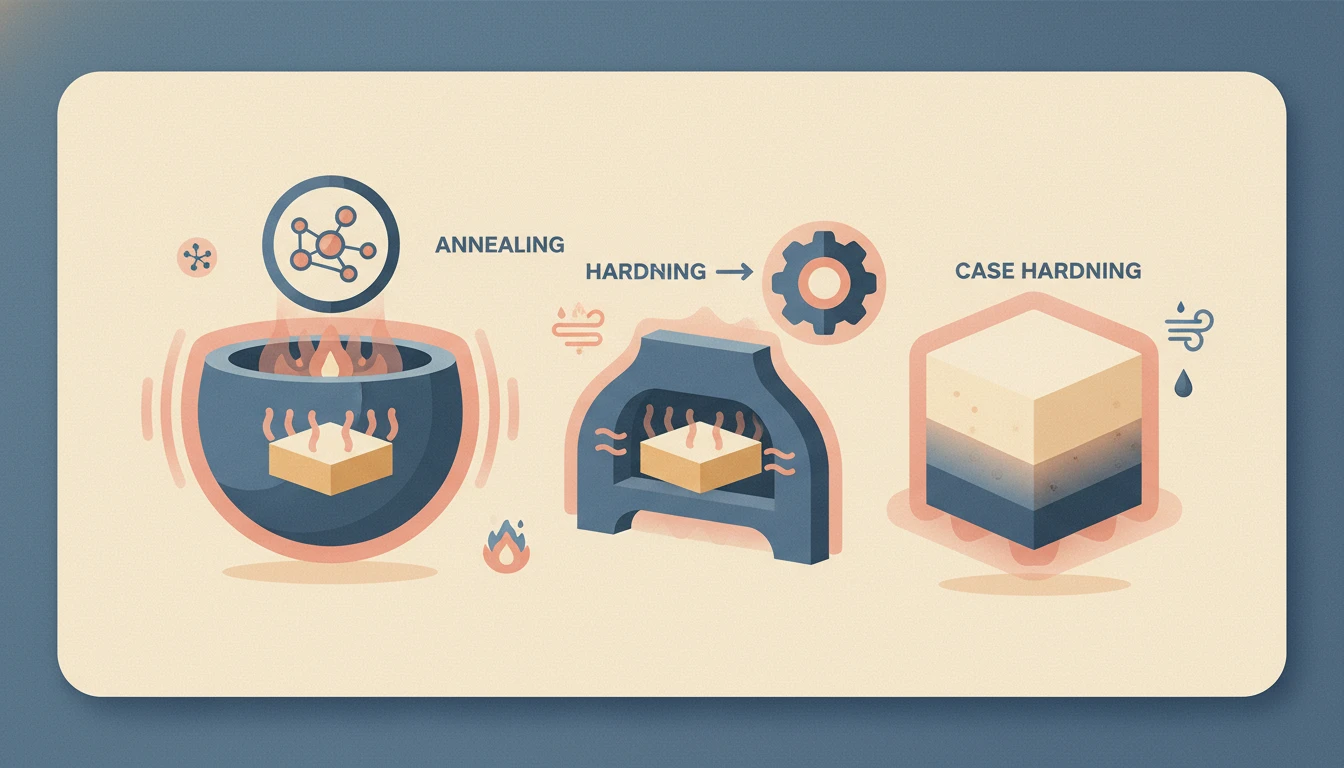
You can machine a perfect steel part, but without the right heat treatment, it’ll fail under load,soft where it needs hardness, brittle where it needs toughness. The steel on your bench is just potential. Heat treatment is the transformative act that turns that potential into performance. Choosing the wrong heat treatment cycle leads to premature failure, scrap, and costly rework. You don’t need just a definition of annealing or hardening; you need a practical roadmap that explains what each process does, why it matters on a metallurgical level, and how to select the right one for your specific steel component.
By the end of this guide, you’ll understand the full spectrum of steel heat treatment,from annealing and normalizing to quenching, tempering, and case hardening. You’ll grasp the foundational science and gain a process-focused framework to confidently select and apply the correct treatment for any carbon or alloy steel.
The Metallurgical Foundation: Why Heat Treatment Changes Steel
At its core, heat treatment is a controlled manipulation of time and temperature to change a metal’s internal structure, or steel microstructure. Think of steel as a complex, three-dimensional mosaic. The tiles in this mosaic are different crystal structures, primarily ferrite (soft, ductile iron), cementite (hard, brittle iron carbide), and their combinations like pearlite (a lamellar sandwich of ferrite and cementite). When you heat and cool steel, you're rearranging these tiles.
The master blueprint for this rearrangement is the iron carbon phase diagram. This chart tells you what microstructure exists at any given combination of temperature and carbon content. The key lines are the Ac1 and Ac3 temperatures. Heating above Ac1 begins the transformation to austenite, a high-temperature, face-centered cubic crystal structure that can dissolve carbon. Heating above Ac3 ensures the steel is fully austenitic. This is the clean slate,the state from which all other transformations begin upon cooling.
But the diagram only tells you what forms at equilibrium. The how fast is dictated by TTT diagram steel (Time-Temperature-Transformation) and CCT (Continuous Cooling Transformation) diagrams. These are the heat treater’s playbook. They plot the time it takes for austenite to transform into other structures like pearlite, bainite, or martensite at different cooling rates. The ultimate goal for maximum hardness is often to bypass all other transformations and achieve martensite formation. Martensite is a super-saturated, body-centered tetragonal structure created by quenching (rapidly cooling) austenite. It’s extremely hard but also brittle.
Why Grain Size Matters
The individual crystals within the microstructure are called grains. Their size is one of the most critical factors determining a steel's mechanical properties. The rule is simple: smaller grains are stronger and tougher. This is because grain boundaries act as barriers to dislocation movement (the microscopic slips that cause deformation).
Heating steel to the austenitic range and holding it allows grains to grow, which can coarsen the structure and reduce strength,this is a defect called overheating. However, controlled heating and cooling cycles are designed to refine grain size. For example, normalizing heats steel into the austenite range and then allows it to cool in still air. This moderate cooling rate produces a finer, more uniform grain structure than the very slow cooling of full annealing. Every time you correctly cycle through the austenite transformation, you have an opportunity to refine the grain size, directly enhancing the component's strength and impact resistance.
Annealing: Softening for Workability
When a piece of steel is too hard to machine, riddled with internal stress from a prior process, or needs to be ductile for forming, annealing is your first stop. Its primary purpose is to soften the metal, relieve internal stresses, and improve machinability by producing a stable, low-hardness microstructure. It’s a reset button.
Full annealing is the most complete softener. The steel is heated to about 50°C above the Ac3 line, held until fully austenitized and homogeneous, then slowly cooled inside the furnace. This painfully slow cooling, often at a rate of 10-30°C per hour, allows the formation of the softest, most stable structures: coarse pearlite and ferrite. The result is maximum softness and ductility, ideal for subsequent severe cold forming or to rectify a disastrously hard structure.
Process annealing, or subcritical annealing, is a more targeted approach. Used primarily on low-carbon steels that have been cold-worked (and thus strain-hardened), it involves heating the steel to a point below the Ac1 temperature (typically 550-650°C). At this subcritical temperature, the steel doesn’t transform to austenite. Instead, the cold-worked, distorted grains recrystallize into new, stress-free equiaxed grains, restoring ductility without significantly altering the overall microstructure.
For high-carbon and tool steels, which can be difficult to machine even in an annealed state, spheroidize annealing is the gold standard. This process involves heating to just below the Ac1 line (or cycling just above and below it) for an extended period,sometimes 15-20 hours. This causes the hard, plate-like cementite in pearlite to coalesce into soft, spherical globules (carbides) suspended in a ferrite matrix. This structure minimizes tool wear during machining and is also the ideal starting condition for subsequent hardening of tool steels.
Typical hardness outcomes post-annealing are in the 150–210 HB (Brinell) range, making the steel readily machinable.
Annealing vs Normalizing: Key Difference
While both are softening processes, the devil is in the cooling rate. As discussed, full annealing uses a slow furnace cool. Normalizing, in contrast, involves air cooling. The steel is heated to a similar austenitizing temperature (often slightly higher) and then removed from the furnace to cool in still air.
This faster cooling rate results in a finer pearlite structure and a slightly higher strength and hardness than full annealing. Think of it this way: annealing gives you maximum softness for extreme workability; normalizing gives you a more refined, uniform, and slightly stronger structure that is often ideal as a pre-treatment before final hardening or for improving the properties of castings and forgings. For many medium-carbon steels destined for quenching, normalizing is the preferred "conditioning" treatment to ensure a consistent, fine-grained starting structure.
Normalizing: Refining Structure for Consistency
Normalizing is the workhorse process for establishing a uniform, baseline microstructure. Its primary goal isn't maximum softness, but consistency and grain refinement. The process is straightforward: heat the steel to about 40-50°C above the upper critical temperature (for hypereutectoid steels, it's heated above the Acm line), hold for sufficient time to homogenize, then cool in still air.
This air cooling is significantly faster than furnace cooling, leading to the transformation of austenite at a lower temperature. The result is a finer pearlite (and, in low-carbon steels, a finer ferrite grain size) than produced by annealing. This grain refinement heat treatment imparts higher strength and better impact properties than an annealed condition.
Normalizing is exceptionally effective at removing undesirable structures. It breaks up the dendritic grain structure left over from casting, refines the coarse grains resulting from hot forging or rolling, and can dissolve and redistribute carbides in alloy steels. Because it produces a predictable and uniform structure, it is the standard pre-heat treatment for many alloy steels before they undergo final hardening (quenching and tempering). A normalized piece will typically have a hardness range of 180–250 HB, offering a good balance of machinability and strength for many intermediate processing steps.
Quenching and Tempering: The Heart of Hardening
This is where steel earns its reputation as an engineering material. The goal is simple: achieve high hardness and strength. The process, however, is a delicate dance between two opposing steps: quenching and tempering.
Quenching is the act of rapid cooling. When austenite is cooled so quickly that atoms cannot diffuse to form pearlite or bainite, they undergo a diffusionless, shear transformation into martensite. This martensitic hardening creates an incredibly hard but brittle structure, often reaching 55-65 HRC. The key is speed: you must cool the steel faster than its "critical cooling rate," a property inherent to the steel's composition.
The choice of quenching media is a critical practical decision that balances cooling speed against the risk of distortion and cracking.
* Water: Very severe quench. High risk of distortion and quench cracking, but effective for simple, low-hardenability steels like plain carbon steels.
* Oil: A milder, more forgiving quench. Much lower risk of cracking. The standard for many alloy and tool steels.
* Polymer (e.g., PAG): An adjustable quench. By varying concentration, you can tailor the cooling rate between that of oil and water.
* Gas (e.g., nitrogen, argon): Used in vacuum furnaces. The mildest quench, offering minimal distortion for high-speed or high-alloy tool steels.
A steel part fresh out of the quench is like a glass sword,hard but deadly brittle. It’s also full of internal stresses. Tempering is the essential follow-up that makes the part usable. Tempering involves reheating the quenched steel to a temperature below the Ac1 line, typically between 150°C and 700°C. This allows some of the supersaturated carbon in the martensite to precipitate out as fine carbides, relieving internal stress and transforming the brittle martensite into a tougher structure called "tempered martensite."
The trade-off is direct: higher tempering temperature = lower hardness but higher toughness and ductility. A tempering temperature chart for a specific steel grade will guide this choice. A razor blade might be tempered at 150-200°C to retain extreme hardness (~60 HRC), while a crankshaft might be tempered at 500-600°C to achieve a tough, shock-resistant structure around 30-40 HRC.
Understanding Hardenability (Jominy Test)
Not all steels harden the same way. Hardenability is not the same as hardness. Hardness is a measure of resistance to indentation at the surface. Hardenability is a measure of how deep a steel can be hardened through its cross-section. A steel with high hardenability will form martensite deep below the surface even with a relatively mild quench (like oil).
This is measured practically using the Jominy end quench test. A standard bar (25mm diameter, 100mm long) is austenitized and then placed in a fixture where one end is quenched with a controlled water jet. This creates a continuous gradient of cooling rates along the bar's length. After quenching, flats are ground along the bar and hardness is measured at regular intervals from the quenched end.
The resulting Jominy curve is a powerful predictive tool. It tells you, for that specific steel grade, what hardness you can expect at any depth under a given quenching condition. When selecting a steel for a thick part that needs to be through-hardened, you consult the Jominy data to ensure the center will achieve the desired microstructure and hardness with your available quenching method.
Case Hardening: Hard Surface, Tough Core
Many components, like gears, bearings, and camshafts, demand a paradoxical set of properties: a hard, wear-resistant surface sitting atop a tough, shock-absorbing core. Through-hardening a low-carbon steel to get a hard surface would make the entire part brittle. The solution is case hardening, which modifies only the surface layer.
Carburizing is the most common method for low-carbon steels (<0.25% C). The part is packed in a carbon-rich material (solid), placed in a carbon-rich gas (gas carburizing), or immersed in a molten salt containing cyanide (liquid carburizing) and heated to 900-950°C. At this temperature, carbon atoms diffuse into the steel surface, enriching it to 0.8–1.2% C. The part is then quenched. The high-carbon "case" transforms to hard martensite, while the low-carbon core forms a softer, tougher structure. Case depths typically range from 0.5 to 2.0 mm.
Nitriding is a lower-temperature (500–550°C) process where nitrogen is diffused into the surface of special alloy steels containing elements like chromium, aluminum, and molybdenum. It forms extremely hard nitride compounds. The biggest advantage is that it’s performed below the steel’s transformation temperature, so no quenching is required, minimizing distortion. The case is shallower (0.1–0.5 mm) but extremely hard and wear-resistant.
Carbonitriding is a hybrid, adding both carbon and nitrogen in a gaseous atmosphere at a temperature similar to carburizing. The nitrogen lowers the critical cooling rate, allowing the use of milder quenches (often oil) to harden the case, and it can achieve a hard case in shorter times.
For medium-carbon steels that already have sufficient carbon to harden, localized induction hardening or flame hardening is used. These methods use an induction coil or oxy-fuel torch to rapidly heat only the surface of the part (a gear tooth, a shaft journal) followed by an immediate quench. This allows for precise, localized hardening without affecting the rest of the component.
Case Depth Selection Guide
Choosing the right case depth is crucial. Too shallow, and it wears through; too deep, and the part becomes prone to subsurface spalling.
| Application | Recommended Case Depth | Preferred Process | Rationale |
|---|---|---|---|
| Light-Duty Gears | 0.5 - 0.8 mm | Carburizing or Carbonitriding | Sufficient for wear resistance without excessive bending fatigue sensitivity. |
| Heavy-Duty Gears / Bearings | 1.0 - 1.5 mm | Carburizing | Deeper case to withstand higher contact stresses and subsurface shear forces. |
| Camshaft Lobes | 0.8 - 1.2 mm | Induction Hardening (if medium-carbon steel) | Provides hard, wear-resistant lobe surface while keeping the shaft tough. |
| Hydraulic Pistons/Rods | 0.1 - 0.3 mm | Nitriding or Chrome Plating | Very thin, hard surface for seal wear and corrosion resistance with minimal dimensional change. |
| Machine Tool Guideways | 0.5 - 1.0 mm | Induction or Flame Hardening | Provides localized wear resistance on sliding surfaces of a larger, stable component. |
Heat Treatment Defects and How to Avoid Them
Even with a perfect recipe, things can go wrong. Recognizing and preventing these heat treatment defects is a mark of a skilled practitioner.
Decarburization is the loss of surface carbon due to reaction with oxygen in the air during heating. This leaves a soft "skin" on the part. Prevention: Use a controlled atmosphere furnace (e.g., endothermic gas, nitrogen), salt bath, or vacuum furnace. If unavoidable, machine off a small amount of stock post-heat treatment.
Quench Cracking is the nightmare scenario: audible "pings" or visible cracks during or after quenching. It's caused by thermal stresses exceeding the steel's strength. Prevention: Avoid sharp corners and sudden section changes in part design. Select a less severe quenchant (oil over water). Perform a "martempering" or "austempering" interrupted quench cycle.
Distortion/Warping is the unintended change in shape due to uneven heating, cooling, or release of residual stresses. Prevention: Use proper distortion control heat treat practices: heat parts slowly and uniformly, use fixturing to support parts during heating and quenching (especially for long, thin parts), and always hang parts vertically to allow uniform quenchant flow.
Residual Stress is locked-in stress that wasn't relieved, leading to dimensional instability or stress-corrosion cracking. Prevention: Always follow a quench with an immediate temper. For complex or high-precision parts, use a stress relieving steel cycle (heating to 550-650°C and slow cooling) prior to final machining.
Overheating/Burning: Overheating causes excessive grain growth, reducing toughness. "Burning" is more severe, where localized temperatures approach the melting point, causing incipient melting at grain boundaries,this is irreparable. Prevention: Strictly control furnace temperature and avoid placing parts too close to heating elements.
Process Selection Matrix: Which Heat Treatment for Which Steel?
Selecting the right process is a function of the steel's carbon content, the desired final properties, and the component's geometry.
- Low‑carbon steel (<0.25% C): Cannot be through-hardened significantly. Use case hardening (carburizing, carbonitriding) to create a hard surface. Use full annealing or process annealing to soften for cold forming or to relieve stress after welding.
- Medium‑carbon steel (0.25–0.60% C): The most versatile for hardening. Primarily suited for quench & temper to achieve a range of strength/toughness combinations. Induction hardening is perfect for localized surface hardness on these grades.
- High‑carbon steel (>0.60% C): Used for cutting tools, blades, and springs. Often starts with spheroidize annealing for machinability. Then undergoes quench & temper for high hardness. Can also be nitrided for extreme surface wear resistance without quenching.
- Alloy steels (with Cr, Ni, Mo, etc.): The alloying elements increase hardenability, allowing thicker sections to be through-hardened with milder quenches (oil instead of water), reducing distortion risk. They follow similar process selection rules based on their carbon content.
A Surprising Analogy: Heat Treatment Is Like Optimizing a Business Process
Just as a medical practice needs to carefully choose between investing in a foundational marketing setup or refining its existing online presence to attract the right patients, a heat treater must select the right cycle to achieve the desired combination of surface hardness and core toughness for each specific steel component. Annealing is like streamlining internal operations,it sets a soft, workable, and stress-free foundation. Normalizing is like standardizing your best practices,it creates a consistent, reliable baseline. Quenching and Tempering is your core product development,transforming raw potential into a high-performance, balanced final product. Case Hardening is your targeted marketing,applying a high-performance "surface" (a specific feature or campaign) to a tough, resilient core business. The wrong choice leads to waste,a part that fails or a campaign that flops. The right choice, based on a deep understanding of the "material" (be it steel or your market), unlocks peak performance and durability.
Key Takeaway
Heat treatment is the alchemy of metallurgy. It systematically transforms steel from a soft, machinable state into a hard, wear-resistant, and tough engineering material. Mastering the continuum from annealing (softest) to case hardening (hard surface + tough core) is not about memorizing recipes; it's about understanding the language of microstructures,ferrite, pearlite, austenite, and martensite,and using the tools of time and temperature to write the property specifications directly into the metal.
Frequently Asked Questions (FAQs)
Q: What is the main difference between annealing and tempering?
A: This is a fundamental distinction. Annealing is done before hardening. It softens the steel, refines the grain, and relieves stresses to prepare it for machining or further processing. Tempering is done after hardening (quenching). It takes a hard, brittle, quenched steel and reheats it to trade off a controlled amount of hardness for greatly increased toughness and ductility. Annealing sets the stage; tempering makes the hardened part usable.
Q: Can you over-temper a piece of steel?
A: "Over-tempering" isn't a defect in the same way as overheating. Tempering is a controlled process of trading hardness for toughness. If you temper at a higher temperature than intended, you will simply get a softer, tougher part than your specification required. This might be unacceptable if you need a specific hardness, but it doesn't ruin the steel's structure. You can often re-harden and re-temper to correct it.
Q: Why does oil quenching cause less distortion than water quenching?
A: Distortion and cracking are caused by extreme thermal gradients and the rapid volumetric change during the martensite transformation. Oil cools the steel more slowly and uniformly than water, especially in the "violent vapor blanket" stage. This allows temperature differences between the surface and core to equalize more, reducing thermal stress. The slower cooling also means the martensite transformation happens more gradually and at a slightly higher temperature, reducing transformational stresses.
Q: How do I choose between carburizing and nitriding for a wear-resistant surface?
A: Use this quick decision matrix:
* Choose Carburizing if: Your base steel is low-carbon (<0.25% C), you need a deep case (0.5-2.0 mm), the part will undergo high contact or bending loads (like gears), and you can tolerate some post-heat treatment distortion that might need to be ground out.
* Choose Nitriding if: Your steel is a special nitriding alloy (contains Al, Cr, V), you need a very hard, thin case (0.1-0.5 mm) with excellent scuffing resistance, you require superior corrosion resistance, or you have a finished, precision-machined part that cannot tolerate any distortion (since nitriding is done at low temperature with no quench).
Written with LLaMaRush ❤️