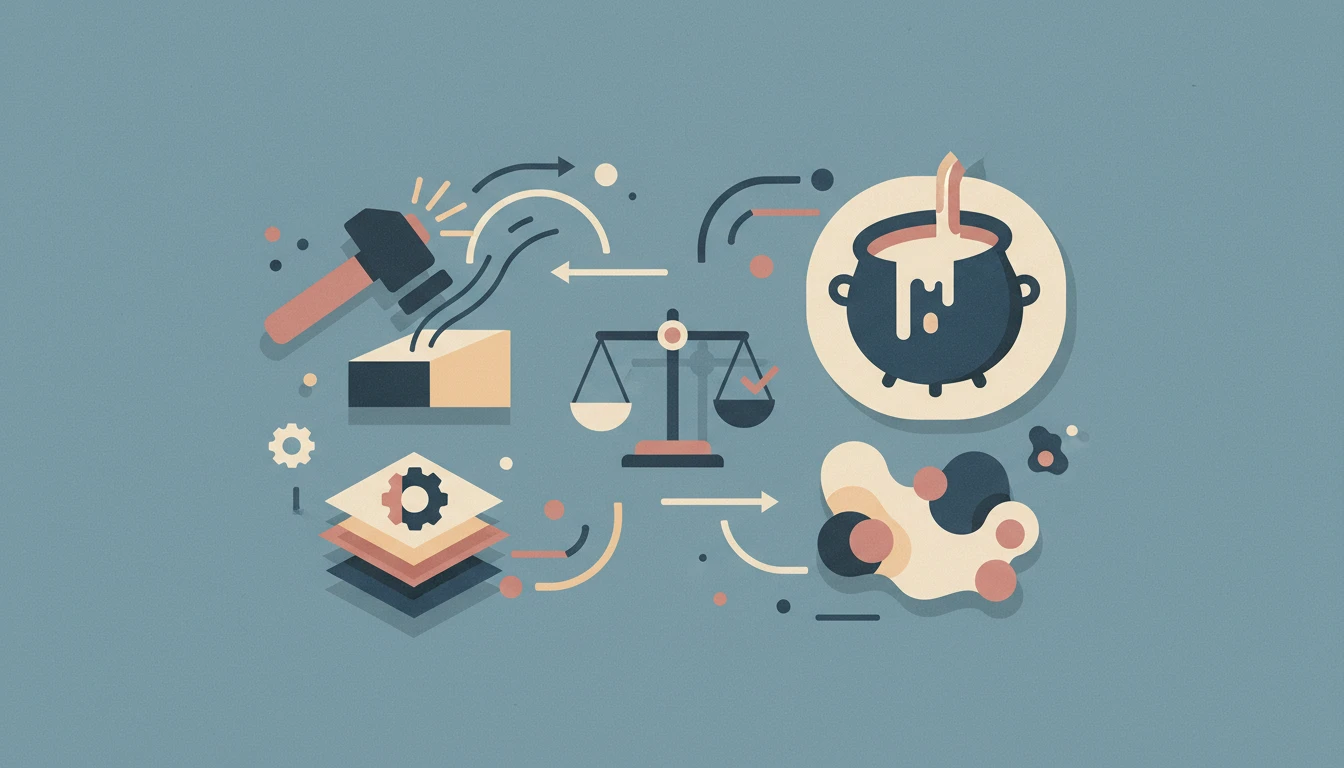
Choosing between forging and casting can make or break your manufacturing project, impacting everything from your budget to your product's performance in the field. Are you confident in your decision? Many Indian manufacturers struggle with selecting the right process due to a lack of clear, practical criteria. This often leads to spiraling costs, compromised product quality, or failure to meet stringent compliance standards, eroding profitability and market trust. This guide cuts through the confusion. By the end, you'll have a clear, actionable framework to decide when to use forging or casting based on critical factors like mechanical strength, cost dynamics, and specific application requirements within the Indian industrial landscape. We'll move beyond textbook definitions to deliver practical insights you can apply directly to your next project.
Understanding Forging and Casting: The Basics
To make an intelligent choice, you must first understand the fundamental nature of each metal forging process and casting method. These are not just different production steps; they are philosophies of shaping metal that yield profoundly different results.
What is Forging?
Forging is the art and science of shaping metal using localized compressive forces, typically delivered by a hammer or a die. Think of a blacksmith at an anvil,this is forging in its oldest form. Modern forging retains that core principle but with immense precision and power. The process works by plastically deforming the metal, meaning it changes shape without breaking. This deformation is the key to its magic.
The two primary categories are hot forging and cold forging. In hot forging, metal is heated to above its recrystallization temperature (often glowing red-hot for steel). This makes the material exceptionally malleable, allowing it to be shaped into complex forms with less force and reducing the risk of cracking. The most significant benefit, however, is what happens internally. The heat and deformation alter the metal grain structure, causing the grains to flow along the contours of the final shape. This creates a continuous grain flow (unlike the random, interrupted grain in castings) which dramatically enhances tensile strength, toughness, and fatigue resistance.
Cold forging, on the other hand, is performed at or near room temperature. It requires significantly higher forces but offers excellent dimensional accuracy and a superior surface finish. The process also increases the metal's strength through a phenomenon called work hardening or strain hardening. While it can't achieve the same level of grain refinement as hot forging for all materials, it is incredibly efficient for producing high-strength, high-volume components like fasteners and shafts with minimal material waste.
What is Casting?
Casting is fundamentally different. Instead of forcing solid metal into a new shape, casting involves pouring molten metal into a hollow mold cavity that holds the shape of the desired part. Once the metal solidifies, the mold is broken or opened to reveal the casting. This manufacturing process is one of humanity's oldest, used for thousands of years to create everything from bronze sculptures to iron tools.
Today, the two most prevalent casting methods are sand casting and investment casting. Sand casting uses a mold made from compacted sand. It's versatile, cost-effective for large or small parts, and can handle a wide range of metals and alloys, especially heavy ones like cast iron. The trade-off is a relatively rough surface finish and lower dimensional precision, often requiring significant machining.
Investment casting, also known as the lost-wax process, excels at producing complex shapes with minimal machining. A wax model of the part is created, coated in a ceramic slurry to form a mold, and then the wax is melted out. Molten metal is poured into this precise ceramic shell. This method can achieve exceptional detail, smooth surfaces, and complex internal geometries that would be impossible or prohibitively expensive to forge or machine. It's ideal for intricate components in industries like aerospace, defense, and medical devices.
These basic forging and casting processes are the bedrock of modern industry because they address different needs: forging for supreme strength and reliability, casting for unparalleled design complexity and volume efficiency.
Key Differences Between Forging and Casting
Choosing the right path requires a side-by-side comparison. Let's move beyond theory and examine the tangible differences that will directly impact your bottom line and product integrity.
Strength and Durability
This is where forging shines and demonstrates its core value proposition. The mechanical properties comparison between a forged and a cast part of the same material is stark, and it all comes down to internal structure.
- Forging improves grain flow. As the metal is deformed, its internal grain structure is compressed and stretched, aligning along the shape's stress lines. Imagine the grain like the wood grain in a sturdy baseball bat,continuous and aligned for maximum strength. This results in superior forging vs casting strength, particularly in fatigue resistance (the ability to withstand repeated loading and unloading).
- Casting creates an isotropic structure. When molten metal solidifies in a mold, grains grow randomly from the mold walls. This creates a uniform structure in all directions, but it can include tiny voids, porosity, and inclusions where material shrank or gases were trapped. These are inherent casting defects that act as stress concentration points, making the part more susceptible to crack initiation under cyclic loads.
Example from High-Stress Applications: Consider a truck's crankshaft or a connecting rod in a high-performance engine. These parts endure incredible, repetitive forces. A forged crankshaft, with its grain flow following the crank's contours, will last significantly longer and withstand higher stresses than a cast one. In applications where failure is not an option,such as in landing gear, power generation turbine shafts, or heavy-duty mining equipment,forging is the non-negotiable choice for enhanced safety and longevity.
Cost Analysis
The financial picture is nuanced. The myth that "casting is always cheaper" is just that,a myth. A true cost difference forging casting analysis must consider the entire product lifecycle, not just the initial piece price.
| Cost Factor | Forging | Casting (Sand) | Casting (Investment) |
|---|---|---|---|
| Tooling & Setup Cost | Very High. Dies are complex, hardened steel, and expensive to machine. | Low to Moderate. Sand molds are relatively cheap to produce. | Moderate to High. Wax patterns and ceramic shells require precision tooling. |
| Material Cost per Part | Lower waste. The process uses near-net-shape forming, minimizing scrap. | Higher waste. Includes the gating system and risers, which are cut off and remelted (reclaimable). | Highest waste. Includes the entire wax tree and ceramic shell, which are lost. |
| Labor & Skill Cost | High. Requires skilled operators and technicians for setup and process control. | Moderate. Less skilled labor is often sufficient for many sand casting operations. | High. Requires skilled labor for wax assembly, shell building, and precision finishing. |
| Post-Processing Cost | Low to Moderate. Often requires minimal machining due to good dimensional accuracy. | High. Typically requires significant machining to achieve final dimensions and finish. | Very Low. Known as a "net-shape" process, often requiring only critical surface finishing. |
| Long-Term Cost (Durability) | Low. Superior strength leads to longer service life, less downtime, and lower maintenance. | Higher. Potential for earlier failure or replacement, especially in high-stress environments. | Variable. Depends on application; excellent for complex parts but may not match forged strength. |
In the Indian Manufacturing Context: Labor costs for skilled forging operators are rising but still competitive globally. Energy costs for running massive forging presses or heating furnaces are a significant consideration. The key is volume. Forging's high initial die cost is amortized over thousands of parts, making it cost-effective for high-volume production (e.g., automotive components). For low-volume, highly complex parts, investment casting often wins despite higher per-part material cost, as it avoids the exorbitant cost of forging dies and complex machining.
When to Use Forging: Applications and Benefits
Forging is your go-to process when the primary design drivers are strength, structural integrity, and reliability. Its advantages are most pronounced in applications where component failure could lead to catastrophic results, expensive downtime, or safety hazards.
Automotive Industry
The Indian automotive sector, a cornerstone of the Make in India initiative, is a massive consumer of forged components. The push for safer, more efficient, and higher-performance vehicles directly aligns with forging's capabilities.
- Crankshafts and Connecting Rods: As mentioned, these are classic forged components. In vehicles made in India, from mass-market hatchbacks to heavy commercial trucks, forged versions offer enhanced safety and performance under the demanding Indian driving conditions,think potholed roads, heavy loads, and high ambient temperatures.
- Steering Knuckles, Gears, and Axle Beams: These are other critical safety components where the superior fatigue resistance of forging is non-negotiable. The grain flow follows the part's shape, creating a natural barrier against crack propagation from high cyclic stresses.
Aerospace Components
The aerospace sector represents the pinnacle of forging's application. Here, the advantages of forging are distilled to their absolute necessity.
- Critical Applications: Turbine disks (the rotating heart of a jet engine), landing gear components, and critical structural airframe parts are almost exclusively forged. The reason is simple: reliability under extreme conditions. These parts must withstand incredible centrifugal forces, temperature extremes, and variable stresses over thousands of flight cycles.
- Compliance with Standards: Forging provides the consistent, verifiable material properties needed to comply with the stringent, often life-critical, standards set by organizations like the Directorate General of Civil Aviation (DGCA) in India and international bodies like the FAA and EASA. The process's traceability and repeatability are as important as the strength it imparts.
When to use forging? Use it when your part is subject to high impact, high stress, cyclic loading, or operates in a critical safety environment. The long-term savings from reduced warranty claims, maintenance, and downtime will almost always justify the higher initial investment. Look to Indian manufacturing success stories in the tractor, power equipment, and defense sectors, where forging has enabled products to compete on a global stage for durability.
When to Use Casting: Applications and Benefits
Casting is the master of complex geometries and the champion of economy of scale. Its core benefit is the ability to create shapes that are otherwise impossible or prohibitively expensive to manufacture.
Complex Geometries
If your part has intricate internal passages, undercuts, thin walls, or highly detailed surfaces, casting is likely your best or only option.
- Engine Blocks and Cylinder Heads: The quintessential example. An internal combustion engine block is a maze of coolant jackets, oil galleries, and cylinder bores. Casting for complex shapes like this in a single piece is remarkably efficient. While high-performance variants may use special processes, the vast majority of engine blocks worldwide are sand-cast, typically in cast iron or aluminum.
- Decorative Elements and Architectural Hardware: From ornate lamp bases to intricate door handles, casting (especially investment casting) enables production with minimal post-processing. It can capture fine detail directly from a pattern, saving countless hours of manual finishing or machining.
Economy of Scale
For high-volume production runs, casting becomes incredibly cost-competitive. The economy of scale casting benefits are clear in India's bustling manufacturing hubs for consumer goods and infrastructure.
- Lower Per-Unit Costs: Once the pattern (for sand casting) or the mold (for die casting) is made, replicating parts is fast and requires less skilled labor per piece than forging. This makes it ideal for producing millions of identical components, such as housings for appliances, pump bodies, or municipal castings like manhole covers and valve bodies.
- Material Versatility: Casting can handle a wider range of materials that are difficult or impossible to forge. Brittle materials like cast iron, or materials with very high melting points, are typically shaped by casting. The Indian construction and heavy machinery sector heavily relies on large, robust cast iron components for bases, frames, and housings.
When to use casting? Choose casting when part geometry is highly complex, when material choice dictates it (e.g., gray iron), or when you need to produce very large volumes at the lowest possible per-part cost. It's dominant in sectors like general machinery, construction, consumer durables, and anywhere intricate design is a key product feature.
Decision-Making for Indian Manufacturing Context
The theoretical choice between forging and casting must be filtered through the realities of the Indian industrial ecosystem. Your decision factors must include local costs, standards, and supply chain dynamics.
Cost Considerations in India
A detailed cost comparison forging casting India must be grounded in local data.
- Labor: While less expensive than in Western nations, the cost gap between semi-skilled (common in casting) and highly skilled labor (required for forging) is widening. Factor in training and retention costs for forging specialists.
- Energy: Forging, especially hot forging, is energy-intensive. Electricity and furnace fuel costs in Indian industrial zones (like Pune, Chennai, or the NCR) are a major operational expense. Compare this with the lower thermal energy requirements of many casting processes.
- Materials: Domestic availability and price fluctuations for specific alloys (e.g., forging-grade vs. casting-grade steel or aluminum) can sway the decision. Relying on imported specialty materials adds cost and supply chain risk.
- Tooling: While forging dies are expensive everywhere, the cost of machining these dies domestically in India versus importing them can impact your initial CAPEX.
Quality and Regulatory Compliance
In India, quality and regulatory compliance are not just checkboxes but key market differentiators and legal requirements.
- Align with Indian Standards: For critical components, compliance with Bureau of Indian Standards (BIS) certifications is often mandatory for market acceptance. Forging processes, with their superior and consistent mechanical properties, can make achieving and proving compliance with standards like IS 1367 (for fasteners) or IS 2004 (for steel forgings) more straightforward.
- Supply Chain Dynamics: Consider the maturity of your local supply chain. Are there reliable, quality-certified forging houses or foundries nearby? Transportation costs and logistics for heavy semi-finished parts can erode cost advantages.
- Step-by-Step Decision Framework for Indian Manufacturers:
- Define the Critical-to-Quality (CTQ) Attributes: Is it ultimate tensile strength? Fatigue life? Geometric complexity? Part weight?
- Analyze Annual Volume & Project Lifecycle: High volume favors processes with lower variable costs (like casting or hot forging). Low volume or prototypes favor processes with lower tooling costs (like sand casting or open-die forging).
- Conduct a Total Cost of Ownership (TCO) Analysis: Include raw material, tooling, labor, energy, finishing, scrap rate, and estimated lifecycle (failure/replacement costs).
- Audit Local Supplier Capability: Visit potential suppliers. Check their certifications (ISO, IATF, BIS), equipment condition, and quality control labs.
- Prototype and Test: Whenever possible, create prototypes using both potential processes and subject them to real-world or simulated testing. Data trumps theory.
Common Myths and FAQs About Forging vs Casting
Let's clear up widespread misconceptions with data-driven facts.
Myth: Casting is Always Cheaper
This is perhaps the most persistent and dangerous myth. As our cost analysis table showed, casting has a lower initial tooling cost for sand casting, but this is not the whole story.
- Long-Term Economics of Forging: Consider a high-stress component like a gear for a heavy-duty transmission. A forged gear, while more expensive upfront, may last 2-3 times longer than a cast gear. When you factor in the cost of unplanned downtime, production losses, and replacement labor, the forging can be more economical long-term. For parts that are difficult or expensive to access and replace, the durability premium of forging pays for itself many times over.
- The High Cost of Failure: A casting defect like subsurface porosity may not be detected during initial inspection but can cause a catastrophic failure in the field, leading to warranty claims, brand damage, and potential liability,costs that dwarf any initial savings.
FAQ: Is Forging Stronger Than Casting?
The nuanced answer is: Yes, generally, for a given material, a forged part will have superior mechanical properties compared to a cast part. However, the magnitude of the difference and its importance depend entirely on the application and material treatment.
- It depends on the application. For a decorative garden fence bracket, the strength advantage of forging is irrelevant; the lower cost of casting makes it the obvious choice. For a connecting rod in a racing engine, the forging's superior fatigue strength is the only choice.
- It depends on material treatment. Advanced casting techniques (like vacuum investment casting) and subsequent heat treatments (like Hot Isostatic Pressing - HIP) can dramatically improve the integrity and strength of castings, closing the gap for some applications. However, they add significant cost.
Other Common FAQs:
-
Q: Can you achieve the same shapes with forging as with casting?
A: Generally, no. Forging is limited by the need to remove the part from the die. Undercuts and enclosed hollows are impossible in closed-die forging. Casting can produce virtually any shape the mold can form. -
Q: Which process has a shorter lead time?
A: For one-off or small batches, sand casting often wins due to quick pattern creation. For large production runs, once tooling is ready, both processes can be very fast, though die casting (a type of casting) is among the fastest for high-volume metal parts. -
Q: Is 3D printing replacing forging or casting?
A: Not directly. 3D printing (Additive Manufacturing) is excellent for prototypes, complex tooling (like conformal cooling channels in casting molds), and low-volume, highly complex parts. For mass production of metallic components, traditional forging and casting remain far more cost-effective and faster. -
Q: How do I prevent common casting defects?
A: Casting defects prevention methods start with proper design (uniform wall thickness, adequate fillets). Control of the molten metal (temperature, chemistry), mold design (correct gating and risering), and the solidification process are critical. Working with an experienced foundry is the best prevention. -
Q: Is "forged" just a marketing term for tools?
A: No. Forged wrenches or sockets are genuinely stronger. The forging process aligns the grain structure along the tool's profile, making it much more resistant to spreading, snapping, or deforming under high torque compared to a cast or even a machined-from-bar equivalent.
Conclusion
The choice between forging and casting is a fundamental strategic decision in manufacturing. It hinges on a clear-eyed evaluation of your product's non-negotiable requirements,be it the supreme strength and durability of forging for critical, high-stress components, or the design freedom and volume efficiency of casting for complex shapes. For Indian manufacturers, this decision must be further refined by local cost considerations, regulatory compliance with standards like BIS, and the realities of the domestic supply chain.
The key takeaway: There is no universal "best" process. Use the frameworks in this guide to make an informed, optimized decision. Start by defining what "quality" means for your specific part, run a thorough Total Cost of Ownership analysis, and partner with capable, certified suppliers. By doing so, you'll build products that are not only cost-competitive but also robust, reliable, and ready to succeed in the Indian market and beyond.
Written with LLaMaRush ❤️