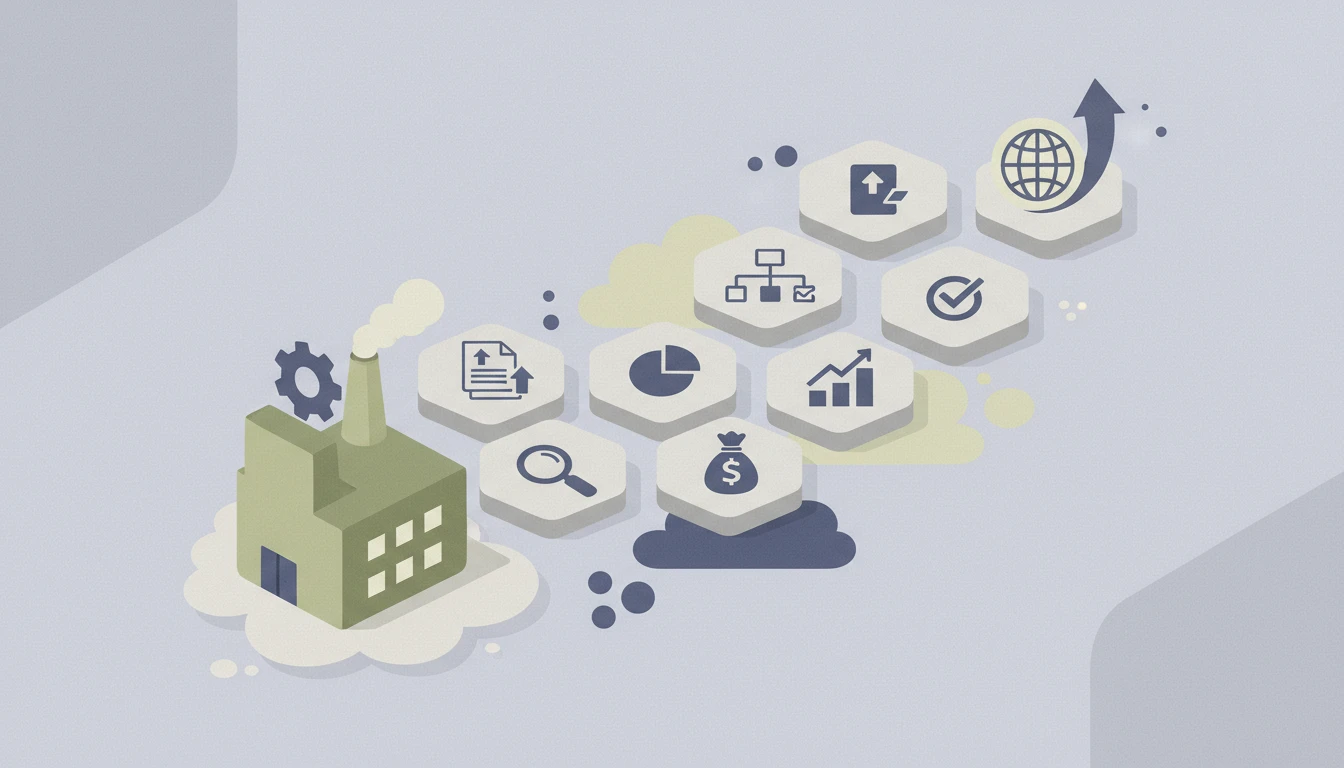
Every year, countless manufacturing projects fail, not for lack of ambition, but due to inadequate planning and unseen risks. These failures lead to millions in wasted capital, squandered time, and missed market opportunities. The single most powerful tool to prevent this outcome is a rigorous, well-structured feasibility study. This guide addresses the core problem of high failure rates and project inefficiencies by providing a comprehensive, step-by-step framework for conducting feasibility studies tailored specifically to the complex world of manufacturing. By the end, you will learn how to systematically evaluate your project’s viability, from initial market analysis to final reporting, ensuring you make informed, data-driven decisions that dramatically increase your chances of success.
What is a Feasibility Study in Manufacturing?
At its heart, a feasibility study is a systematic analysis used to determine the viability of a proposed project or initiative. In a manufacturing context, this goes far beyond a simple financial calculation. It is a multi-disciplinary diagnostic tool that asks and answers the critical question: "Can this manufacturing project be successful, and should we proceed?"
Its core purpose is to provide an objective foundation for decision-making, reducing emotional investment and gut-feel guesses. For manufacturers, this isn't a luxury; it's a necessity. A 2023 industry report by the National Association of Manufacturers indicated that projects initiated without a formal feasibility study were over 50% more likely to exceed budget or fail to meet operational targets.
Core Concepts
A manufacturing feasibility study is built on three foundational pillars: objectives, scope, and analysis.
- Objectives: Clearly define what "success" looks like. Is it launching a new product line, increasing production capacity by 30%, automating a manual assembly process, or relocating a factory? The objectives must be SMART: Specific, Measurable, Achievable, Relevant, and Time-bound.
- Scope: This establishes the boundaries of the study. It details what will be assessed (e.g., specific production lines, machinery, or product variants) and, just as importantly, what will not be considered. A well-defined scope prevents "scope creep," where the analysis becomes unwieldy and unfocused.
- Analysis: This is the investigative engine. It involves gathering and evaluating data across multiple dimensions,market, technical, financial, legal, and operational,to test the project against the stated objectives within the defined scope.
The ultimate deliverable is a comprehensive report that presents facts, forecasts, and risk assessments, culminating in a clear "go," "no-go," or "go, but with major changes" recommendation.
Why Manufacturing Needs Special Attention
Manufacturing projects are uniquely complex, demanding a specialized feasibility assessment. Unlike launching a software service or opening a retail store, manufacturing involves tangible, interconnected systems with high inertia and capital commitment.
- Supply Chain Complexities: Your feasibility is only as strong as your weakest supplier link. The study must assess raw material availability, supplier reliability, logistics costs, and geopolitical risks. A bottleneck in semiconductor chips can halt an entire automotive assembly line.
- Technological & Capital Intensity: The choice of technology,be it CNC machining, injection molding, or additive manufacturing,has decades-long implications for quality, cost, and flexibility. Evaluating machinery costs, integration with existing systems, maintenance needs, and the pace of technological obsolescence is critical.
- Regulatory and Environmental Hurdles: Manufacturing is heavily regulated. A study must factor in environmental permits (EPA), workplace safety standards (OSHA), product certifications (UL, CE), and international trade regulations. Overlooking a single permit can delay a project by months.
- Fixed Operational Costs: The economics are dominated by high fixed costs: facility leases, machinery depreciation, and skilled labor. The feasibility study must accurately determine the break-even point and how sensitive it is to production volume fluctuations.
Conducting a thorough feasibility study in manufacturing is the most effective way to reduce investment risks and optimize resource allocation. It transforms uncertainty into managed risk, guiding you to commit resources only to projects with a clear, evidence-based path to profitability.
The 7-Step Process to Conduct a Feasibility Study
A robust manufacturing feasibility study isn't a linear checklist but an iterative, interconnected process. Each step informs the others, and findings in one area may require you to revisit a previous assumption. This methodology provides a structured framework from conception to final decision.
Step 1: Market Analysis and Demand Assessment
This is your reality check. Before investing in machinery, you must know if anyone will buy what you produce.
* Research Market Trends: Analyze industry reports, economic indicators, and technological shifts. Is the market for electric vehicle batteries growing at 15% annually? Is consumer demand shifting towards sustainable packaging?
* Understand Customer Needs: Conduct surveys, interviews, or focus groups. What specifications do your target customers require? What price point are they willing to pay? For a B2B component, this means deep engagement with potential client engineering teams.
* Map the Competitive Landscape: Identify direct and indirect competitors. Analyze their strengths, weaknesses, pricing, market share, and distribution channels. Use a SWOT analysis (Strengths, Weaknesses, Opportunities, Threats) to position your proposed project.
* Forecast Demand: Based on your research, create a realistic, data-backed sales forecast for Years 1-5. Be conservative. It's better to be pleasantly surprised than catastrophically overextended.
Step 2: Technical Feasibility Assessment
Can you physically build it? This step translates the market opportunity into a production plan.
* Evaluate Technology: Determine the best manufacturing process. Is high-volume injection molding suitable, or is low-volume 3D printing more viable? What are the tolerances, material options, and production speeds?
* Specify Equipment & Space: List all required machinery, tools, and auxiliary equipment. Determine the factory floor layout, required utilities (3-phase power, compressed air, water), and warehouse space. Obtain quotes from multiple equipment vendors.
* Assess Production Capabilities: Can your proposed system achieve the desired quality and output rate? Consider prototyping and pilot run requirements. Do you have, or can you hire, the technical expertise to operate and maintain this technology?
Step 3: Economic and Financial Analysis
This is the bottom-line truth. It quantifies the opportunity in financial terms.
* Detailed Costing: Calculate all capital expenditures (CapEx: machinery, facility build-out) and operational expenditures (OpEx: raw materials, labor, utilities, maintenance). A common pitfall is underestimating installation, training, and initial spare parts costs.
* Revenue Modeling: Project your income based on the demand forecast and pricing strategy.
* Conduct Cost-Benefit Analysis & ROI Calculations: Build a financial model, typically a 5-year pro forma P&L statement. Calculate key metrics:
* Net Present Value (NPV): The project's value in today's dollars.
* Internal Rate of Return (IRR): The project's annualized effective compounded return rate.
* Payback Period: How long until the initial investment is recovered.
* Determine Funding Requirements: How much capital is needed, and from what sources (equity, loans, grants)?
Step 4: Legal and Regulatory Compliance
Ignorance of the law is no excuse and can be financially fatal.
* Review Laws and Permits: Identify all necessary business licenses, factory operation permits, and zoning approvals.
* Environmental Regulations: Assess waste disposal (hazardous/non-hazardous), emissions controls, and environmental impact statements required by agencies like the EPA.
* Product & Safety Standards: Ensure the planned product will meet all relevant safety, quality, and performance standards (e.g., ISO 9001, industry-specific certifications).
* Labor Laws: Understand regulations related to wages, hours, safety (OSHA), and unionization, if applicable.
Step 5: Operational and Scheduling Feasibility
This step tests the project plan in the dimension of time and resources.
* Develop a Master Timeline: Create a detailed Gantt chart from concept to full-scale production. Include milestones for design, procurement, installation, testing, and ramp-up.
* Plan Resource Allocation: Do you have the human resources? Detail the organizational structure, required skill sets, hiring plan, and training schedule.
* Workflow Logistics: Map the material flow through the plant. Identify potential bottlenecks in receiving, production, quality control, and shipping. Plan for inventory management of raw materials and finished goods.
Step 6: Risk Identification and Mitigation
What could go wrong? A proactive hunt for risks is essential.
* Identify Potential Risks: Brainstorm risks across all categories using a framework like PESTLE (Political, Economic, Social, Technological, Legal, Environmental). Examples: key supplier failure, technological disruption, regulatory change, skilled labor shortage, natural disasters.
* Analyze Probability and Impact: Use a Risk Matrix to plot each identified risk based on its likelihood of occurring and its potential impact on the project.
* Develop Mitigation Strategies: For each high-probability/high-impact risk, create a contingency plan. For a critical single-source supplier, a mitigation strategy might be to qualify a backup supplier during the pilot phase.
Step 7: Final Reporting and Decision-Making
Synthesize everything into a compelling, honest report.
* Compile the Comprehensive Report: The report should have an executive summary, detailed findings from each step, supporting data, and clear conclusions.
* Present Findings and Recommendations: The final section must state a definitive recommendation: Go, No-Go, or Go with Major Changes (e.g., "Proceed only if an alternative technology with 20% lower CapEx is identified").
* Make the Decision: This report is the primary document for stakeholders, executives, or investors to make the final, informed investment decision.
Key Components of a Manufacturing Feasibility Study
While the 7-step process is your roadmap, these three components form the core analytical engine of any manufacturing feasibility study. Integrating them provides a holistic view of project viability.
Technical Assessment
This component evaluates the "how" of production. It's not just about buying machines; it's about ensuring they create a capable, efficient, and sustainable production system.
* Methods for Evaluation: Start with Process Flow Diagrams to visualize every step from raw material to shipped product. Use Capacity Analysis to calculate the maximum output of each machine and the overall system bottleneck. Conduct Failure Mode and Effects Analysis (FMEA) on proposed equipment to anticipate potential points of failure.
* Real-World Scenario: A company wants to manufacture carbon fiber bicycle frames. The technical assessment must compare the feasibility of traditional lay-up + autoclave curing versus automated fiber placement. It would analyze the capital cost, cycle time per frame, required skill level of operators, consistency of quality, and scalability of each method.
Cost-Benefit Analysis
This is the financial translation of your technical and market plans. A robust framework is crucial.
* Framework for Calculation:
1. Identify All Costs: Categorize as Direct (raw materials, direct labor) and Indirect (supervision, utilities, depreciation). Include one-time CapEx and recurring OpEx.
2. Quantify All Benefits: Primarily revenue from sales, but also include tangible benefits like reduced waste, lower labor costs via automation, or tax incentives.
3. Perform the Analysis: Calculate Total Costs and Total Benefits over the project's life. The simplest metric is the Benefit-Cost Ratio (BCR). A BCR > 1.0 indicates the benefits outweigh the costs.
4. Model Scenarios: Run "what-if" analyses (sensitivity analysis). What if raw material costs rise by 15%? What if sales volume is only 80% of forecast? This shows the project's financial resilience.
Legal and Environmental Considerations
These are non-negotiable gatekeepers. A project can be technically and financially sound but illegal or unsustainable.
* Compliance Checks: Create a regulatory checklist. For a food packaging plant, this includes FDA food-contact material regulations, local health department permits, and fire safety codes for your facility.
* Sustainability Factors: Modern feasibility studies must evaluate environmental impact. This involves assessing carbon footprint, energy consumption (and opportunities for renewables), water usage, recyclability of waste, and alignment with ESG (Environmental, Social, and Governance) principles, which are increasingly important to investors and consumers.
Tools, Templates, and Best Practices
Leveraging the right resources can turn a daunting study into a manageable, even streamlined, process.
Digital Tools for Analysis
| Tool Category | Specific Software | Primary Use in Feasibility Study | Best For |
|---|---|---|---|
| Financial Modeling | Microsoft Excel, Google Sheets | Building pro forma statements, ROI, NPV/IRR calculations, sensitivity analysis. | The universal foundation for all financial analysis. Pivot tables and scenario manager are invaluable. |
| Project Management | Smartsheet, Microsoft Project, Asana | Creating Gantt charts for the project timeline, managing tasks and resources for the study itself. | Visualizing the master schedule and dependencies for Step 5 (Operational Feasibility). |
| Data Visualization | Tableau, Power BI | Analyzing and presenting market research data, competitive analysis, and operational metrics. | Turning raw data from Step 1 (Market Analysis) into compelling, actionable charts. |
| Specialized Manufacturing | AutoCAD, SolidWorks (for layout), Arena/SIMUL8 (for simulation) | Designing factory floor plans, simulating production flow to identify bottlenecks. | Conducting a deep technical assessment (Step 2) by digitally testing the production system. |
| Risk Management | Risk Cloud, Simple Risk Registers in Excel | Documenting risks, assigning probability/impact, tracking mitigation actions. | Systematically managing the risk identification and mitigation process in Step 6. |
Downloadable Templates
Using a structured template ensures completeness and consistency. Look for or adapt templates that include:
* Project Charter & Scope Definition: A one-page document to crystallize objectives and boundaries.
* Capital Expenditure (CapEx) Cost Sheet: A detailed list for all machinery, tooling, and facility costs.
* Operational Expenditure (OpEx) Forecast: A monthly or annual breakdown of all running costs.
* 5-Year Pro Forma Financial Statement: Integrated income statement, cash flow, and balance sheet projections.
* Risk Assessment Matrix: A simple grid to plot and prioritize risks.
* Feasibility Study Report Outline: A standard structure for the final deliverable.
Best Practice Tip: Always validate your financial model by having a colleague or mentor "stress-test" it. Ask them to challenge your assumptions on sales volume, pricing, and major cost items. This peer review is one of the most effective ways to improve accuracy.
Common Pitfalls and How to Avoid Them
Even with a good process, biases and oversights can creep in. Being aware of these common traps is your first defense.
Overlooking Hidden Costs
The Pitfall: The budget accounts for the sticker price of a CNC machine but forgets the cost of rigging, installation, electrical upgrades, operator training, initial tooling, and a maintenance contract. These "hidden" costs can easily add 25-50% to your initial CapEx estimate.
How to Avoid It:
1. Use Detailed Checklists: Employ comprehensive CapEx and OpEx templates that prompt you to consider every category.
2. Consult with Experts: During vendor negotiations, ask "What is the total installed and operational cost?" Speak with facility managers about utility requirements.
3. Include a Contingency Buffer: Always add a line item for contingency,typically 10-20% of total project cost,to cover unforeseen expenses.
Underestimating Risks
The Pitfall: The study identifies obvious risks like market competition but misses a critical dependency on a single sub-component supplier located in a geopolitically unstable region.
How to Avoid It:
1. Structured Brainstorming: Conduct formal risk identification sessions with a cross-functional team (engineering, supply chain, finance, sales). Use the PESTLE framework to ensure all angles are covered.
2. Quantify, Don't Qualify: Move beyond "high/medium/low." Assign numerical probabilities and financial impacts. This forces more rigorous thinking.
3. Develop "Trigger-Based" Action Plans: For key risks, don't just have a plan; define the specific trigger that will activate it. For example, "If Supplier A's lead time extends beyond 8 weeks for two consecutive months, we will activate our agreement with Backup Supplier B."
Other critical mistakes include confirmation bias (seeking only data that supports your desired outcome) and overly optimistic timelines. Combat these by appointing a "devil's advocate" in the review process and by adding buffer time to every major phase of your project schedule.
Conclusion
A well-executed feasibility study is not a barrier to progress; it is the blueprint for success. In the capital-intensive, complex world of manufacturing, it is the essential process for ensuring project viability, systematically reducing risks, and maximizing return on investment. It transforms uncertainty into a managed plan, guiding you to commit resources only to opportunities with a clear, evidence-based path forward. By following the structured 7-step process,from validating market demand to preparing for potential pitfalls,you equip yourself to make decisions not with hope, but with confidence.
Frequently Asked Questions (FAQ)
1. How long does a typical manufacturing feasibility study take?
The timeline varies dramatically with project scope. A study for a minor process upgrade might take 2-4 weeks. For a major new product line or greenfield factory, a comprehensive study can take 3-6 months of dedicated work. The key is to allocate enough time for proper data collection and analysis; rushing this phase is a major risk.
2. What's the difference between a feasibility study and a business plan?
A feasibility study asks "Can we and should we do this?" It is an investigative, analytical tool to support a go/no-go decision. A business plan asks "How will we do this and succeed?" It is a detailed execution roadmap created after the decision to proceed, covering marketing, sales, operations, and management strategy in depth. The feasibility study feeds into the business plan.
3. Who should be involved in conducting the study?
A cross-functional team is crucial. It should include representatives from: Engineering/Operations (technical feasibility), Finance (economic analysis), Sales/Marketing (market assessment), Supply Chain/Procurement, and Legal/Compliance. A project manager should orchestrate the entire effort.
4. How much does a feasibility study cost?
Costs can range from a few thousand dollars for an internal analysis of a small project to hundreds of thousands for a large, complex project requiring extensive external consulting, market research, and engineering studies. View this cost as an insurance premium against a multi-million dollar failed investment.
5. What if my feasibility study results in a "No-Go" recommendation?
A "no-go" is a successful outcome, not a failure. It means the study prevented you from wasting significant capital, time, and resources on a project that was destined to underperform or fail. It allows you to redirect those resources to more viable opportunities, making it one of the most valuable conclusions a study can provide.
Written with LLaMaRush ❤️