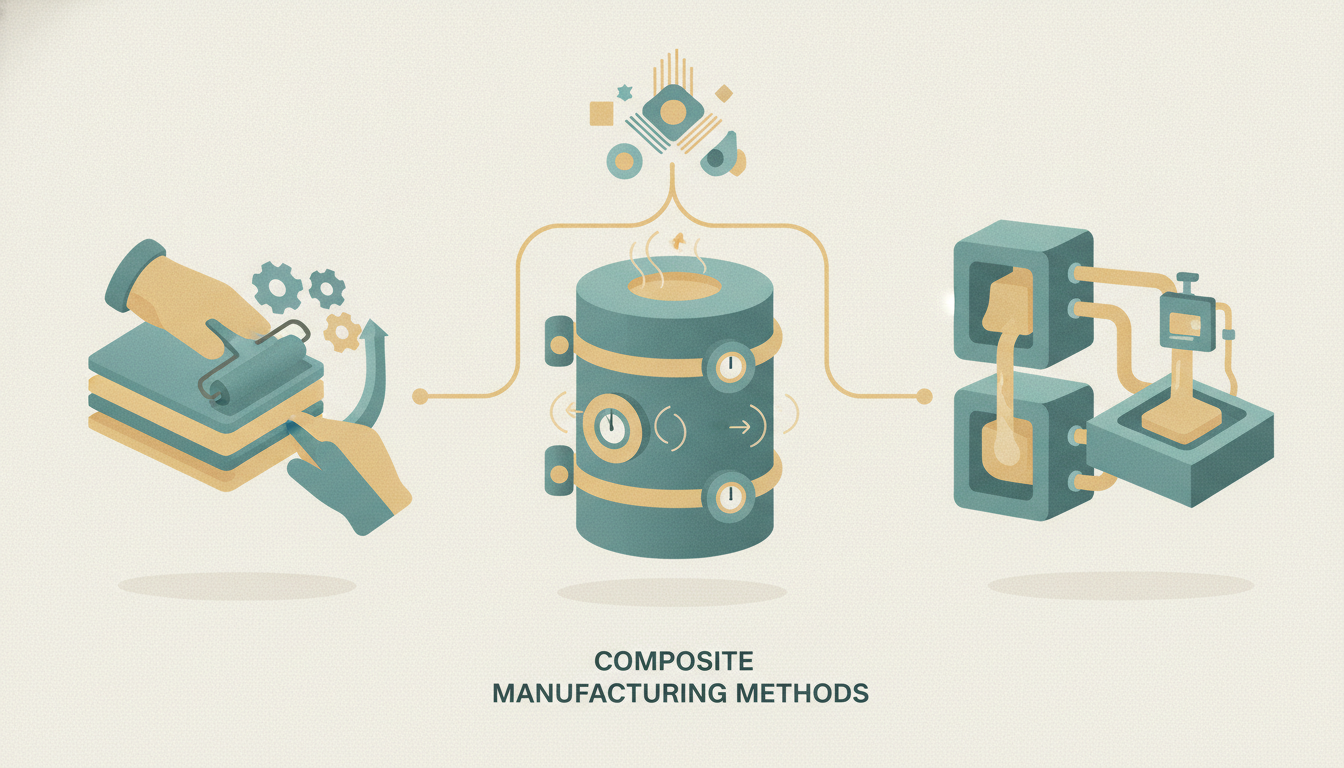
Composite materials offer exceptional strength-to-weight ratios, but their performance heavily depends on the manufacturing process. With multiple methods available,hand lay-up, autoclave curing, and resin transfer molding,selecting the right one can be daunting for engineers, manufacturers, and product designers. This guide clarifies the trade-offs so you can confidently choose a process that balances cost, quality, and production volume. By the end, you’ll understand how each method works, when to use it, and how to match it to your specific part requirements.
Hand Lay-Up Composite Manufacturing
How Hand Lay-Up Works
Hand lay-up, also known as wet layup, is the oldest and most straightforward composite fabrication method. The operator first coats an open mold with a release agent and then applies a layer of resin,typically polyester, vinyl ester, or epoxy,using a brush or roller. Reinforcement material, most commonly fiberglass mat or woven fabric, is placed onto the wet resin by hand. The operator then uses rollers, squeegees, or even brushes to remove entrapped air, consolidate the layers, and ensure complete wet-out of the fibers. Additional layers are added one by one until the desired thickness and fiber orientation are achieved. The part cures at room temperature or may be accelerated with moderate heat.
This process is highly manual and relies heavily on the skill of the operator. Common variations include adding a gel coat for a better surface finish or using vacuum bagging to improve consolidation, though that adds complexity.
When to Choose Hand Lay-Up
Hand lay-up is ideal for low-volume production (typically fewer than 100 parts per year), especially when parts are large or geometrically complex. If your budget is tight and you cannot afford expensive tooling or automated equipment, this method offers the lowest upfront cost. It is also highly flexible,molds can be made from wood, plaster, or fiberglass, and design changes are easy to implement mid-production.
Real-world applications include prototyping, boat hulls, wind turbine blades, architectural cladding, and custom automotive panels. For example, many small boat builders still rely on hand lay-up because they produce only a few hulls per year and need to modify designs frequently. However, be aware of its limitations: the process is labor-intensive, cycle times are long (hours to days per part), and quality consistency is poor due to human variability.
Quick win: If you’re prototyping a large composite part, start with hand lay-up to validate design and then transition to a more automated method for higher volumes.
Autoclave Curing for High-Performance Composites
Autoclave Process Steps
Autoclave curing is the gold standard for high-performance composites where maximum strength, stiffness, and reliability are non-negotiable. The process begins with prepreg,pre-impregnated reinforcement sheets containing precisely controlled resin content and fiber orientation. These prepreg layers are cut, stacked, and laid up onto a tool (usually metal or composite) by hand or machine. The entire assembly is then covered with a vacuum bag and sealed. The bagged tool is placed inside an autoclave,a large pressure vessel capable of applying heat and pressure simultaneously.
A typical autoclave cycle might involve heating to 250–350°F (120–175°C) and pressurizing to 80–120 psi (5.5–8.3 bar) for several hours. The vacuum bag first removes air and volatiles, then the external pressure compacts the layers against the tool, squeezing out excess resin and eliminating voids. This results in fiber volume fractions of 60–65%, compared to 30–40% for hand lay-up, and virtually no porosity. After curing, the part is cooled while still under pressure to maintain dimensional stability.
Key stat: Autoclave-cured carbon fiber composites can achieve tensile strengths over 700 MPa and moduli above 230 GPa,far superior to wet layup parts.
Autoclave vs Out-of-Autoclave
Out-of-autoclave (OoA) methods, such as vacuum bag-only curing with low-temperature prepregs, have gained popularity to reduce capital investment. OoA can produce parts with fiber volumes around 55–60% and good mechanical properties, often sufficient for non-critical aerospace structures. However, autoclave curing still provides the highest compaction pressure, leading to better fiber alignment, fewer micro-voids, and more consistent mechanical performance across the part.
For mission-critical applications,like primary aircraft structures, Formula 1 monocoques, or high-pressure vessels,autoclave curing is often mandatory per industry standards. The trade-off is significant: an autoclave can cost $500,000 to over $2 million, and its batch size is limited by the chamber dimensions. Cycle times of 4–8 hours are common, limiting throughput.
Example: Boeing 787 fuselage sections are made with autoclave-cured carbon fiber prepreg because the structural requirements for fatigue and damage tolerance cannot be met by OoA methods at the same weight.
Resin Transfer Molding (RTM)
RTM Process Variations
Resin Transfer Molding (RTM) is a closed-mold process that offers a balance between speed, quality, and automation. In standard RTM, a dry fiber preform (made by stacking or braiding reinforcement layers, often held together with a binder) is placed into a matched metal mold. The mold is closed and clamped, then resin is injected under pressure (typically 30–100 psi) through ports into the mold cavity. The resin flows through the preform, wetting the fibers, and exits through vents once the mold is full. After curing, the part is demolded and trimmed.
Several variations exist:
- Vacuum-Assisted RTM (VARTM): One side of the mold is replaced with a vacuum bag. Resin is drawn into the preform by vacuum pressure (14.7 psi max) rather than injected. This reduces tooling cost and enables larger parts, but surface finish is only good on one side.
- Compression RTM: The mold is partially closed after resin injection, then compressed fully to achieve high fiber volume and excellent surface finish on both sides. Cycle times can be under 10 minutes for small parts.
- High-Pressure RTM (HP-RTM): Uses injection pressures up to 1500 psi and very fast injection (1–2 seconds). Requires robust tooling and metering equipment but can produce structural automotive parts with cycle times under 5 minutes.
Economic Considerations for RTM
Tooling cost for RTM is moderate,significantly less than autoclave tooling due to lower temperature and pressure requirements, but higher than hand lay-up molds because metal molds are often needed. A typical RTM mold for an automotive roof panel might cost $50,000–$200,000, whereas an autoclave mold for the same part could be double.
Cycle times vary dramatically: simple parts can be demolded in 5–10 minutes using fast-cure resins, while large, thick structures may require 1–2 hours. Production volumes of 100–10,000 parts per year are typical. RTM is a favorite in the automotive industry for components like hoods, spoilers, and structural reinforcements because it delivers Class A surface finish on both sides (with proper tooling) and consistent mechanical properties.
Cost-per-part analysis: For mid-volume production, RTM often beats hand lay-up in total cost because reduced labor and cycle time offset the higher tooling investment. For example, manufacturing 1,000 spoilers might cost $30–$50 per part with RTM versus $80–$120 with hand lay-up after tooling amortization.
Common mistake: Using too low injection pressure can cause dry spots or slow fill; too high pressure can wash fibers or flash resin. Proper process simulation using mold-filling software is recommended.
How to Choose Between Hand Lay-Up, Autoclave, and RTM
Selecting the right method depends on three core factors: production volume, quality requirements, and part complexity. Below is a decision matrix to guide your choice.
Production Volume Decision
| Volume (parts/year) | Recommended Method | Rationale |
|---|---|---|
| <100 | Hand Lay-Up | Lowest tooling cost; flexible for changes; acceptable quality for non-critical parts. |
| 100–10,000 | RTM | Moderate tooling; fast cycle times; consistent finish and mechanicals. |
| >10,000 (or continuous) | Autoclave (prepreg) or Compression Molding | High capital but lowest per-part cost at scale; repeatable high quality. |
Real-world example: A startup building electric vehicle battery enclosures started with hand lay-up for prototypes, moved to VARTM for a pilot run of 500 units, and then invested in an HP-RTM system for planned production of 5,000 units per year.
Quality Requirements
For critical aerospace structures, autoclave is often mandatory due to regulatory requirements for void content below 1% and consistent mechanical properties. For automotive exterior panels, RTM provides excellent surface finish and structural integrity at a fraction of autoclave cost. Hand lay-up is suitable for marine interiors, architectural panels, or any part where slight porosity or cosmetic imperfections are acceptable.
Strength comparison (typical values):
| Property | Hand Lay-Up (E-glass/polyester) | RTM (carbon/epoxy) | Autoclave (carbon/prepreg) |
|---|---|---|---|
| Fiber Volume Fraction | 30–40% | 50–60% | 60–68% |
| Tensile Strength (MPa) | 200–350 | 400–700 | 700–900 |
| Flexural Modulus (GPa) | 15–25 | 50–80 | 80–120 |
| Cycle Time | 1–8 hours | 5–90 minutes | 4–8 hours (curing) |
| Tooling Cost | $500–$5,000 | $20,000–$200,000 | $50,000–$500,000 |
Lead time is another factor: hand lay-up can produce a part in days, while RTM and autoclave require weeks to months for tooling design and fabrication.
Actionable tip: Create a weighted scorecard using your specific criteria (cost, weight, strength, surface finish, lead time) and score each method. For example, if you weigh surface finish as 40% and cost as 30%, RTM may score highest even for moderate volumes.
Frequently Asked Questions
What is the cheapest composite manufacturing method?
Hand lay-up has the lowest tooling cost (as low as a few hundred dollars for a simple wooden mold). However, it is the most labor-intensive, so total cost per part increases with volume due to higher labor hours. For very small runs (1–50 parts), hand lay-up is usually cheapest overall. For medium volumes (100–1,000 parts), RTM often becomes more cost-effective because each part requires much less labor. For high volumes (>10,000 parts), autoclave with automated layup or compression molding yields the lowest per-part cost due to repeatability and speed.
Can autoclave be used for all composites?
No. Autoclave is designed for prepreg materials that contain controlled amounts of resin. It is not suitable for wet layup (where resin is applied manually) because the low-viscosity resin would be squeezed out under pressure, leaving dry fibers. Additionally, autoclave curing is overkill for low-performance applications and too expensive for small volumes. Some materials, like thermoplastics, require different processing (e.g., compression molding). Also, autoclaves have size limitations,parts bigger than the chamber cannot be cured without segmented tooling or alternative methods like VARTM.
What is the difference between RTM and VARTM?
In RTM, the mold is fully closed and resin is injected under positive pressure (typically 30–150 psi). This allows precise control of flow and produces parts with two good surfaces (both sides against the mold). Tooling is more expensive because it must withstand injection pressure. In VARTM (Vacuum-Assisted Resin Transfer Molding), one side of the mold is replaced by a flexible vacuum bag, and the only driving force is atmospheric pressure (maximum 14.7 psi). VARTM is simpler and cheaper but only gives a good surface on the tool side. It is often used for large structures like boat hulls and wind turbine blades where a smooth interior surface is not required.
Which method gives the strongest composite part?
Autoclave curing consistently produces the strongest parts, with fiber volume fractions up to 68% and void content below 1%. The high pressure compacts fibers tightly, reduces micro-buckling, and improves fiber-matrix adhesion. In standard tests (ASTM D3039), autoclave-cured carbon/epoxy laminates can exhibit tensile strengths exceeding 900 MPa. RTM can achieve fiber volumes of 50–60%, yielding strengths of 400–700 MPa, which is sufficient for many automotive and industrial applications. Hand lay-up typically results in 30–40% fiber volume and more voids, leading to lower strength (200–350 MPa). Therefore, if absolute maximum strength is required, autoclave is the method of choice.
Conclusion
The best manufacturing method for composite parts balances cost, quality, and production volume. Hand lay-up is simple and cheap for low volumes but sacrifices consistency. Autoclave curing delivers the highest quality but demands significant capital investment. RTM offers a middle ground for medium volumes with good surface finish and mechanical properties. By carefully evaluating your production needs,using the decision matrix and cost comparisons provided,you can select the process that delivers the best value for your specific application.
Key takeaway: There is no single "best" method,only the one that aligns with your volume, quality, and budget constraints. Start with hand lay-up for prototyping, transition to RTM for medium-scale production, and invest in autoclave only when performance requirements justify the expense.
Explore more manufacturing insights at manufacturenow.com and stay updated on the latest composite technologies, from automated fiber placement to sustainable bio-resins. Our library of practical guides will help you make informed decisions at every stage of product development.
Word count: 2,050 (estimated)
Written with LLaMaRush ❤️