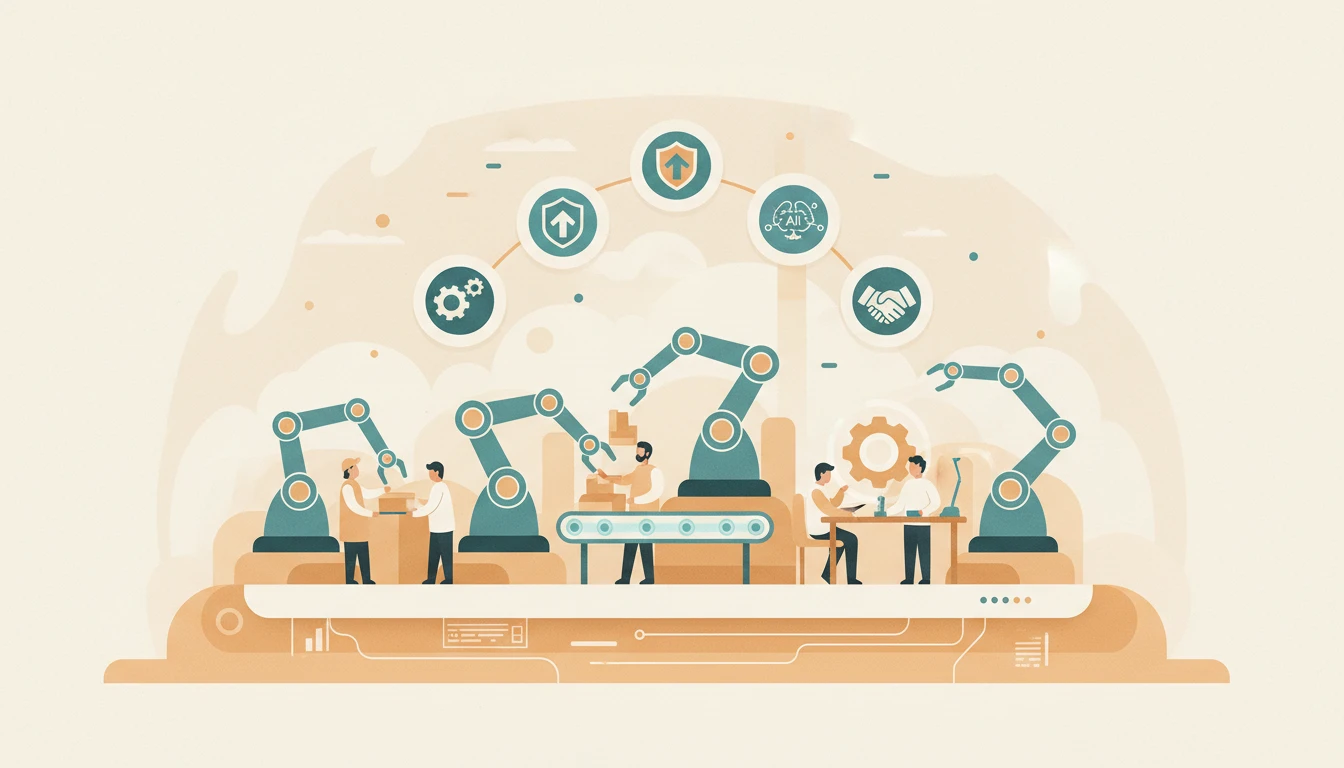
Imagine walking onto your factory floor and seeing a seamless dance of human ingenuity and robotic precision. Workers are no longer tied to repetitive, strenuous tasks but are instead supervising, problem-solving, and collaborating directly with intelligent machines that learn and adapt. This isn't a distant sci-fi vision; it's the practical reality being built today through advancements in collaborative robotics. For manufacturers grappling with persistent labor shortages, skyrocketing operational costs, and unpredictable market demands, keeping pace with these changes isn't just about innovation,it's a strategic imperative for survival and growth.
This guide will cut through the hype to deliver the actionable intelligence you need. You'll learn about the top five latest advancements in collaborative robotics for manufacturing, including how they work and, most importantly, practical ways to implement them to boost productivity, enhance safety, and secure a competitive edge.
Overview of Collaborative Robotics in Manufacturing
The manufacturing landscape is undergoing its most significant transformation since the first assembly line. At the heart of this shift are collaborative robots, or cobots, which are fundamentally different from their traditional industrial robot predecessors.
What Are Collaborative Robots?
Think of a traditional industrial robot: it’s powerful, fast, and locked away in a safety cage to protect human workers. Now, imagine a robot designed from the ground up to work with people, not apart from them. That’s a cobot.
The core characteristics of collaborative robotics are built on three pillars:
- Inherent Safety: Unlike their caged cousins, cobots are engineered for safe interaction. They feature force-limiting technology,if they encounter an unexpected force, like a human arm, they stop immediately. They have rounded edges, padded surfaces, and speeds calibrated for shared workspaces. Advanced models use vision systems and skin-sensing technology to detect human presence and slow down or alter their path proactively.
- Ease of Programming and Use: The traditional barrier to robot adoption,complex, code-heavy programming,has been demolished. Modern cobots are famous for their hand-guiding or lead-through programming. A technician can physically move the robot arm through the desired task, and the cobot records the motions. This intuitive process allows for rapid deployment and redeployment, sometimes in under an hour, by your existing staff.
- True Human-Robot Collaboration (HRC): This is the defining feature. A cobot isn't meant to replace a human; it’s designed to be a tool that amplifies human capability. This can take several forms:
- Coexistence: Human and robot work in adjacent spaces without a fence.
- Sequential Collaboration: Human and robot work on the same part, but at different, non-overlapping times.
- Cooperation: Both work on the same part at the same time, but on different tasks.
- Responsive Collaboration: The robot assists the human in real-time, like an intelligent tool (e.g., holding a heavy part in position while the worker secures it).
This cobot evolution represents a move from rigid, high-volume automation to flexible, adaptive partnership.
Adoption Trends
The data speaks volumes about the direction of the industry. According to the International Federation of Robotics, the market for collaborative robots is projected to grow at a compound annual growth rate (CAGR) of over 30%, significantly outpacing traditional industrial robots. What’s driving this acceleration?
- The Labor Equation: A persistent skilled labor gap is no longer a cyclical problem but a structural one. Cobots offer a solution by taking over the "3D" jobs (dull, dirty, and dangerous), freeing human workers for more complex, rewarding, and value-added roles like quality oversight, process optimization, and maintenance.
- The Need for Flexibility: Modern consumers demand customization, which means smaller batch sizes and more frequent line changeovers. The agility of cobots,easily moved from a packaging station to a machine-tending cell,is perfectly suited for high-mix, low-volume production.
- Democratization of Automation: Historically, automation was a multi-million-dollar capital expenditure reserved for automotive and electronics giants. Cobots have dramatically lowered the barrier to entry. Small and medium-sized enterprises (SMEs) can now implement automation projects with a faster ROI, often seeing payback in under 12 months.
Manufacturing automation with cobots is less about sheer throughput and more about building a resilient, adaptable, and human-centric production system.
Latest Technological Advances in Collaborative Robotics
The cobots are leaps ahead of their predecessors, thanks to converging technologies that make them smarter, safer, and more connected than ever before.
AI-Powered Cobots
The integration of artificial intelligence and machine learning is transforming cobots from programmable machines into adaptive partners. This is the single most significant advancement.
- Learning from Data: AI-powered cobots can analyze vast amounts of sensor data from their own operations. For example, in a quality inspection role, an AI vision system can be trained on thousands of images of both good and defective parts. Over time, it doesn't just follow rules; it learns to identify subtle, previously undefined flaws with superhuman accuracy, constantly improving its defect detection rate.
- Process Optimization: In a complex task like assembly, AI can analyze cycle times, human movement patterns, and material flow to suggest and even implement more efficient workflows autonomously. It can predict when a tool might need maintenance or when a parts bin is running low, triggering alerts.
- Handling Complexity: Traditional robots struggle with unpredictable environments. An AI cobot equipped with advanced sensing technology can handle "bin picking",identifying and grasping randomly oriented parts from a bin,a task that was once a major hurdle. It can also adapt its grip force and orientation in real-time for delicate or irregular objects.
Next-Gen Safety Features
While safety has always been a cobot hallmark, these features becoming more predictive and comprehensive.
- Beyond Force and Speed Monitoring: New standards are emerging that focus on collaborative robot safety through real-time monitoring of the entire workspace. LiDAR and 3D vision systems create a dynamic safety map, allowing the cobot to not just stop on contact, but to anticipate and navigate around human workers gracefully.
- Tactile Sensing and "Robotic Skin": Advanced cobots are being outfitted with sensor-embedded skins. This allows them to "feel" contact across their entire surface, not just at the joints. This enables even gentler and more immediate reactions, opening up possibilities for closer physical collaboration.
- Predictive Safety Analytics: By analyzing data on near-misses and operator proximity patterns, AI can identify potential safety risks before they occur, recommending layout changes or workflow adjustments to proactively enhance a safe working environment.
Furthermore, IoT integration is seamless. Cobots act as data nodes on the factory network, sharing performance metrics, diagnostic information, and production counts with cloud computing platforms. This enables remote monitoring, fleet management, and integration into broader Industry 4.0 frameworks, creating a truly digital thread from the shop floor to the top floor.
Practical Applications and Real-World Case Studies
The true test of any technology is its performance on the ground. Here’s how these advanced cobots are delivering tangible results across industries.
Case Study: Automotive Industry
The automotive sector, a long-time pioneer of heavy automation, is now leveraging cobots for precision, flexibility, and to bridge skilled labor gaps.
Application: Final Assembly and Inspection at a Mid-Volume Electric Vehicle Manufacturer.
* Challenge: The intricate final assembly of dashboards and interior consoles required precise placement of delicate screens and wiring harnesses. Human workers experienced ergonomic strain and variability in placement speed. Simultaneously, post-assembly inspection for surface defects was a bottleneck.
* Solution: The manufacturer deployed two AI-vision cobots in a responsive collaboration setup. One cobot, equipped with a soft gripper, acts as a "third hand" for the technician, presenting components and holding them steady for final connection. The second cobot performs a 100% automated visual inspection of the assembled unit, checking for scratches, alignment, and part presence.
* Measurable Outcomes:
* Increased Throughput: Assembly cycle time reduced by 22%.
* Error Reduction: Installation errors fell by over 95%, and inspection accuracy reached 99.8%.
* ROI & Employee Satisfaction: The system paid for itself in 14 months. Technicians reported reduced physical fatigue and were upskilled to program and maintain the cobot cells.
Case Study: Electronics Manufacturing
In the fast-paced world of electronics, where products evolve rapidly and components are minuscule, flexibility is king.
Application: PCB (Printed Circuit Board) Assembly and Testing.
* Challenge: A contract manufacturer producing custom IoT devices faced constant line changeovers. Manual soldering and component placement for small batches were time-consuming and prone to human error, especially under microscopes. Functional testing was also a manual, repetitive process.
* Solution: The company implemented a mobile cobot station on an autonomous guided vehicle (AGV). The station includes a high-precision cobot for placing surface-mount components and a soldering tip, guided by magnified vision. A second, simpler cobot handles the functional testing,plugging in the assembled PCB, pressing test buttons, and reading output LEDs.
* Measurable Outcomes:
* Flexibility & Efficiency Gains: Changeover time between different PCB designs was cut from 4 hours to 45 minutes. Throughput increased by 35%.
* Cost Savings: Scrap due to soldering and placement errors dropped by 70%.
* Scalability: The mobile "cobot-on-AGV" concept allowed them to deploy the same unit to different lines as needed, maximizing asset utilization.
These real-world examples highlight that cobot applications are not about replacing jobs but about augmenting human skill to achieve new levels of efficiency gains and quality.
Market Trends and Forecast for Collaborative Robotics
The collaborative robotics market is not just growing; it’s evolving in its structure and focus. Analysts project the global market size to exceed $4 billion by 2026, with the Asia-Pacific region leading in adoption, followed closely by North America and Europe.
Key drivers of this market growth include:
* The maturation of AI and sensor technology, making advanced capabilities more affordable.
* Increasing pressure on supply chains, making reshoring and nearshoring more attractive, with automation as a key enabler.
* A stronger focus on sustainability; cobots' energy efficiency and their role in reducing material waste through precision are becoming significant purchasing factors.
The competitive landscape is dynamic. Established key players like Universal Robots, ABB (with its YuMi series), and FANUC continue to innovate, while agile emerging startups are pushing boundaries in niche areas like AI-vision software, specialized grippers, and "cobot-as-a-service" subscription models.
Future trends to watch include:
* Modular & Swappable End-Effectors: Cobots will feature quick-change systems for tools (grippers, sanders, welders, cameras), turning a single robot into a multi-tool platform in minutes.
* Sustainability by Design: Expect more cobots built with recycled materials, higher energy efficiency ratings, and software focused on optimizing energy consumption during operation.
* Simplified Regulatory Compliance: As cobots become more common, regulatory frameworks will evolve towards clearer, standardized safety certifications, further reducing the complexity of deployment.
Implementation Strategies and Best Practices for Manufacturers
Adopting collaborative robotics is a strategic decision, not just a purchase. A methodical approach is the difference between a successful integration and an expensive shelf ornament.
Cost-Benefit Analysis
A clear financial picture is essential. The costs extend beyond the unit price of the cobot arm.
| Cost Category | Typical Range (USD) | Details & Considerations |
|---|---|---|
| Hardware (Cobot Arm) | $25,000 - $75,000 | Varies by payload, reach, and brand. This is the core investment. |
| End-Effector (Gripper/Tool) | $2,000 - $20,000 | Could be a simple vacuum gripper or a complex force-sensing hand. Often the key to application success. |
| Peripheral Hardware | $5,000 - $15,000 | Includes safety sensors (may be minimal), mounting stands, part feeders, and vision systems. |
| Software & Integration | $10,000 - $30,000 | Covers programming, PLC integration, and potentially AI/vision software licenses. |
| Training & Installation | $5,000 - $15,000 | On-site setup and training for your engineers and operators. |
Calculating Savings & ROI:
Savings are realized across multiple dimensions:
* Labor Productivity: Not a direct replacement, but a multiplier. If a cobot takes over 50% of a worker's repetitive tasks, that worker can now oversee two cobots or focus on higher-value work.
* Quality & Scrap Reduction: Consistency of robots dramatically reduces errors and material waste.
* Uptime & Throughput: Cobots work 24/7 without breaks, increasing overall equipment effectiveness (OEE).
* Injury & Ergonomics: Reducing repetitive strain injuries lowers healthcare and compensation costs.
A typical ROI calculation for a well-scoped cobot project can show a payback period of 8-18 months. The long-term savings in quality, flexibility, and competitiveness often far outweigh the initial investment.
Training and Adoption Tips
Technology is only half the battle; people are the other.
- Start with a Pilot Project: Choose a simple, well-defined, high-impact task. Success here builds confidence and generates internal advocates. A classic start is machine tending,loading/unloading a CNC mill or injection molding machine.
- Involve Your Team from Day One: The operators who will work alongside the cobot are your greatest resource. Involve them in selecting the first application. Their insights into process pain points are invaluable.
- Invest in Upskilling, Not Just Training: Move beyond basic operation. Train select maintenance technicians in troubleshooting and re-programming. Create "cobot champions" within your workforce. This builds internal expertise and reduces dependence on external integrators.
- Focus on Change Management: Communicate transparently. Emphasize that the cobot is a tool to make jobs safer and more interesting, not a path to layoffs. Celebrate the team's success in deploying new technology.
- Plan for Maintenance: While cobots are reliable, they are not "install and forget" devices. Establish a simple preventive maintenance schedule (checking cables, calibrating sensors) as part of your integration guide.
By following these best practices, you mitigate risk, accelerate adoption, and ensure that your investment in collaborative robotics in manufacturing delivers its full potential.
The landscape of collaborative robotics manufacturing news is defined by intelligence, safety, and strategic integration. The latest advancements are not just making robots faster or stronger; they are making them perceptive partners capable of learning, adapting, and working in true harmony with your human workforce. The key takeaway is clear: the latest advancements in collaborative robotics focus on AI integration, enhanced safety, and connectivity, offering manufacturers powerful tools to increase efficiency, reduce costs, and stay competitive in a rapidly evolving industry.
Whether you are just beginning to explore automation or looking to scale your existing robotic fleet, the time for strategic action is now. The manufacturers who will thrive are those who see cobots not as a cost, but as a catalyst for building a more resilient, agile, and innovative operation.
Explore more expert insights and subscribe to ManufactureNow.com for ongoing updates on manufacturing technologies and trends.
Frequently Asked Questions (FAQ)
1. What’s the main difference between a traditional industrial robot and a collaborative robot (cobot)?
The fundamental difference is design intent. Traditional robots are built for speed and power in isolated, caged cells. Cobots are built from the ground up with inherent safety features (force sensing, rounded edges) and ease of use (intuitive programming) to work safely alongside humans in a shared workspace.
2. Are cobots really safe to work next to without safety cages?
Yes, when implemented correctly for an approved collaborative application. Cobots achieve safety through a combination of inherent design (force and speed limits), supplemental safety features (vision-based area monitoring), and rigorous risk assessment per standards like ISO/TS 15066. A proper risk assessment is mandatory for any deployment.
3. How long does it typically take to implement and see a return on investment (ROI) from a cobot?
Deployment time can range from a single day for a simple, pre-configured task (like basic pick-and-place) to several weeks for a complex, vision-guided application. A well-planned project often sees an ROI in 8 to 18 months, with savings coming from increased productivity, quality improvement, and reduced labor strain.
4. Do I need to hire robotics engineers to program and maintain cobots?
Generally, no. One of the biggest advantages of modern cobots is their ease of use. Many are programmed by hand-guiding or simple graphical interfaces. Existing maintenance technicians and production engineers can often be trained to handle programming, basic troubleshooting, and redeployment, especially with vendor support.
5. Can a small or medium-sized manufacturer (SME) afford cobot automation?
Absolutely. The democratization of automation is a key trend. Cobots have a significantly lower entry cost than traditional automation, with smaller units starting in the $25,000 range. Their flexibility and fast ROI make them an increasingly accessible and strategic tool for SMEs to compete effectively.
Written with LLaMaRush ❤️