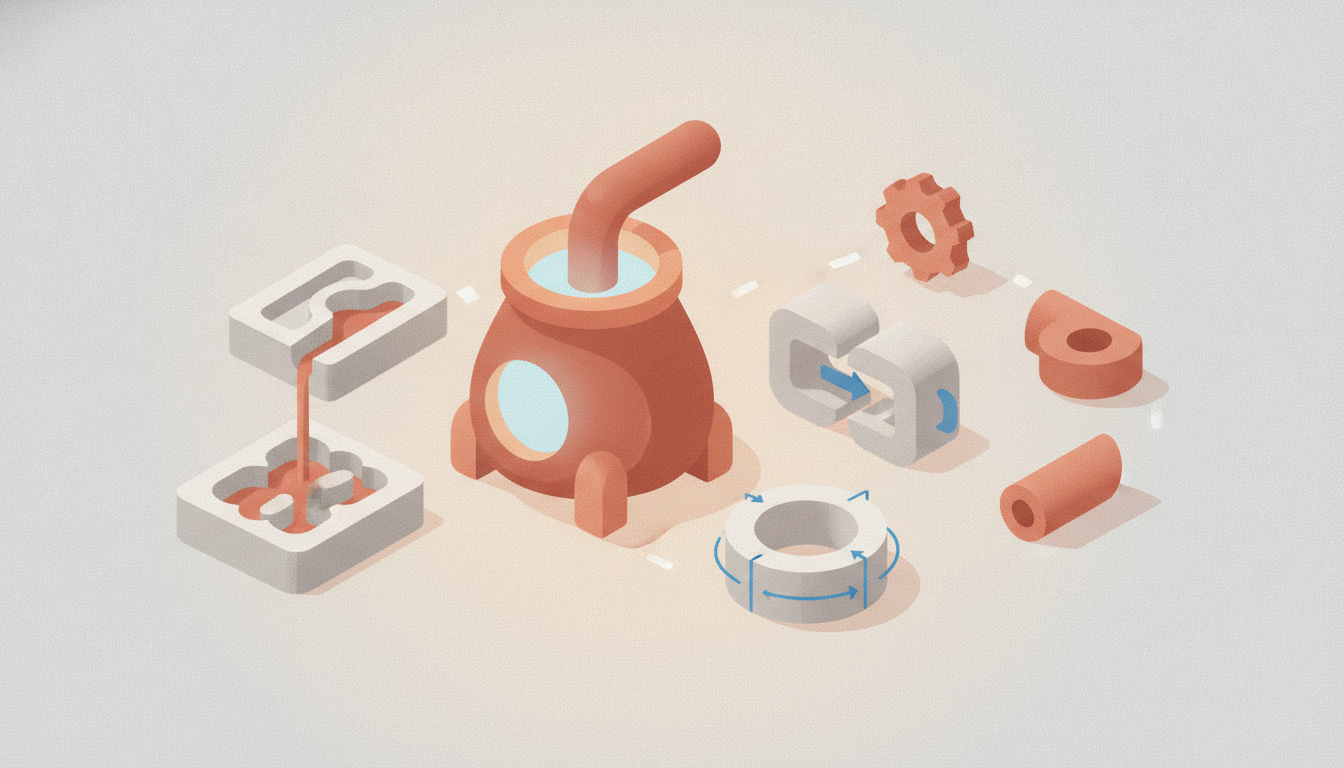
What is Casting in Manufacturing?
Casting is a manufacturing process where a liquid material is poured into a mold containing a hollow cavity of the desired shape and then allowed to solidify. The solidified part, known as a casting, is ejected or broken out of the mold to complete the process. While the principle sounds simple, the engineering behind it is anything but. This technique dates back over 7,000 years to the Copper Age, when early civilizations poured molten copper into stone molds to create tools and weapons. Today, casting remains a cornerstone of modern manufacturing, producing everything from a 500-ton ship propeller to a tiny dental implant.
The Casting Process in a Nutshell
To understand casting, you need to visualize it as a sequence of five core steps. First, a pattern,a replica of the final object,is created, usually from wood, metal, or plastic. This pattern is used to form the mold cavity. Second, the mold material (sand, metal, or ceramic) is packed around the pattern to create the negative space. Third, the raw material (metal, plastic, or even concrete) is heated until molten in a furnace. Fourth, this liquid is poured into the mold cavity. Fifth, the material is allowed to cool and solidify inside the mold. Finally, the casting is removed, cleaned, and finished,cutting off excess material (like the sprue and risers), grinding rough edges, and performing heat treatment or surface coating.
Why is casting so vital today? Casting is often the only economic way to produce complex internal geometries (like the cooling passages inside an engine block) or to manufacture large, heavy components in a single piece. No other process can match its ability to turn a design concept into a solid metal object with minimal raw material waste at high production volumes.
Materials used in casting are diverse. The most common are ferrous metals like gray iron, ductile iron, and steel; non-ferrous metals like aluminum, copper alloys (bronze), zinc, and magnesium; and even polymers (plastic injection molding). The choice of material directly impacts the required melting temperature, mold material, and cooling rate.
The Casting Process: Step-by-Step Explained
Let's drill down into each stage of the casting manufacturing steps to understand what happens on the foundry floor.
Step 1: Pattern & Mold Making. This is where the blueprint becomes a physical form. A pattern must be slightly larger than the final part to account for shrinkage during cooling,a factor known as "shrinkage allowance." Patterns can be single-use (like wax in investment casting) or reusable (like metal dies in die casting). The mold itself is the negative cavity. For a sand mold, the pattern is placed in a flask (a rigid frame), and sand mixed with a binder is compacted around it. After the pattern is removed, the mold cavity remains. Cores (separate sand shapes) are inserted to create hollow sections.
Step 2: Melting the Material. The metal is heated in a furnace (electric arc, induction, or cupola) to a temperature well above its melting point. This ensures the liquid has enough fluidity to fill every crevice of the mold. Temperature control here is everything. If the metal is too hot, it can cause defects like gas porosity; if too cold, it might freeze before filling the entire cavity.
Step 3: Pouring into the Mold. The molten metal is transferred via ladles to the mold and poured through a pouring cup and down a sprue (vertical channel) into the mold cavity. A well-designed gating system (the network of channels) ensures the metal flows smoothly without turbulence, which can trap air and cause inclusions. Risers (reservoirs of molten metal) are placed in the mold to feed the casting as it shrinks during solidification, preventing voids.
Step 4: Solidification & Cooling. This is the most critical phase. As the metal cools, it changes from liquid to solid, contracting in volume. The cooling rate determines the microstructure of the metal,faster cooling generally produces finer grains and higher strength, while slower cooling can lead to larger grains and more ductility. Complex parts with thin and thick sections require careful design to ensure uniform cooling and avoid internal stresses.
Step 5: Removal & Finishing. Once solidified, the casting is shaken out of the mold (sand molds are destroyed, permanent molds are opened). The sprue, risers, and flash (excess metal squeezed between mold halves) are removed via cutting, grinding, or sawing. Heat treatment (like annealing or tempering) may be applied to relieve stresses or adjust mechanical properties. Finally, the part undergoes inspection for dimensional accuracy and internal defects.
Key Factors Affecting Casting Quality
Three primary variables dictate whether a casting is scrap or a success:
- Temperature Control: As mentioned, the pouring temperature affects fluidity and gas absorption. Fluxing (adding a chemical to remove impurities) is often used to clean the melt.
- Mold Material: The mold's thermal conductivity affects cooling rate. Sand molds insulate, causing slower cooling (useful for gray iron), while metal molds (dies) extract heat quickly, producing a finer, stronger microstructure (ideal for aluminum).
- Cooling Rate: Inconsistent cooling leads to residual stresses and distortion. Designers must ensure adequate fillets, uniform wall thickness, and proper placement of risers to control solidification direction.
Actionable tip for engineers: Always discuss the shrinkage allowance and draft angle (a slight taper on vertical walls) with your pattern maker. A 1% mistake on a 2-foot-long casting means a dimensional error of nearly a quarter-inch.
Types of Casting Processes in Manufacturing
There is no single "best" casting method. The choice depends on part complexity, material, production volume, and budget. Here are the five dominant types of casting processes.
Sand Casting
Sand casting is the oldest, most flexible, and most widely used method. A mold is created by compacting a mixture of sand (silica, olivine, or zircon) and a bonding agent (like clay or resin) around a pattern.
- Process: The pattern is removed, leaving a cavity. Molten metal is poured in. After cooling, the sand mold is broken away.
- Advantages: Extremely low tooling cost; can cast virtually any ferrous or non-ferrous metal; suitable for large parts (engine blocks, pump housings). Part sizes range from a few ounces to several tons.
- Limitations: Lower dimensional accuracy (typically ±0.030 inches, though better with resin-bonded sand); rougher surface finish; the mold is destroyed after each pour (high per-part cycle time).
- When to use it: Low-to-medium volume production (10–1,000 parts) when cost is the primary concern and tight tolerances are not required.
Investment Casting (Lost Wax)
This method produces near-net-shape parts with excellent surface finish and tight tolerances. A wax pattern is coated with multiple layers of ceramic slurry to build a shell.
- Process: The wax is melted out (hence "lost wax"), leaving an exact ceramic mold. Molten metal is poured into the hot shell. After cooling, the ceramic is broken off.
- Advantages: Outstanding accuracy (±0.003 inches per inch; excellent surface finish (125–250 microinch); ability to cast complex geometries (undercuts, thin walls) that cannot be machined; minimal secondary machining.
- Limitations: High tooling cost (for the master die to make wax patterns); slower cycle time; limited part size (typically up to 30 pounds).
- When to use it: High-precision applications like aerospace turbine blades, medical implants (hip replacements), and firearms components where dimensional precision and material integrity are non-negotiable.
Die Casting
Die casting forces molten metal at high pressure (1,000–20,000 psi) into a reusable steel mold (die). It is the fastest casting method for non-ferrous metals.
- Process: Metal is injected into a closed die under high pressure, maintaining that pressure during solidification to prevent shrinkage porosity. The die is then opened, and the part is ejected.
- Advantages: Excellent dimensional consistency (±0.002 inches per inch); very high production rates (up to 1,000 parts per hour per die); thin walls possible (0.04 inches); smooth surfaces.
- Limitations: High initial die cost (tens of thousands of dollars); limited to non-ferrous metals (aluminum, zinc, magnesium, copper) because the high pressure erodes steel dies when casting ferrous alloys; porosity is common unless vacuum-assisted.
- When to use it: High-volume manufacturing (10,000+ parts) for lightweight components: automotive transmission housings, electronic enclosures, power tool bodies.
Other Notable Casting Methods
- Centrifugal Casting: Molten metal is poured into a rotating mold. Centrifugal force pushes the metal against the mold walls, creating a dense, void-free tube. Ideal for pipes, rings, and cylinder liners.
- Continuous Casting: Molten metal is poured directly into a water-cooled mold and continuously withdrawn as a solid strand. Used exclusively for producing billets, blooms, and slabs for further rolling or forging.
- Plaster Mold Casting: Uses a plaster-based mold (gypsum) for high-dimensional accuracy and superior surface finish on non-ferrous alloys (aluminum, zinc). Suitable for prototypes and short runs of complex parts where investment casting is too expensive.
- Lost Foam Casting: A polystyrene foam pattern is coated with refractory material and buried in sand. When molten metal is poured, the foam vaporizes, and the metal fills the exact pattern shape. Excellent for complex castings with no parting line.
| Casting Method | Tooling Cost | Cycle Time | Tolerance | Typical Metals | Best Use Case |
|---|---|---|---|---|---|
| Sand Casting | Low | Long | ±0.030 in | All ferrous and non-ferrous | Large parts, low volume |
| Investment Casting | High | Medium | ±0.003 in | Most alloys (ferrous & non-ferrous) | Complex, high-precision parts |
| Die Casting | Very High | Very Fast | ±0.002 in | Non-ferrous only (Al, Zn, Mg) | High-volume, small-to-medium parts |
| Centrifugal Casting | Medium | Slow | ±0.010 in | Most alloys | Cylindrical parts (pipes, rings) |
| Continuous Casting | Very High | Continuous | ±0.100 in | Steel, aluminum, copper | Semi-finished shapes (billets) |
Advantages and Disadvantages of Casting
Advantages of Casting
- Complex Geometries: Casting can produce shapes with internal passages, undercuts, and complex curves that are impossible or prohibitively expensive to machine. An engine block's water jackets are a perfect example,they are formed completely by cores in a sand mold.
- Material Versatility: Almost any metal that can be melted can be cast. Specialized alloys like superalloys (for jet engine turbine blades) or ductile iron (for high-strength automotive crankshafts) are routinely cast.
- Cost-Effectiveness at Scale: After the initial tooling investment, the per-part cost plummets, especially in die casting or investment casting. For medium-to-high volumes, casting is often cheaper than forging or machining from a solid block (subtractive manufacturing).
- Large Parts: Casting is the only viable process for very large, heavy components. Ship propellers weighing 80 tons, massive valve bodies for power plants, and machine tool bases are cast as single pieces.
Disadvantages of Casting
- Dimensional Accuracy Limitations: Compared to CNC machining, casting has looser tolerances. You might need to machine critical surfaces (like bearing journals) after casting.
- Surface Finish: Cast surfaces are inherently rougher than machined or forged surfaces. Investment casting is the best among casting methods, but even it falls short of a polished machined finish.
- Porosity and Defects: Trapped gas, shrinkage cavities, and inclusions are inherent risks (covered in detail in the next section). These can weaken the part or cause leaks in pressure-tight components.
- High Tooling Cost for Some Methods: Permanent mold casting and die casting require expensive metal dies. This makes them uneconomical for small production runs.
Casting vs Machining vs Forging
| Process | Complexity | Strength | Volume/Cost | Material Waste |
|---|---|---|---|---|
| Casting | Very High (internal shapes) | Moderate (is not work-hardened) | Low cost at high volume | Low to moderate (lost wax = low waste) |
| CNC Machining | Limited (external shapes only) | High (removes weakest surface layer) | High cost per part | Very high (up to 90% waste) |
| Forging | Simple shapes only | Very High (grain flow aligned) | Moderate cost at high volume | Very low (near-net-shape forgings) |
When to choose casting over forging? Choose casting when you need extreme geometric complexity or when the material cannot be forged (e.g., gray iron). Choose forging when maximum mechanical strength (tensile and fatigue) is paramount, as in connecting rods or gears.
Applications and Uses of Casting in Manufacturing
Casting is the invisible backbone of modern industry. Here’s how it serves key sectors.
Casting in the Automotive Sector
The automotive industry alone accounts for over 25% of all metal castings produced globally.
- Engine Components: Sand casting produces iron engine blocks and cylinder heads for trucks. Die casting produces aluminum transmission housings, intake manifolds, and engine blocks for passenger cars.
- Suspension and Chassis: Nodular iron castings (using a type of ductile iron) are used for control arms, steering knuckles, and differential housings. These parts benefit from the combination of cast complexity and high strength.
- Braking Systems: Gray iron is the standard for brake rotors and drums because its graphitic microstructure provides excellent thermal conductivity and damping characteristics.
Casting in Aerospace
Weight and reliability are everything in aerospace. Investment casting dominates here.
- Turbine Blades: Single-crystal investment cast superalloys (like Inconel 718) can withstand extreme temperatures and centrifugal forces inside a jet engine.
- Structural Components: Castings in aluminum and titanium are used for brackets, housings, and airframe components where complex shapes would be too expensive to machine from billet.
Casting in Medical Devices
Precision and biocompatibility are non-negotiable.
- Implants: Cobalt-chrome and titanium investment castings are used for hip and knee replacement components, creating the porous surface structures that promote bone ingrowth.
- Surgical Tools: Handles for scalpels, forceps, and clamps are investment cast from stainless steel or aluminum.
Industrial Machinery & Consumer Goods
- Pumps & Valves: Sand casting and investment casting are the primary processes for producing pump housings, impellers, and valve bodies in a wide range of alloys.
- Cookware: Stainless steel cookware is often investment cast, while cast iron skillets are classic sand castings.
- Construction & Hardware: Door handles, plumbing fixtures, and electrical fittings are commonly die cast in zinc or aluminum for high productivity and low cost.
Common Casting Defects and Quality Control
No casting is perfect, but understanding defects is the first step to preventing them. Here are the five most common casting defects.
| Defect | Description | Cause | Prevention |
|---|---|---|---|
| Porosity (Gas) | Spherical voids inside the casting | Entrapped gas (hydrogen in aluminum, or air trapped during turbulent pouring) | Degas the melt; use vacuum assist; design gating system for laminar flow |
| Shrinkage | Irregular cavities, often at thick sections | Insufficient liquid metal feeding during solidification | Proper placement of risers; use exothermic riser sleeves; ensure progressive solidification |
| Hot Tears | Irregular cracks that form during solidification | Constrained contraction of the casting against the mold; high thermal stress | Modify mold design to allow contraction; use cores with lower collapsibility |
| Misrun | Incomplete filling of the mold cavity | Low pouring temperature; insufficient metal fluidity; thin walls | Increase pour temperature; redesign gating; increase the pouring rate |
| Inclusions | Non-metallic particles (sand, slag) embedded in the casting | Poorly cleaned melt; loose mold sand; slag carried in with the pour | Use filters in the gating system; skim the melt; use clean mold materials |
How to Prevent Casting Defects
Prevention is better than inspection. Here are the most effective strategies:
- Design for Castability: Uniform wall thickness is the single most important design rule. Sharp corners should be avoided; use generous fillets (radius ≥ 1x the adjacent wall thickness). Avoid isolated heavy sections that cannot be fed by risers.
- Process Simulation: Modern software like MAGMA or ProCAST allows engineers to simulate filling, solidification, and cooling on a computer. This can predict shrinkage porosity and misruns before any metal is poured, saving enormous cost in trial-and-error.
- Mold Quality Control: For sand casting, regular testing of sand moisture, green strength, and permeability is essential. For investment casting, ceramic shell thickness and curing must be strictly monitored.
- Non-Destructive Testing (NDT): Once cast, critical parts go through inspection:
- Radiography (X-ray): Detects internal voids and inclusions.
- Ultrasonic Testing: Uses sound waves to find cracks and porosity.
- Magnetic Particle Inspection (MPI): For ferrous metals, finds surface and near-surface cracks.
- Dye Penetrant Testing: For all metals, finds surface-breaking defects.
Future Trends in Casting Technology (2026)
Casting is not a stagnant industry. Several technology trends are reshaping the foundry floor as we approach 2026.
The Role of Simulation in Casting
Digital twin technology is now mainstream in modern foundries. Simulation software no longer just predicts defects; it optimizes the entire process. Engineers input the desired properties (e.g., "tensile strength of 35 ksi" or "zero porosity"), and the algorithm adjusts the gating system, riser size, and pour temperature to achieve that outcome automatically. The result is a massive reduction in physical trials (from 5-10 iterations to 1-2) and significant time-to-market compression.
3D Printing for Patterns and Molds
Additive manufacturing is having a profound impact on casting.
- Binder Jetting of Sand Molds: Large-format 3D printers can directly print the sand mold using a binder, eliminating the need for a physical pattern altogether. This is revolutionary for prototyping and low-volume production (e.g., for creating a single complex part without waiting weeks for a wooden pattern).
- Printed Wax Patterns: 3D printing any geometry directly in wax significantly reduces the lead time for investment casting tooling.
- Printed Ceramic Cores: Complex internal cooling channels in gas turbine blades are now routinely 3D-printed in ceramic, enabling designs that were previously impossible to create with conventional cores.
Automation and Robotics
Foundries are notoriously difficult environments (heat, dust, noise). Robots are taking over dangerous tasks like shot blasting (cleaning castings), fettling (removing flash), and pouring the melt. Automated guided vehicles (AGVs) transport molds and castings, while robotic inspection systems perform 100% visual quality checks using machine vision.
Sustainable Casting
The pressure to decarbonize is reshaping the industry.
- Recycled Materials: Casting is inherently a recycling process. Steel and aluminum castings can be made from 100% scrap. The industry is optimizing melt practices to reduce energy consumption per ton of cast metal.
- Green Sands: Binders that produce fewer volatile organic compounds (VOCs) are being adopted.
- Energy Efficiency: Induction furnaces are replacing older cupolas, offering better energy efficiency and lower CO₂ emissions. Direct-chill casting for aluminum billets recovers waste heat to preheat the furnace.
Advanced Alloys and Composites
Casting is enabling new material frontiers. Metal matrix composites (aluminum reinforced with silicon carbide particles) are being cast for brake rotors and other high-wear applications. High-entropy alloys (composed of equal proportions of five or more elements) are being explored for extreme environments, and casting is the primary shaping method due to their unworkability in forging.
Conclusion
Casting manufacturing is not just a process,it is a foundational pillar of the industrial world. From the sand-cast iron block in your car to the investment-cast superalloy blades spinning in a jet engine, casting enables the creation of components of unmatched complexity, scale, and economy. By understanding the different types of casting processes, their respective strengths and weaknesses, and the critical factors that govern casting quality, you gain the knowledge to make better decisions for your manufacturing projects.
Key takeaway: Casting is a fundamental manufacturing process with diverse methods tailored to different applications, offering a balance of complexity, cost, and scalability. The right choice depends on your material, volume, tolerance requirements, and budget.
Quick Wins For Your Next Project:
- Use investment casting for complex, high-value parts requiring tight tolerances.
- Use sand casting for large, simple parts when cost is the primary driver.
- Use die casting for high-volume production of non-ferrous parts.
- Always run a simulation (MAGMA, ProCAST) before cutting metal,it will save you time and money.
- Design with uniform wall thickness and generous fillets in mind.
For more in-depth guides on manufacturing processes, explore our articles on ManufactureNow and stay ahead of the curve.
Written with LLaMaRush ❤️