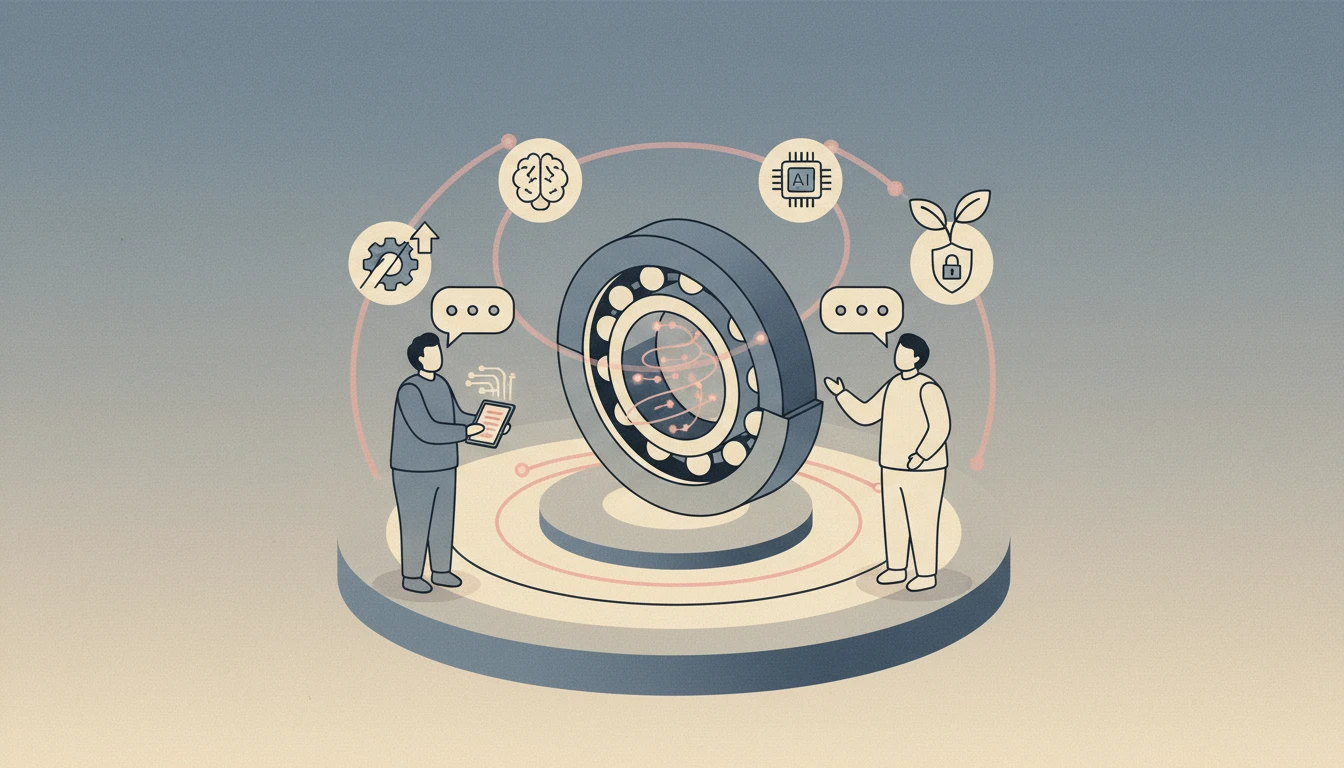
Imagine a critical production line grinding to a halt because of a component no larger than your thumb. This isn’t a rare disaster; it’s a daily reality for manufacturers relying on outdated bearing technology. High maintenance costs, unpredictable failures, and inefficiency are persistent drains on productivity and profit.
The unsung hero at the heart of nearly every rotating machine is also a common point of failure. While the core function of a bearing,to reduce friction and support loads,hasn’t changed, the technology surrounding it is undergoing a revolution. Sticking with conventional systems means accepting avoidable downtime and operational waste.
This article, built on insights from leading industry experts, cuts through the noise to reveal the cutting-edge bearing technology innovations that are redefining manufacturing. You’ll discover not just what’s new, but how to strategically implement these solutions to boost efficiency, slash maintenance budgets, and future-proof your operations.
The Evolution of Bearing Technology: Where We Stand Today
The journey of the bearing is a story of incremental yet profound progress. From the simple wooden rollers used in ancient Egypt to the precision-engineered steel bearings of the industrial age, each leap has enabled new mechanical possibilities. Today, we stand at an inflection point where digital and material sciences are converging to create the most intelligent and durable bearings in history.
Current market data underscores this shift. The global bearing market, valued at over $120 billion, is projected to grow steadily, driven by automation and the need for predictive maintenance. In industrial settings, over 70% of rotating machinery failures are linked to bearing issues, highlighting both their critical importance and the immense cost of their failure. This has fueled a massive push towards smarter, more resilient systems.
Manufacturers today grapple with several persistent challenges tied to conventional bearings. Unplanned downtime remains the top concern, with a single critical failure capable of costing tens of thousands of dollars per hour in lost production. Manual lubrication schedules are labor-intensive and often imprecise, leading to both under-lubrication (causing wear) and over-lubrication (causing heat and energy loss). Furthermore, traditional steel bearings struggle in extreme environments,be it high temperatures, corrosive chemicals, or demanding high-speed applications,leading to shortened lifecycles and frequent replacements.
These challenges are setting the stage for the next generation of solutions. The integration of sensors, the development of advanced materials, and a focus on total lifecycle cost are moving bearings from being mere mechanical components to becoming intelligent, integrated system assets.
The Rise of Smart Bearings
Smart bearings represent the most significant leap in bearing technology trends in decades. By embedding miniature sensors directly into the bearing housing or ring, these devices transform from passive parts into active data nodes. These IoT-enabled bearings continuously monitor their own health, measuring critical parameters like vibration, temperature, and load in real-time.
This data is transmitted wirelessly to a central dashboard, providing a live health monitor for your entire facility. The power isn't just in monitoring, but in prediction. Advanced algorithms analyze trends in the data to forecast potential failures weeks or even months in advance. For a manufacturer, this shifts maintenance from a reactive, calendar-based model to a precise, condition-based strategy. Instead of shutting down a line every six months "just in case," you service a machine only when the data indicates it's needed, maximizing uptime and extending component life.
Material Advances in Bearings
While digital gets the headlines, the quiet revolution in materials is equally transformative. The shift from traditional through-hardened steel to advanced alloys, ceramics, and composites is solving age-old problems.
Ceramic hybrid bearings, which use silicon nitride balls with steel races, are a prime example. They offer up to 60% less weight, significantly reducing centrifugal force and allowing for higher operating speeds. They are electrically insulating, preventing damage from stray currents, and are highly resistant to corrosion and wear. For applications in food processing, chemical plants, or marine environments, this is a game-changer.
Similarly, polymer and composite-based bearings are eliminating metal-on-metal contact in corrosive or dry environments. Materials like PEEK (Polyether Ether Ketone) and reinforced PTFE offer excellent wear resistance, can operate without external lubrication, and are impervious to rust. This current bearing market move towards specialized materials means there is now a bearing engineered for virtually every specific environmental challenge.
Key Innovations Transforming Bearing Performance
Beyond connectivity and new materials, breakthroughs in fundamental design and lubrication are pushing performance boundaries further. These innovations in bearing design are delivering tangible results: longer service life, reduced energy consumption, and operation in previously untenable conditions.
One major trend is the refinement of bearing geometry through advanced simulation. Using Finite Element Analysis (FEA) and computational fluid dynamics, engineers can now optimize raceway curvature, ball size, and cage design to minimize stress concentrations and friction. The result is a bearing that runs cooler, quieter, and lasts longer under the same load.
Lubrication technology has also evolved dramatically. Synthetic lubricants with tailored additive packages can withstand wider temperature ranges and longer intervals. More radically, solid lubricants like graphene or advanced polymers are being integrated into bearing materials or cage designs, creating "lubricated-for-life" solutions for sealed applications where re-lubrication is impossible.
Self-Lubricating Bearings
Self-lubricating bearings are a cornerstone of maintenance reduction strategies. These bearings incorporate a lubricant directly into their matrix,often through oil-filled polymer cages, graphite plugs, or surface coatings like PTFE.
The benefits are profound in high-demand or inaccessible environments. Consider a massive conveyor system in a mining operation or a bearing inside a sealed food processing machine. Traditional grease would degrade, wash out, or require frequent, costly re-application. A self-lubricating bearing steadily releases lubricant over its entire lifespan, ensuring consistent performance and eliminating a major maintenance task. This directly translates to enhanced reliability, lower labor costs, and reduced risk of contamination in clean environments.
Hybrid Ceramic Bearings
Hybrid ceramic bearings deserve a deeper look for their role in bearing performance improvements. The silicon nitride balls used are harder than steel, leading to dramatically reduced wear. Their lower density means they generate less centrifugal force at high RPMs, reducing heat generation and allowing for DN values (bearing speed factor) that steel bearings cannot achieve.
This makes them ideal for high-speed machine tool spindles, turbochargers, and precision medical equipment. Furthermore, their thermal expansion coefficient is lower than steel, meaning they maintain preload and precision better under temperature fluctuations. While the upfront cost is higher, the total cost of ownership is often lower due to extended lifespan, reduced energy consumption from lower friction, and the elimination of downtime for premature failures.
| Bearing Innovation | Core Benefit | Ideal Application | Key Consideration |
|---|---|---|---|
| IoT-Enabled Smart Bearings | Predictive Maintenance, Real-Time Health Data | Critical machinery, remote or hazardous locations | Requires IT infrastructure and data analysis capability |
| Hybrid Ceramic Bearings | High-Speed Operation, Corrosion Resistance, Long Life | Machine tool spindles, pumps, aerospace | Higher initial cost, sensitive to installation damage |
| Self-Lubricating Polymer Bearings | Zero Maintenance, Chemical Resistance | Food & beverage, chemical processing, washdown areas | Load and temperature limits lower than steel |
| Advanced-Coated Bearings | Enhanced Wear & Fatigue Resistance, Anti-Corrosion | Wind turbine gearboxes, heavy off-road equipment | Coating integrity is critical; proper handling required |
Future Trends: What to Expect in the Next Decade
Looking toward 2030, the trajectory of bearing innovation is clear: deeper integration, greater intelligence, and a unwavering focus on sustainability. The bearings of the future will not just be components; they will be sentient nodes within a holistic, optimized production ecosystem.
Experts forecast that AI and machine learning will move from analyzing bearing data to actively controlling systems based on it. Imagine a bearing in a wind turbine that not only predicts its own failure but also communicates with the turbine's control system to subtly adjust operational parameters,reducing load and speed,to extend its life until the next scheduled service window. This level of system-level optimization will maximize asset utilization and redefine reliability engineering.
Sustainability will cease to be a niche concern and become a primary design driver. This goes beyond energy efficiency to encompass the entire lifecycle: sourcing of raw materials, manufacturing energy, longevity, and end-of-life recyclability.
Integration with Industry 4.0
The integration with Industry 4.0 is where bearings become true cyber-physical components. In a smart factory, a bearing’s data stream will feed into a Digital Twin,a virtual, real-time replica of the physical machine. This allows engineers to run simulations, test the impact of operational changes, and predict outcomes with incredible accuracy.
For example, before increasing the production speed on a packaging line, a factory manager could use the Digital Twin to simulate the effect on bearing load and temperature. This proactive approach prevents failures and optimizes throughput. In this data-driven manufacturing system, bearings provide the foundational condition data that fuels overall equipment effectiveness (OEE) metrics and continuous improvement cycles.
Sustainable Bearing Solutions
The push for sustainable bearing solutions is accelerating. Innovations are focusing on two main fronts: material composition and energy impact.
New bearing steels are being developed using recycled content and cleaner production methods. Researchers are also making strides with bio-based polymers for cages and seals. The goal is a "circular economy" bearing, designed for easy disassembly and material recovery at end-of-life.
Perhaps more impactful is the drive for energy efficiency. Bearings account for a significant portion of a machine's frictional losses. Next-generation designs, surface finishes, and lubricants are targeting reductions in friction torque. A bearing that uses 1% less energy might seem trivial, but multiplied across thousands of bearings in a large plant, the annual savings in electricity costs and carbon footprint are substantial.
Practical Insights from Industry Experts
Theory is essential, but application is everything. Drawing from our expert interviews, the real value of these bearing technology innovations is unlocked through careful, strategic implementation. The most common mistake is viewing new bearings as a simple drop-in replacement rather than a system upgrade.
Experts consistently emphasize a phased approach. Start with a pilot project on a non-critical but problematic machine. This allows you to gather data, validate performance claims, and build internal competency without risking core production. The key is to measure not just the bearing's life, but its impact on overall machine performance: energy consumption, vibration levels, and maintenance hours.
Another critical insight is the importance of proper installation and handling. A $500 hybrid ceramic bearing can be ruined in minutes if installed with incorrect tools or techniques. Investing in training for your maintenance team on the specific requirements of advanced bearings is non-negotiable for realizing their full benefits.
Case Study: Reducing Downtime with New Bearings
A mid-sized automotive parts supplier was plagued by monthly failures on the main spindle bearings of their high-speed CNC machining centers. Each failure caused 48 hours of downtime for diagnosis, repair, and recalibration, costing over $25,000 per event in lost production and urgent parts/labor.
After a detailed analysis, they piloted a switch to smart bearings with integrated vibration sensors on two machines. The data immediately revealed an abnormal vibration signature developing weeks before a traditional temperature alarm would trigger. More importantly, it diagnosed the root cause: slight misalignment from thermal growth that was missed during installation.
Armed with this knowledge, they implemented two changes: 1) They permanently installed the smart bearings for continuous monitoring, and 2) They revised their installation procedure to account for thermal expansion. The result was a 30% reduction in annual maintenance costs for those spindles and the complete elimination of unplanned downtime on the piloted lines. The ROI on the bearing upgrade was achieved in less than five months.
Expert Tips for Adoption
Based on expert advice, here is a step-by-step guide for evaluating and scaling new bearing technologies:
- Audit & Identify: Conduct a plant-wide audit to identify chronic failure points, high-maintenance machines, and applications in extreme environments. These are your high-potential candidates for an upgrade.
- Define Success Metrics: What are you solving for? Is it uptime, maintenance cost, energy use, or speed capability? Define clear, measurable Key Performance Indicators (KPIs) before you begin.
- Partner, Don't Just Purchase: Engage with bearing specialists and engineers from leading suppliers. Share your operational data and challenges. The right partner will help you select a solution, not just a product.
- Pilot Rigorously: Run a controlled pilot with the old and new bearings side-by-side if possible. Document everything: installation time, initial performance, energy readings, and any maintenance interventions.
- Scale with Support: When rolling out to the wider facility, ensure your technical data (installation manuals, lubrication specs) is accessible and that your team is trained. Consider a staggered rollout to manage the learning curve.
Common pitfalls to avoid:
* Focusing only on unit cost: The cheapest bearing often has the highest total cost of ownership.
* Neglecting installation: Allocating budget for new bearings but not for proper tools and training.
* Data overload: Implementing smart bearings without a plan to analyze and act on the data they provide.
Frequently Asked Questions (FAQ)
Q: Are smart bearings and Industry 4.0 solutions only viable for large enterprises?
A: Not at all. While large plants benefit from scale, the cost of sensor technology and cloud data storage has plummeted. Many suppliers now offer scalable, subscription-based monitoring platforms that make smart bearing technology accessible for small and medium-sized manufacturers. The key is to start small with a single critical machine to demonstrate value.
Q: With so many new materials (ceramic, polymer, etc.), how do I choose the right one?
A: Let the application dictate the material. Use this simple rule of thumb: For extreme speed, precision, or electrical insulation, explore hybrid ceramic bearings. For corrosive, wet, or lubrication-free environments, look to advanced polymer or composite bearings. For high-load, high-impact general industrial use, advanced steel alloys or coated steels are often best. A trusted technical supplier can be invaluable in this selection process.
Q: What's the biggest barrier to adopting these new bearing technologies?
A: Resistance to change and an over-reliance on initial purchase price are the most common barriers. Overcoming them requires shifting the conversation from "bearing cost" to "total cost of ownership." Building a strong business case that quantifies the cost of downtime, maintenance labor, and energy waste will show that investing in advanced technology is a strategic cost-saving measure, not an expense.
The landscape of bearing technology innovations is rich with opportunity. From the real-time intelligence of smart bearings to the rugged resilience of new materials, these advancements are direct answers to the core challenges of modern manufacturing: efficiency, reliability, and cost.
The key takeaway is clear: Innovations in bearing technology are no longer just about incremental improvements; they are essential strategic tools for enhancing manufacturing efficiency, reducing total operational costs, and staying competitive in an increasingly automated and data-driven industry landscape. The manufacturers who prosper will be those who view these components not as commodities, but as critical investments in their operational future.
Written with LLaMaRush ❤️