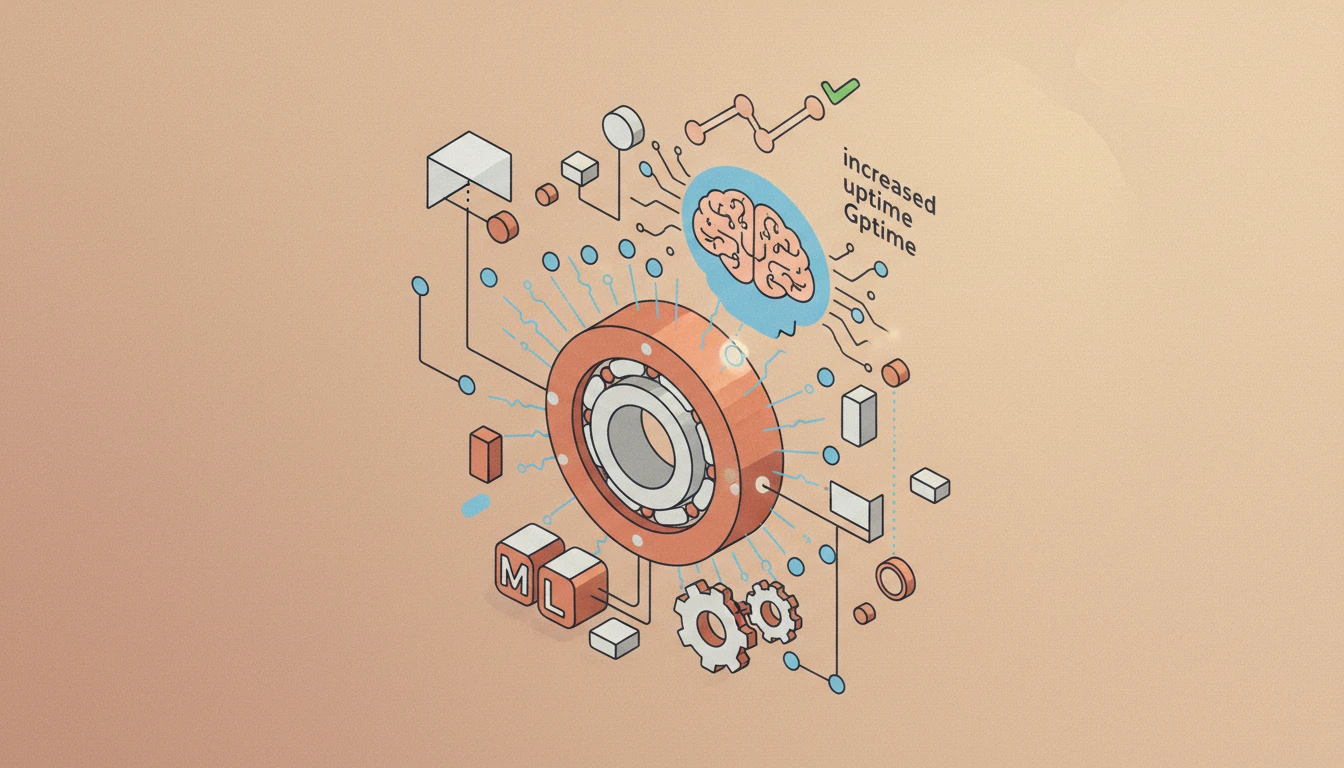
Imagine a production line suddenly grinding to a halt. A critical bearing has failed, halting the entire assembly, delaying orders, and triggering costly emergency repairs. This isn't a rare event. In fact, bearing failures are responsible for over 40% of all unplanned machine downtime in manufacturing, leading to billions of dollars in annual losses globally. For decades, the industry has operated reactively, fixing things only after they break, or following rigid, often inefficient schedules. This post addresses that costly paradigm shift by exploring how machine learning for predictive maintenance transforms bearing health from a mystery into a managed, predictable metric. You'll learn the fundamentals of bearing failure prediction with machine learning, understand the key algorithms that make it work, and get a practical, step-by-step guide to implementing a system that can save your operation from expensive, unexpected shutdowns.
Understanding Bearing Failure and Its Impact
At its core, a bearing failure is the inability of a bearing to perform its fundamental function: to support a load and facilitate smooth, controlled motion. It's the point where friction wins, wear accelerates, and the component can no longer operate within its designed parameters. The common causes of bearing failure are often interlinked and progressive. They include lubrication issues (too much, too little, or contaminated lubricant), improper installation causing misalignment, excessive load, contamination from dirt or moisture, and simple fatigue from normal operation over time. These issues don't cause immediate catastrophic failure; they create a degradation path that, if undetected, leads to a breakdown.
The economic impact on manufacturing operations of such a breakdown is staggering. It's not just the cost of a $50 bearing. It's the domino effect: lost production during downtime, overtime wages for repair crews, expedited shipping for replacement parts, potential damage to other connected components, and missed delivery deadlines that can harm customer relationships and future contracts. For a high-volume production line, downtime can cost tens of thousands of dollars per hour. This makes unplanned maintenance one of the largest, yet most controllable, costs in manufacturing.
Beyond economics, the safety and operational risks are significant. A failing bearing can cause a machine to vibrate violently, potentially leading to catastrophic mechanical failure that endangers nearby personnel. It can also produce sub-standard products due to inconsistent machine operation, leading to scrap and rework. The traditional approach has been either run-to-failure (expensive and risky) or preventive maintenance (scheduled replacements regardless of actual condition, which can be wasteful). The modern solution is predictive maintenance, which uses data to determine the actual condition of equipment and predict when failure might occur, allowing you to intervene just in time. The benefits of predictive maintenance are clear: maximize component life, minimize unplanned downtime, reduce spare parts inventory, and optimize maintenance crew scheduling.
Introduction to Machine Learning for Predictive Maintenance
Machine Learning (ML) is a subset of artificial intelligence that enables computers to learn patterns from data without being explicitly programmed for every scenario. In the context of predictive maintenance, ML algorithms are trained on historical sensor data,like vibration, temperature, and acoustic emissions,from machinery. They learn to recognize the subtle, complex patterns that signal the early stages of a bearing fault. This is a perfect application for ML because the relationship between raw sensor data and impending failure is highly complex and nonlinear, something traditional threshold-based alarm systems struggle to capture accurately.
The basics of machine learning and its types are crucial to understand for effective application. Broadly, ML tasks fall into categories like classification (is this bearing healthy or faulty?), regression (how many operating hours until failure?), and anomaly detection (is this vibration pattern normal?). Why ML is suited for predictive maintenance is its ability to handle high-dimensional, noisy data from multiple sensors and identify correlations that are invisible to the human eye or simple statistical process control.
Supervised vs Unsupervised Learning
Supervised learning is the most common and effective approach for bearing failure prediction. In this method, the algorithm is trained on a "labeled" dataset. This means each example of sensor data is tagged with the corresponding machine state,e.g., "normal," "inner race defect," "outer race defect," or "ball defect." The algorithm learns the signature patterns associated with each label. Once trained, it can analyze new, unlabeled data and predict the state. For failure prediction, supervised learning is highly effective because you are directly teaching the model to recognize known failure modes. Common supervised algorithms used include Random Forests, Support Vector Machines (SVM), and Neural Networks.
Unsupervised learning, on the other hand, works with unlabeled data. Its goal is to find hidden structures or patterns within the data. For maintenance, this is often used for anomaly detection. The model learns what "normal" operation looks like. When new data comes in that significantly deviates from this learned norm, it's flagged as an anomaly, potentially indicating a developing fault. While powerful for discovering unknown failure modes, it is generally less precise for diagnosing specific, known faults compared to supervised learning and may generate more false alarms.
Reinforcement Learning in Maintenance
Reinforcement Learning (RL) represents a more advanced frontier. Here, an "agent" learns to make decisions (like "perform maintenance" or "keep running") by interacting with a dynamic environment (your production line). The agent receives rewards or penalties based on the outcomes of its actions. Over time, it learns an optimal policy,a strategy that maximizes long-term reward. In maintenance, RL can be used to optimize maintenance schedules dynamically. Instead of a fixed schedule, the RL agent can consider real-time health predictions, production demands, part availability, and crew workload to recommend the most cost-effective time to perform maintenance, balancing the risk of failure against the cost of intervention. While still emerging in industrial applications, RL holds promise for truly autonomous, adaptive maintenance systems.
Advanced ML Algorithms for Bearing Failure Prediction
Selecting the right algorithm is critical. The choice depends on your data type, volume, computational resources, and the required interpretability of the model's decisions.
Random Forests, Support Vector Machines (SVM), and Neural Networks are workhorses in this field. An SVM works well with smaller, high-dimensional datasets, finding the optimal boundary (hyperplane) that separates different failure classes in a high-dimensional space. Its strength is in its mathematical robustness. Neural Networks, particularly deep learning models, excel at automatically learning hierarchical features from raw, complex data like vibration spectrograms. However, they often require large amounts of data and significant computational power for training. The accuracy and computational requirements vary: SVMs can be fast to train on moderate data, Random Forests are generally robust and provide feature importance, while deep learning models can offer superior accuracy but are "black boxes" and computationally intensive.
Random Forest for Vibration Data
Random Forest is an ensemble method that operates by constructing a multitude of decision trees during training. For classification tasks like fault diagnosis, it outputs the class that is the mode of the classes output by individual trees. Its power for vibration data analysis lies in its inherent handling of time-series data. While not a native sequence model like an RNN, vibration data is typically pre-processed into statistical features (e.g., root mean square, kurtosis, skewness, spectral peak values). Random Forest excels at learning from these feature vectors. It can handle a mix of feature types, is resistant to overfitting, and provides a measure of feature importance, telling you which vibration metrics (e.g., high-frequency energy) are most indicative of a fault. This interpretability is a major advantage for engineers who need to trust and understand the model's reasoning.
Deep Learning Approaches
Deep Learning models, specifically Convolutional Neural Networks (CNNs) and Recurrent Neural Networks (RNNs), take a different, more automated approach. Instead of relying on manually extracted features, they can learn directly from raw or lightly processed sensor data. A CNN is exceptional at identifying spatial patterns. When vibration time-series data is transformed into a spectrogram (a visual representation of frequencies over time), a CNN can scan this image-like data to detect the distinctive "smudges" or patterns that correspond to specific bearing faults, much like it identifies objects in a photo.
RNNs, and their more advanced variants like Long Short-Term Memory (LSTM) networks, are designed to work with sequential data. They have an internal memory, making them ideal for analyzing complex sensor data patterns over time. An LSTM can learn the temporal progression of a fault,how subtle vibration changes at time T-100 relate to a more pronounced anomaly at time T. This makes them powerful for Remaining Useful Life (RUL) prediction, estimating not just if but when a bearing will fail. The trade-off is that these models require large, labeled datasets and significant expertise to train and tune effectively.
| Algorithm | Best For | Pros | Cons | Ideal Scenario |
|---|---|---|---|---|
| Random Forest | Multi-class fault diagnosis, RUL estimation with features. | Robust, interpretable, handles mixed data, less prone to overfitting. | May not capture complex temporal patterns as well as DL. | Medium-sized datasets, need for model interpretability, starting point for ML projects. |
| Support Vector Machine (SVM) | High-accuracy classification on smaller, clean datasets. | Effective in high dimensions, memory efficient, strong theoretical foundation. | Doesn't scale well to very large datasets, poor interpretability. | Well-defined fault classes, limited historical data, need for a strong baseline model. |
| Convolutional Neural Network (CNN) | Analyzing vibration spectrograms/ images for fault detection. | Automates feature extraction, excellent for spatial pattern recognition. | Requires data conversion (to spectrograms), large dataset needed, "black box." | Large volumes of vibration data, where manual feature engineering is impractical. |
| LSTM/RNN | Predicting failure progression and Remaining Useful Life (RUL). | Captures temporal dependencies, models sequence data natively. | Computationally intensive, requires massive datasets, complex to tune. | When predicting time-to-failure is critical, and you have extensive time-series data. |
Data Collection and Preprocessing Steps
The famous adage "garbage in, garbage out" is paramount in ML. A sophisticated model built on poor data is worthless. The foundation of any bearing failure prediction system is high-quality, relevant data.
The types of sensors and data needed are focused on capturing the physical manifestations of bearing degradation. Vibration analysis is the cornerstone, typically using accelerometers to measure amplitude and frequency spectra. Temperature sensors monitor heat buildup from friction. Acoustic emission sensors detect high-frequency stress waves from micro-cracks. Sometimes, motor current signature analysis is also used. Best practices for data collection involve strategic sensor placement (as close to the bearing housing as possible), appropriate sampling rates (high enough to capture relevant frequencies, often 10-100 kHz for vibration), and consistent data logging intervals, especially during known normal operation to establish a baseline.
Once collected, raw sensor data is messy. Data cleaning and normalization techniques are essential. This involves handling missing values (e.g., through interpolation), removing outliers caused by sensor glitches or external shocks, and normalizing or standardizing the data so that all features contribute equally to the model (e.g., scaling vibration amplitude and temperature to a common range like 0 to 1).
The magic happens in feature extraction methods for ML models. Raw vibration waveforms are too noisy and high-dimensional for most algorithms. Engineers extract meaningful statistical features that condense the signal's information. These can be:
* Time-domain features: Root Mean Square (RMS), Kurtosis (indicates "spikiness"), Crest Factor.
* Frequency-domain features: Obtained via Fast Fourier Transform (FFT),the amplitude at specific fault frequencies (Ball Pass Frequency Outer Race, Ball Pass Frequency Inner Race, etc.).
* Time-frequency features: Using Wavelet Transforms to see how frequencies change over time.
Creating a rich set of these features from your raw data is often the single most important step in building an accurate predictive model.
Implementing ML Models: A Practical Guide
Moving from theory to practice requires a structured, phased approach. The step-by-step process generally follows: 1) Business & Data Understanding, 2) Data Acquisition & Preparation, 3) Feature Engineering, 4) Model Selection & Training, 5) Model Validation & Evaluation, and 6) Deployment & Monitoring.
Choosing the Right Tools
Your software and hardware choices depend on budget, in-house expertise, and scale. For prototyping and many production systems, the open-source Python ecosystem is dominant. Key libraries include Pandas (data manipulation), Scikit-learn (for traditional ML like Random Forest/SVM), and TensorFlow/PyTorch (for deep learning). For teams less familiar with coding, commercial platforms like MATLAB, SAS, or cloud-based AI services (AWS SageMaker, Azure Machine Learning) offer GUI-driven workflows and managed infrastructure. Hardware can range from local servers for training to edge computing devices (like ruggedized industrial PCs) placed directly on the factory floor for real-time inference, reducing latency and data transfer costs.
Model Validation Techniques
You cannot trust a model you haven't rigorously tested. Model validation ensures your model will perform well on new, unseen data,the data from tomorrow's bearing. The most common technique is k-fold cross-validation. Here, your historical dataset is split into 'k' groups (e.g., 5 or 10). The model is trained on k-1 groups and tested on the remaining one. This process is repeated k times, with each group serving as the test set once. The final performance metric is the average across all k tests, giving a robust estimate of real-world performance. Other methods include using a completely independent "hold-out" test set that the model never sees during training or tuning. Key metrics to track are accuracy, precision, recall, F1-score (for classification), and Mean Absolute Error (for RUL prediction).
Integration with existing manufacturing systems is the final hurdle. The trained model needs to be packaged (often as a REST API or a library) and integrated into your Plant Information (PI) system, SCADA, or CMMS (Computerized Maintenance Management System). This allows the model's predictions to automatically create work orders or trigger alerts for maintenance teams, closing the loop from data to action.
Case Studies and Real-World Success Stories
The theory is compelling, but real-world results are what matter. Across industries, ML for bearing failure prediction is delivering tangible value.
In the automotive sector, a major engine manufacturer implemented vibration monitoring and an ML-based system on their crankshaft grinding line. The system successfully predicted bearing failures in the spindle motors up to 5 days in advance. This allowed for planned maintenance during scheduled breaks, reducing unplanned downtime by 70% and saving an estimated $500,000 annually in lost production and emergency repair costs for that single line.
An aerospace component supplier used acoustic emission sensors and a deep learning model to monitor high-speed bearings in their composite curing autoclaves. The model identified early signs of lubricant degradation and cage wear that were undetectable by traditional vibration analysis. By addressing these issues proactively, they extended mean time between failures (MTBF) by 40%, significantly reducing spare parts inventory costs and improving the reliability of a critical, high-value asset.
Common pitfalls avoided by successful teams include: starting with a clear, small-scale pilot project (one critical machine), ensuring close collaboration between data scientists and veteran maintenance engineers for domain expertise, and prioritizing data quality over model complexity from day one. The future potential and scalability are immense. Success on a single machine can be scaled to fleets of identical assets, and the underlying platform can be adapted to predict failures in gears, pumps, and motors, creating a plant-wide predictive maintenance ecosystem.
Overcoming Challenges and Future Trends
Implementation is not without its hurdles. Common challenges include data quality (inconsistent collection, missing labels), model interpretability (especially with deep learning,why did it predict a fault?), and the initial cost of sensor infrastructure and talent.
Best practices for successful implementation are to start with a well-defined, high-value use case, secure buy-in from both maintenance and operations leadership, and build a cross-functional team. Treat the first project as a learning experience, not just a technology deployment.
Emerging trends are shaping the next generation of predictive maintenance:
* IoT Integration: Proliferation of low-cost, wireless sensors making data collection easier and more comprehensive.
* Edge Computing: Running ML inference directly on devices at the source of data, enabling real-time, low-latency predictions without constant cloud connectivity.
* AI Advancements: Development of more efficient, lighter models that can run on edge hardware, and techniques like transfer learning that allow models pre-trained on similar machinery to be adapted with less data.
* Digital Twins: Creating a virtual, dynamic model of a physical asset that is continuously updated with sensor data, allowing for ultra-realistic simulation and prediction of failure scenarios under different operating conditions.
Staying updated requires engaging with industry consortia (like MIMOSA or the Industrial Internet Consortium), attending specialized conferences, and following research from leading universities and tech companies focused on industrial AI.
Conclusion
The journey from reactive breakdowns to proactive, intelligence-driven maintenance is no longer a futuristic concept. Machine learning offers a powerful tool for predictive maintenance, enabling manufacturers to proactively address bearing failures, reduce costs, and improve operational efficiency. By understanding the failure modes, harnessing the right ML algorithms like Random Forest or Deep Learning, meticulously collecting and preprocessing data, and following a structured implementation plan, you can transform bearing health from a major risk into a managed variable. The goal is clear: replace uncertainty with insight, and replace downtime with optimized, predictable uptime.
Ready to move from theory to action? [Download our free checklist to start implementing ML for bearing failure prediction in your manufacturing setup.] This practical guide will help you navigate the key steps, from identifying your pilot machine to validating your first model.
Frequently Asked Questions (FAQs)
1. What is the minimum amount of data needed to start an ML project for bearing failure prediction?
While more data is always better, you can begin a proof-of-concept with data from a single machine covering at least one complete maintenance cycle,from a known healthy state through to a failure (or scheduled replacement). This might represent 6-12 months of operational data. The key is having labeled data points indicating the machine's health state at different times. For deep learning approaches, significantly larger datasets are required.
2. Can I use machine learning for prediction if I don't have historical failure data?
Yes, but the approach changes. Without labeled failure data, you would typically use unsupervised learning for anomaly detection. The model learns the patterns of "normal" operation from your historical data. When new data deviates significantly from this baseline, it flags an anomaly, which could indicate an incipient fault. This is a great starting point to build a failure library over time.
3. How accurate are ML models for predicting bearing failure, and can they predict the exact time of failure?
Model accuracy for fault detection (classifying the type of fault) can exceed 95% with good data and well-tuned models. Predicting the exact time of failure (Remaining Useful Life - RUL) is more challenging and less precise. The best RUL models provide a probabilistic estimate (e.g., "failure is likely within the next 48-72 hours with 85% confidence") rather than an exact timestamp, which is still immensely valuable for planning.
4. What's more important: the sophistication of the ML algorithm or the quality of the sensor data?
Data quality is unequivocally more important. A simple model trained on clean, relevant, and well-labeled data will outperform the most advanced deep learning algorithm trained on noisy, inconsistent, or incomplete data. Your primary investment should be in establishing robust data collection and management processes.
5. How do we integrate the predictions from an ML model into our existing maintenance workflow?
The most effective integration is through your Computerized Maintenance Management System (CMMS) or Enterprise Asset Management (EAM) system. The ML model's output (e.g., "Bearing on Pump-12: High probability of outer race fault. Recommended inspection within 7 days") can be formatted to automatically generate a prioritized work order in the CMMS. This ensures the right information gets to the right maintenance technician without manual intervention.
Written with LLaMaRush ❤️