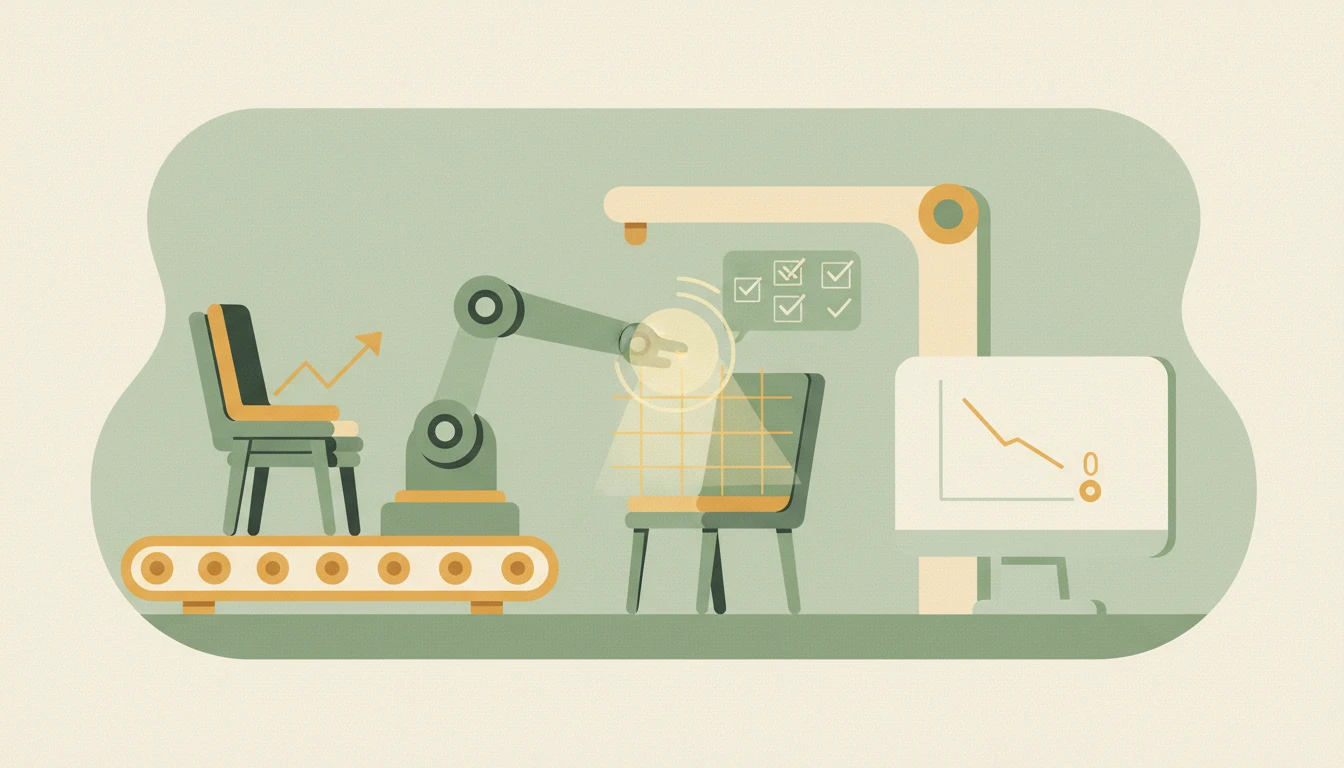
A leading furniture manufacturer was facing an escalating crisis. Despite a skilled quality control team, return rates were climbing, customer complaints were piling up, and the brand’s reputation was taking a hit. The root cause? Manual visual inspection – a slow, inconsistent process that missed up to 15% of defects. This wasn't just a minor quality hiccup; it was a $2 million annual drain from returns, rework, and lost customer trust.
But this story doesn’t end with a blame game. Instead, the company took a bold step: they deployed an AI-powered visual inspection system on the production line. The result? Defect rates dropped to zero, inspection time was cut by 80%, and within just four months the system paid for itself, generating a 300% ROI in the first year. This article walks through exactly how they did it – the challenges, the technology, the implementation pitfalls, and the measurable outcomes – so you can see if a similar approach makes sense for your factory.
The Challenge: High Defect Rates in Furniture Production
The manufacturer, a mid-sized producer of solid-wood and veneered furniture, was running three high-volume production lines. Each day, thousands of pieces – table tops, cabinet doors, chair frames – moved through finishing and assembly. Their furniture defect rate hovered around 15%, meaning nearly one in six pieces had a visible flaw.
The defects were diverse: scratches on polished surfaces, dents from handling, misalignments in joints, and subtle color variations in staining. Some were obvious; many were tiny – a hairline scratch or a slight shade difference – but still visible to a discerning customer. And customers noticed. Return rates climbed to nearly 8% of shipped orders, far above the industry average.
Why Manual Inspection Falls Short
Quality control relied on a team of 12 human inspectors stationed at the end of each line. They had 30 seconds per piece to visually scan every visible surface under standard lighting. Here’s why that approach was doomed to fail:
- Human fatigue: After the first hour, attention spans drop sharply. Studies show that visual inspection accuracy can decline by 50% after just 20 minutes of repetitive work. For furniture inspectors, the same-same nature of parts made this even worse.
- Subjectivity: What one inspector called a “minor scratch” another might miss completely. There were no calibrated standards – just each person’s judgment.
- Complex details: Furniture has curved surfaces, intricate carvings, and varied grain patterns. Defects can hide in shadows or be masked by wood texture. The human eye simply can’t catch everything.
- Speed limits: To meet production targets, inspectors had to move fast. The trade-off between thoroughness and throughput meant many defects got through.
The result: an estimated 15% defect escape rate – that is, 15% of all defective pieces were shipped to customers. And because defects were only caught at final inspection, the company was paying for the full production cost of every defective piece, including material, labor, and finishing.
The Cost of Defects
Let’s put hard numbers on this. The manufacturer’s annual spend related to quality failures was:
| Cost Category | Annual Amount |
|---|---|
| Customer returns (shipping, restocking, discount) | $1,500,000 |
| Rework labor (disassembly, repair, refinishing) | $500,000 |
| Scrapped material and wasted finishing chemicals | $200,000 |
| Total defect-related costs | $2,200,000 |
On top of that, brand damage is harder to quantify but real. A few bad reviews on social media about scratched furniture can deter hundreds of potential buyers. The quality team knew they needed a scalable, consistent solution – one that didn’t rely on human vigilance alone.
Solution: AI-Powered Visual Inspection System
The company chose to deploy an AI visual inspection system built on deep learning defect detection and computer vision manufacturing technology. The core idea is simple: train a neural network to recognize the difference between a “good” piece and a “defective” piece, then use cameras to inspect every part in real time.
How the AI Model Was Trained
This was the most critical step. The manufacturer partnered with an AI vendor who specialized in automated quality control for industrial settings. Together, they collected over 50,000 labeled images of furniture parts:
- 30,000 images of good parts (various wood species, finishes, and shapes).
- 20,000 images of defective parts, covering every known defect type: scratches, dents, misalignments, color variations, grain mismatches, surface roughness, and even edge chipping.
Each image was annotated by experienced quality inspectors – the same people who used to perform manual checks. They drew bounding boxes around defects and labeled the defect type. This labeled dataset was then fed into a convolutional neural network (CNN), a type of deep learning architecture specialized for image recognition.
Training took about two weeks on a GPU cluster. The model learned to detect subtle patterns that even trained humans often missed – like a micro-scratch that only appeared under certain lighting angles. Key to success: the training set included images taken under the exact same lighting and camera setup that would be used in production, so the model never had to guess under different conditions.
Hardware and Software Stack
The system comprised three main components:
-
High-resolution cameras – Four industrial-grade cameras (5 megapixel each) per inspection station, positioned at different angles to capture all visible surfaces. Two cameras covered the top and bottom; two covered the sides. They were triggered automatically as each part entered the inspection zone.
-
Edge computing unit – A ruggedized computer with a GPU that ran the AI inference in real time – no cloud latency. This unit processed each image in under 0.5 seconds, allowing the line to run at full speed.
-
Rejection mechanism – A pneumatically actuated pusher arm that would gently nudge a defective piece off the main conveyor onto a rework lane. The whole cycle – detection plus rejection – took 5 seconds per piece, replacing the 30-second manual inspection.
The software stack included the trained CNN model plus a custom application that integrated with the existing MES (Manufacturing Execution System). When a defect was detected, the system logged the part ID, defect type, and location on the part. This data fed into a dashboard that gave supervisors real-time visibility into quality trends.
Integration example: The AI system was placed right after the final sanding and finishing station, before packaging. When a table top rolled through, cameras captured four images. The model scored each image. If any defect probability exceeded a 95% threshold, the pusher fired.
Implementation: From Pilot to Full Deployment
Rolling out AI on a live production line isn’t as simple as plugging in cameras. The manufacturer took a careful, phased approach to minimize disruption and win over a skeptical workforce.
Overcoming Initial Resistance
The biggest hurdle wasn’t technology – it was people. When workers heard about “AI inspectors,” many feared they’d lose their jobs. The quality team, in particular, felt threatened. One senior inspector told management: “I’ve been doing this for 15 years. A computer can’t see what I see.”
The company tackled this head-on. In town hall meetings, they explained that the AI wasn’t meant to replace inspectors, but to augment their work. Inspectors would be redeployed to more valuable tasks: training the AI model on new defect types, doing deeper root-cause analysis on the defects the AI flagged, and handling rework decisions. No one was laid off; instead, the team’s role shifted from repetitive checking to quality engineering.
Quick win: The manufacturer invited three veteran inspectors to spend a week “teaching” the AI by labeling its false positives (parts the AI flagged as defective that were actually good). This hands-on involvement turned skeptics into advocates. After seeing the system catch defects they themselves had missed, the inspectors became the loudest champions of the new tool.
Iterative Model Improvement
In the first month of pilot operation on a single line, the system produced 5% false positives – meaning one in twenty good parts was unnecessarily rejected. This was unacceptable because it disrupted workflow and wasted rework capacity.
The model fine-tuning process was systematic:
- Week 1-2: The AI vendor team collected every false positive image and the inspectors’ corrected labels. They built a special “hard dataset” of borderline cases.
- Week 3: The model was retrained with these new examples, weighted to reduce false positives.
- Week 4: The updated model was deployed, and false positive rates dropped to 2%.
- After three more retraining rounds over three months: false positives settled at 0.5% – one reject out of 200 good parts.
Similarly, false negatives (missed defects) were monitored. Inspectors checked all rejected and accepted parts manually during the pilot. The model’s detection rate for defects improved from 95% to 99.8% after four months of continuous learning from new defect types that emerged (e.g., a new scratch pattern from a worn-out sanding belt).
Results: Zero Defects and Significant ROI
After six months of deployment on all three production lines, the numbers spoke for themselves.
Defect Rate Over Time
The following table shows the monthly defect escape rate (the percentage of defective pieces that reached customers) before and after AI deployment:
| Month | Defect Escape Rate | Notes |
|---|---|---|
| Before AI (average) | 15% | Baseline from manual inspection |
| Month 1 of AI on Line 1 | 3% | Pilot – only one line, but escape rate dropped immediately |
| Month 2 | 1.2% | Model improving, false positives still problematic |
| Month 3 | 0.5% | Second line deployed |
| Month 4 | 0.1% | All three lines online |
| Month 6 | 0.0% | Zero defective pieces shipped for three consecutive weeks |
By month six, the manufacturer achieved zero defect manufacturing – not a single defective piece left the factory. This was a first in their 30-year history. The lines kept running at full speed, and inspection speed increased from 30 seconds to 5 seconds per piece – a 6x throughput improvement.
Financial Impact
The financial gains were equally dramatic:
| Savings Category | Annual Amount |
|---|---|
| Elimination of customer returns (from 8% to 0%) | $1,500,000 |
| Rework labor reduced by 90% | $450,000 |
| Material waste reduction (scrapped parts down to near zero) | $180,000 |
| Reduced warranty replacements | $70,000 |
| Total annual savings | $2,200,000 |
The AI inspection ROI was remarkable: the system cost $550,000 to deploy (hardware, software, integration, training). With annual savings of $2.2 million, payback occurred in just under 3 months (calculated as $550k / $2.2M * 12 = 3 months). Over the first year, net savings after the initial investment were $1.65 million, yielding a 300% ROI.
The defect reduction statistics also improved customer satisfaction scores: Net Promoter Score (NPS) jumped from +15 to +62 within six months.
Key Takeaways for Furniture Manufacturers
If you’re considering a similar AI visual inspection project, here are the critical success factors from this case.
Lessons Learned
- Start with a clear metric baseline. The manufacturer measured defect escape rate, false positive rate, and inspection time before deployment. Without that baseline, you can’t prove ROI.
- Involve operators early. The skeptical inspectors who became trainers were key. Don’t force AI on a team; make them part of the solution.
- Invest in high-quality data labeling. The 50,000-image dataset was the single biggest factor in model accuracy. Use your best inspectors for labeling, not cheap outsourced labor.
- Plan for iterative improvement. Expect false positives and false negatives initially. Budget 3-6 months for model fine-tuning.
- Don’t neglect lighting. The cameras and lighting setup must be precisely engineered to avoid shadows and glare that confuse the AI.
Next Steps
The manufacturer isn’t stopping at inspection. They’re now exploring:
- In-process adjustments: Using the same AI system to identify when a defect originates (e.g., a worn saw blade) and automatically adjusting machine parameters or triggering maintenance.
- Predictive quality analytics: Feeding defect data into a model that predicts which batches or machines are likely to produce defects, so preventive actions can be taken.
These are natural extensions of the same data pipeline, and the scalable AI inspection approach means the system can be adapted for new furniture types, materials (including laminates and upholstery), and even other industries like automotive or consumer electronics.
FAQ: AI Visual Inspection for Furniture Manufacturing
1. How accurate is AI visual inspection compared to human inspectors?
In this case, the AI achieved 99.8% defect detection rate (compared to ~85% for humans) with a 0.5% false positive rate. Accuracy depends heavily on training data quality and lighting, but AI consistently outperforms humans on subtle or tiny defects.
2. How long does it take to implement an AI visual inspection system?
From contract to full production, expect 4-6 months. The first month is for data collection and labeling, the second for model training and hardware setup, followed by a 3-month pilot and fine-tuning phase. Rolling out to multiple lines adds 2-3 months.
3. Can the system integrate with my existing MES or conveyor systems?
Yes. Most AI inspection vendors provide APIs and standard communication protocols (OPC UA, Modbus, REST). The manufacturer in this case integrated with their existing MES using a simple webhook that logged defect data. Hardware integration (conveyor triggers, reject mechanism) typically requires an automation partner, but commercially available kits exist.
Ready to Transform Your Quality Control?
This furniture maker’s journey proves that AI visual inspection can eliminate defects in furniture manufacturing, delivering massive cost savings and quality improvements with a quick ROI. The technology is proven, the implementation path is clear, and the barriers – cost, change resistance, data requirements – are surmountable.
Written with LLaMaRush ❤️