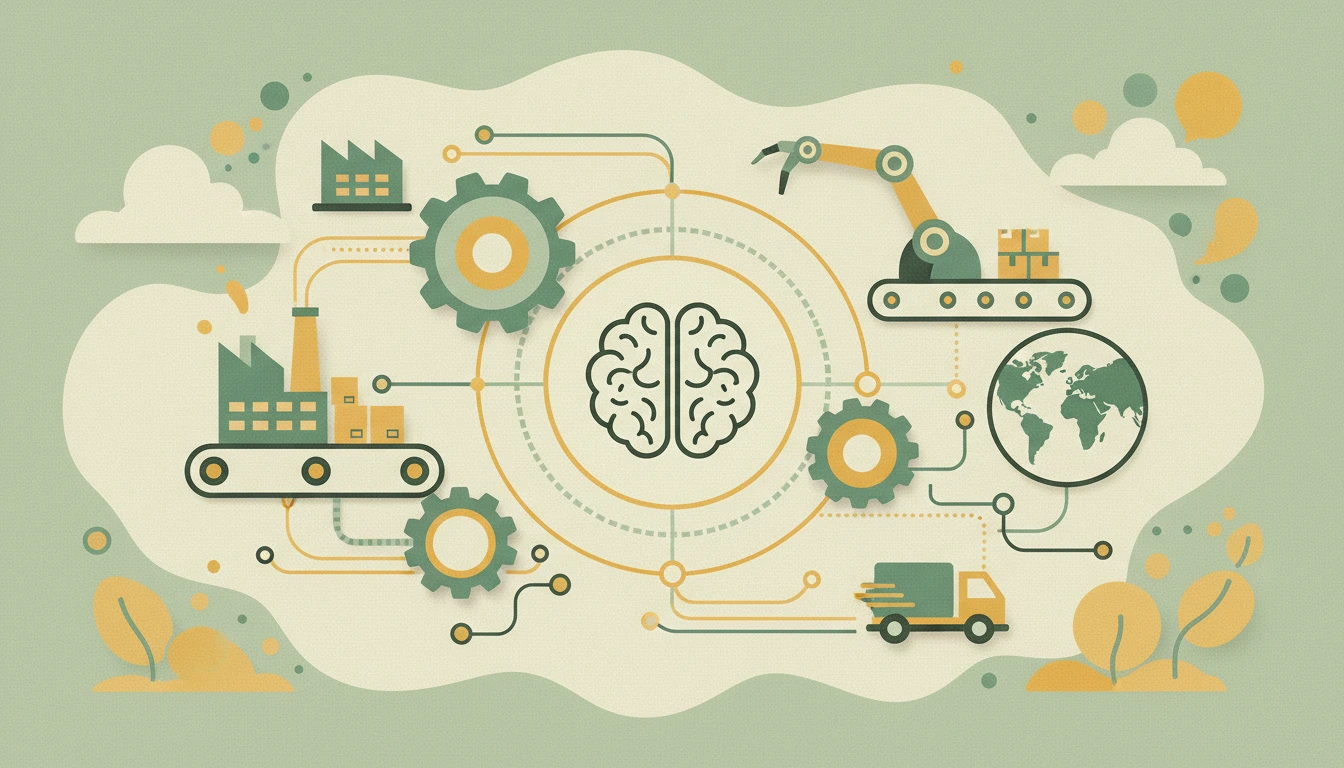
When a single delayed component can idle an entire assembly line, or a sudden demand spike leaves you scrambling for raw materials, you understand that your supply chain is more than a logistics function,it’s the central nervous system of your manufacturing operation. These inefficiencies, from unpredictable delays and bloated inventory costs to a frustrating lack of real-time visibility, are not just operational headaches; they are direct threats to profitability and competitiveness.
This guide cuts through the hype to deliver a clear, actionable roadmap. You will gain a comprehensive understanding of how AI supply chain optimization manufacturing integrates into real-world operations, learn its tangible benefits and ROI, navigate the common adoption challenges, and prepare for the innovations shaping the industry.
Understanding AI in Supply Chain Optimization for Manufacturing
At its core, supply chain optimization is about making the best possible decisions with the information available. Traditional methods often rely on historical averages, manual forecasts, and reactive problem-solving. AI in manufacturing supply chain flips this script, enabling systems to learn from vast amounts of data, identify complex patterns, and make proactive, predictive decisions.
Why is manufacturing particularly ripe for this transformation? Manufacturing supply chains are uniquely complex, involving multi-tiered supplier networks, capital-intensive equipment, perishable raw materials, and volatile customer demand. This complexity creates specific pain points that AI is exceptionally well-suited to address. The evolution from basic automation to intelligent, self-optimizing systems represents the next critical leap in industrial efficiency.
Core AI Technologies Explained
To demystify the process, it’s essential to understand the key technologies powering this shift:
- Machine Learning (ML): This is the workhorse of AI supply chain applications. ML algorithms ingest data,from sales history and machine sensors to weather reports and social sentiment,and learn to make predictions or decisions without being explicitly programmed for each scenario. For instance, an ML model can predict machine failure weeks in advance by analyzing subtle patterns in vibration and temperature data that would be invisible to human analysts.
- Neural Networks & Deep Learning: A more advanced subset of ML, these systems are inspired by the human brain and excel at processing unstructured data. In a supply chain optimization with machine learning context, deep learning powers computer vision systems that can inspect products for defects with superhuman accuracy on a production line, or analyze satellite images to predict port congestion and shipping delays.
- Internet of Things (IoT): IoT acts as the central nervous system, providing the real-time data that AI brains need to function. Sensors on factory equipment, warehouse shelves, shipping containers, and even products themselves generate a continuous stream of data on location, condition, temperature, and utilization. This real-time data analytics in supply chain is the foundational fuel for all AI-driven insights.
Manufacturing-Specific Supply Chain Pain Points
Manufacturers face a distinct set of challenges that traditional tools struggle to solve:
- Inventory Mismanagement: The classic dilemma of too much vs. too little. Excess inventory ties up capital and risks obsolescence, while stockouts halt production and disappoint customers. Static safety stock formulas fail in today’s dynamic environment.
- Demand Volatility: Consumer trends shift rapidly, competitor actions are unpredictable, and external events (like geopolitical issues or pandemics) can cause sudden spikes or drops in demand. Manual forecasting becomes a guessing game.
- Logistics Bottlenecks: From port delays and customs hold-ups to inefficient truck routing and last-mile delivery failures, logistics is a constant source of risk and cost overruns.
- Quality Control Variability: Relying on human inspectors for quality control is slow, prone to error, and inconsistent, leading to scrap, rework, and customer returns.
- Reactive Maintenance: Unplanned equipment downtime is a massive cost driver. Running machines to failure or relying on rigid scheduled maintenance leads to catastrophic breakdowns or unnecessary servicing.
Key Applications of AI in Manufacturing Supply Chains
Moving from theory to practice, AI is delivering concrete value across the manufacturing lifecycle. These are not futuristic concepts but deployed solutions generating real returns today.
Case Study: AI in Automotive Manufacturing
Consider a global automotive manufacturer facing challenges with part shortages and long lead times. By implementing an AI-powered platform, they integrated data from thousands of tier-1 and tier-2 suppliers, real-time logistics tracking, and their own production schedules.
- The AI Solution: Machine learning models began predicting part delivery delays an average of two weeks in advance by analyzing factors like supplier order history, regional weather patterns, and transportation carrier performance.
- The Result: The system could automatically trigger alternative sourcing recommendations or adjust production line sequencing in real-time to prioritize vehicles with available parts. This led to a 30% reduction in lead time variability and a 15% decrease in premium freight costs incurred from emergency air shipments. This is a prime example of AI-driven demand forecasting and logistics working in tandem.
Implementing AI for Demand Forecasting
Accurate forecasting is the cornerstone of an efficient supply chain. Here’s a practical approach to implementation:
- Data Aggregation: Consolidate internal data (historical sales, promotions, production rates) with external data sources (market trends, economic indicators, social media sentiment, even weather forecasts).
- Model Selection & Training: Choose an appropriate ML algorithm (e.g., time-series forecasting models like ARIMA or more complex neural networks). "Train" the model on several years of historical data, allowing it to learn seasonal patterns, trend lines, and correlations.
- Integration & Execution: Integrate the model’s forecasts directly into your Enterprise Resource Planning (ERP) and Material Requirements Planning (MRP) systems. The AI doesn’t just create a report; it automatically generates recommended purchase orders and production plans.
- Continuous Learning: The system continuously compares its predictions to actual outcomes and retrains itself, becoming more accurate over time. This moves you from a static annual forecast to a dynamic, weekly or even daily planning cycle.
Beyond forecasting, AI applications are vast:
* Real-Time Inventory & Warehouse Management: AI optimizes stock placement within a warehouse for faster picking, predicts replenishment needs, and can even orchestrate autonomous mobile robots (AMRs).
* Logistics & Route Optimization: Algorithms process real-time traffic, weather, fuel costs, and delivery windows to dynamically calculate the most efficient delivery routes, reducing mileage and fuel consumption.
* Predictive Maintenance: By analyzing sensor data, AI predicts equipment failures before they happen, scheduling maintenance only when needed, which maximizes uptime and extends asset life.
* Computer Vision for Quality Control: Cameras powered by deep learning can inspect thousands of parts per minute with flawless consistency, identifying microscopic defects invisible to the human eye.
Benefits and ROI of Implementing AI in Supply Chains
The investment in AI is justified by a compelling return across financial, operational, and strategic dimensions. The benefits of AI extend far beyond simple cost-cutting.
Statistical Evidence of AI Impact
The numbers speak for themselves. Recent industry studies provide concrete evidence of AI's transformative power:
| Metric | Average Improvement with AI | Practical Implication |
|---|---|---|
| Inventory Reduction | 20-50% | Frees up working capital, reduces storage costs and waste. |
| Forecasting Accuracy | Up to 85% (from ~60-70%) | Drastically reduces stockouts and overstock situations. |
| Logistics Costs | 5-15% Reduction | Savings from optimized routes, load planning, and fuel efficiency. |
| On-Time Delivery Rate | 10-20% Increase | Enhances customer satisfaction and strengthens contractual compliance. |
| Equipment Uptime | 10-20% Increase | More productive hours from existing capital assets, higher output. |
(Sources: McKinsey & Company, Deloitte, Forbes Insights)
These efficiency gains translate directly to the bottom line. Furthermore, AI enables enhanced scalability, allowing operations to flex up or down without proportional increases in overhead or errors. Perhaps most importantly, it empowers improved decision-making; leaders shift from gut-feel reactions to data-driven strategies based on simulated outcomes.
Calculating Your AI Investment Return
A realistic ROI calculation for an AI supply chain optimization project must look at both costs and benefits.
Costs to Consider:
* Software & Licensing: Subscription or perpetual license fees for AI platforms.
* Implementation & Integration: Costs for consultants or internal IT to connect AI tools with existing ERP, WMS, and PLC systems.
* Data Infrastructure: Potential upgrades to data storage, processing, or IoT sensor networks.
* Change Management & Training: Programs to upskill your workforce to work alongside AI.
Benefits to Quantify:
* Direct Cost Savings: Reduced inventory carrying costs, lower freight spend, decreased waste/scrap, lower energy consumption.
* Revenue Enhancement: Fewer lost sales from stockouts, ability to fulfill rush orders, potential for premium pricing due to superior reliability.
* Intangible Benefits: Improved customer satisfaction, stronger supplier relationships, enhanced agility to market changes, better risk mitigation.
A pragmatic approach is to start with a pilot project in one high-impact area, such as predictive maintenance for a critical production line. Measure the reduction in unplanned downtime and maintenance parts costs against the pilot's expense. This tangible proof of concept builds the case for broader rollout and simplifies ROI calculation.
Overcoming Challenges in AI Adoption for Manufacturing
Despite the clear potential, integration is not without its hurdles. Acknowledging and planning for these challenges is key to successful implementation.
Best Practices for Data Management
The adage "garbage in, garbage out" is never truer than with AI. Your algorithms are only as good as the data they consume.
- Start with Data Auditing: Identify all relevant data sources (machine logs, supplier scorecards, shipment trackers) and assess their quality. Is the data complete, accurate, and consistently formatted?
- Establish a Single Source of Truth: Break down data silos between departments. Sales forecasts, production schedules, and warehouse data must be integrated into a unified data lake or warehouse.
- Implement Data Governance: Assign ownership for maintaining data quality. Create standard procedures for data entry and validation. Clean, structured, and normalized data is non-negotiable for effective AI in manufacturing supply chain projects.
- Begin with What You Have: Don't wait for perfect data. Start with your most reliable datasets to build initial models. The value generated can then fund further data cleansing and integration efforts.
Partnering with AI Solution Providers
Most manufacturers will not build AI solutions from scratch. Choosing the right partner is critical.
- Look for Industry Specificity: Seek providers with proven experience in manufacturing, not just generic AI. They should understand MRP, shop floor scheduling, and quality management systems.
- Evaluate Integration Capabilities: The provider's platform must have pre-built connectors or flexible APIs to integrate with your core systems (e.g., SAP, Oracle, custom MES).
- Assess the Support Model: Do they offer co-development and ongoing support? Your team will need guidance during implementation and as you scale.
- Demand Transparency: The provider should be able to explain, in understandable terms, how their models arrive at recommendations. Avoid "black box" solutions where you cannot audit the logic.
- Start with a Pilot Agreement: Structure the engagement to begin with a well-scoped pilot project with clear success metrics before committing to an enterprise-wide license.
Common challenges like high initial costs can be mitigated with cloud-based AI services that operate on a subscription model, reducing upfront capital expenditure. Skill gaps are addressed through a mix of strategic hiring, upskilling programs for existing engineers and planners, and relying on the partner's expertise.
Future Trends: AI in Supply Chain
The pace of innovation is accelerating. To stay competitive, manufacturers must look beyond today's applications and prepare for the next wave.
Key Innovations to Watch
- Generative AI for Supply Chain Design: Beyond analyzing data, GenAI will be used to create optimal supply chain networks. It can simulate thousands of scenarios,considering new trade policies, tariff changes, or sustainability goals,to design the most resilient and efficient supply chain structure from scratch.
- Hyper-Automation with AI & Robotics: The convergence of AI, IoT, and advanced robotics will create fully autonomous "lights-out" warehouse and production cells. AI will manage entire workflows, from ordering materials to scheduling production and shipping finished goods, with minimal human intervention.
- AI for the Circular Economy: AI will optimize sustainable supply chain practices by tracking materials throughout their lifecycle, identifying the most efficient paths for recycling and remanufacturing, and minimizing environmental footprint through smarter logistics and packaging design.
- Autonomous Logistics Networks: Self-driving trucks and drones, coordinated by a central AI "traffic control" system, will become more prevalent for middle-mile and last-mile delivery, further reducing costs and improving speed.
Long-Term Strategic Planning
Building an AI-ready supply chain is a journey, not a one-time project.
- Cultivate an Agile Data Infrastructure: Invest in scalable, cloud-based data platforms that can easily incorporate new data sources, from blockchain-led material provenance to real-time carbon emission trackers.
- Develop In-House AI Literacy: Foster a culture of data-driven decision-making. Train your procurement, planning, and operations teams to understand and collaborate with AI tools.
- Adopt a Modular Technology Approach: Implement systems with open APIs. This allows you to plug in best-in-class AI applications for specific functions (forecasting, logistics, quality) without being locked into a single monolithic vendor.
- Prioritize Ethical AI & Governance: As AI makes more decisions, establish clear guidelines for accountability, bias mitigation, and data privacy. Prepare for emerging regulations in this space.
Key Takeaway: AI is transforming manufacturing supply chains from static, cost-centered functions into dynamic, intelligent value drivers. It enhances efficiency, reduces costs, and enables proactive decision-making, making it an essential component for staying competitive.
The transformation is underway. The question is no longer if AI will reshape your supply chain, but how and when. By understanding its applications, quantifying its benefits, strategically overcoming adoption hurdles, and preparing for future trends, you can position your manufacturing operations for resilience, agility, and sustained growth.
Stay updated with the latest manufacturing insights,subscribe to ManufactureNow for more expert guides and tips.
FAQ: AI Supply Chain Optimization in Manufacturing
Q1: How much historical data do I need to start with AI for demand forecasting?
A: You can start building a useful model with as little as 2-3 years of consistent, granular historical sales data. However, more data (5+ years) typically allows the AI to better identify long-term trends and seasonal patterns. The quality and granularity (e.g., weekly vs. monthly) of the data are more important than sheer volume alone.
Q2: Is AI supply chain optimization only for large enterprises?
A: Absolutely not. While large firms were early adopters, cloud-based AI Software-as-a-Service (SaaS) platforms have dramatically lowered the barrier to entry. Small and medium-sized manufacturers can now access powerful AI for inventory management and forecasting tools via affordable subscriptions, often starting with a single module or process.
Q3: What's the biggest risk when implementing AI in our supply chain?
A: The single greatest risk is poor data integration. If the AI system cannot access clean, real-time data from your ERP, warehouse systems, and production equipment, it cannot generate accurate insights. A close second is organizational resistance; failing to manage change and train staff on how to use and interpret AI-driven recommendations can doom an otherwise technically sound project.
Q4: Can AI completely replace human planners and managers?
A: No, and it shouldn't be the goal. AI excels at processing vast datasets and identifying patterns to provide recommendations and automate routine tasks. Human experts provide critical context, strategic oversight, ethical judgment, and manage exceptions. The ideal outcome is a collaborative environment where AI handles computational heavy lifting, empowering humans to focus on higher-value strategic work.
Q5: How do we measure the success of our AI implementation beyond ROI?
A: Look at leading indicators of resilience and agility: Time to Insight (how quickly you detect a disruption), Time to Decision (how fast you can formulate a response), and Plan Adherence (how closely operations follow the optimized plan). Also, track improvements in customer satisfaction scores and supplier performance metrics, as these reflect a healthier, more responsive end-to-end supply chain.
Written with LLaMaRush ❤️