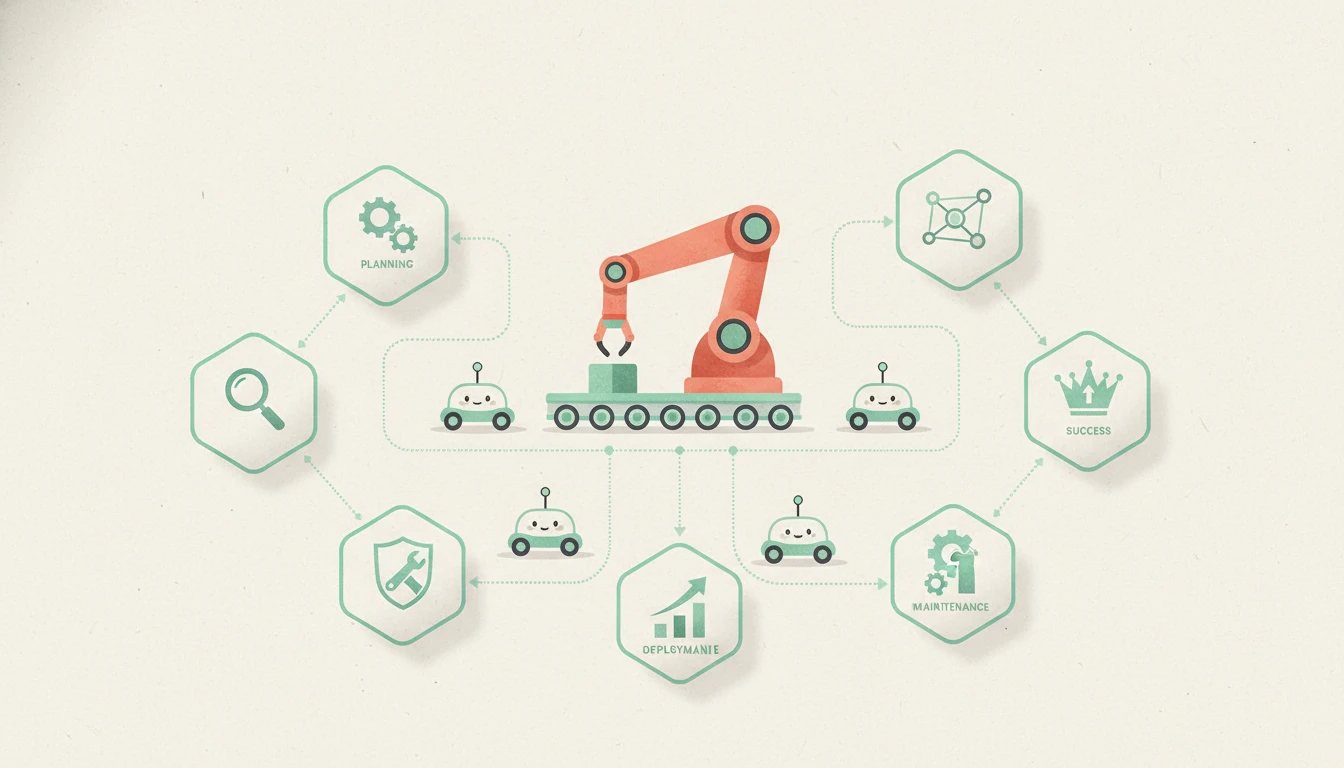
Is your factory still relying on manual carts and forklifts to move materials? Labor shortages are hitting hard, and customer demand for faster turnaround is relentless. Many manufacturers are exploring automation but get stuck at the first hurdle: Should I invest in an AGV (Automated Guided Vehicle) or an AMR (Autonomous Mobile Robot)? The confusion is real, and the wrong choice can cost you months of wasted time and budget.
This guide solves that confusion. You’ll learn the core differences between AGVs and AMRs, understand the tangible benefits of implementing them, and most importantly,get a clear, actionable 7-step implementation roadmap that works on any factory floor. By the end, you’ll be able to confidently evaluate your material flow, pick the right technology, and measure your ROI.
What Are AGVs and AMRs? Key Differences
Before diving into implementation, you must understand the fundamental difference between these two types of automated material handling equipment. They are not interchangeable; each excels in specific environments.
AGVs: Proven Reliability for Fixed Routes
An Autonomous Guided Vehicle (AGV) follows a predetermined, fixed path. Think of it as a robot that runs on invisible rails. It navigates using physical or painted lines on the floor, magnetic tape, embedded wires, or, in more advanced cases, laser reflectors placed at known locations.
- Navigation technologies: Most AGVs use magnetic tape (easy to install, cheap to replace) or inductive wire (buried in the floor, durable but expensive to modify). Some use laser navigation with reflectors mounted on walls or columns.
- Typical use cases: AGVs are ideal for repetitive, high-volume point-to-point transport within a well-defined area. Examples include moving raw materials from a central warehouse to a production cell, transporting pallets of finished goods to a stretch wrapper, or delivering heavy reels of wire in a cable factory. They shine when the route never changes.
- Limitations: Any obstacle on the path stops the AGV until the path is cleared. Changing a route requires physically modifying the floor (e.g., re-taping or cutting the floor to relocate the wire). This is not flexible.
AMRs: Flexibility and Scalability
An Autonomous Mobile Robot (AMR) is a step up in intelligence. Instead of following a fixed physical path, an AMR builds a digital map of its environment using sensors like LiDAR, cameras, and ultrasonic scanners. It then uses SLAM (Simultaneous Localization and Mapping) to navigate freely.
- Navigation technologies: AMRs rely on natural features (walls, pillars, machine bases) and dynamic obstacle detection. They don’t need floor tape or reflectors.
- Typical use cases: AMRs are perfect for dynamic environments where layouts change often, or where robots must interact with unpredictable human traffic. Examples include delivering components to multiple assembly stations on a flexible line, transporting tools to operators on a just-in-time basis, or moving finished goods from a packaging area to a shipping dock where the route changes daily.
- Advantages: If a pallet is left in the way, an AMR will replan its route and go around it. If a new machine is installed, you simply update the digital map. This flexibility makes AMRs highly scalable for Industry 4.0 factories.
When to Choose Which
Here’s a summary table to help you decide quickly:
| Criteria | AGV (Automated Guided Vehicle) | AMR (Autonomous Mobile Robot) |
|---|---|---|
| Path Flexibility | Fixed – requires physical infrastructure | Dynamic – replans routes on the fly |
| Initial Cost | Lower (as low as $10k per unit) | Higher (typically $20k-$100k per unit) |
| Payload Capacity | Moderate to High (up to 50 tons) | Low to Moderate (typically up to 1500 kg) |
| Speed | Moderate (1-2 m/s) | Moderate to high (1-2 m/s, but slower in crowded areas) |
| Safety | Requires defined safety zones and bumpers | Advanced obstacle avoidance; safer in mixed-traffic areas |
| Best for | Stable, high-volume, predictable routes | Flexible, dynamic, human-intensive environments |
Rule of thumb: If your factory layout hasn’t changed in five years and your routes are set in stone, an AGV is likely the more cost-effective choice. If you expect future layout changes, need to navigate around forklifts and workers, or have multiple drop-off points per route, go with an AMR.
Benefits of Implementing AGVs and AMRs
Automation isn’t just about replacing people; it’s about making your entire operation leaner, safer, and more responsive. The benefits of deploying AGVs or AMRs go far beyond simple labor reduction.
Tangible ROI: Labor and Productivity Gains
The most compelling reason to automate material handling is the direct impact on labor productivity. Manual transport,pushing carts or driving forklifts to move parts,is a huge time sink. Studies show that workers in warehouses and factories spend up to 60% of their time just walking or driving between tasks. An AMR can take over those trips entirely.
Real-world example: A mid-sized automotive parts manufacturer installed five AMRs to deliver components from the warehouse to 15 assembly stations. Previously, operators spent 45 minutes per shift walking to get parts. After deployment, that walking time was eliminated, allowing operators to focus on value-added assembly. The company reported a 50% increase in throughput within the first three months.
- Reduced labor dependency: With fewer people needed for transport, you mitigate the impact of labor shortages. You can reassign workers to higher-skilled tasks like quality inspection or machine tending.
- Increased throughput and error reduction: AGVs and AMRs follow precise routes and always go to the correct station. This eliminates “I thought you were going to bring that part” errors that cause line stoppages.
- Improved worker safety: Collision avoidance systems in AMRs (and basic bumpers in AGVs) reduce the risk of forklift-related accidents. Safety is a top priority,automation removes human-driver mistakes.
Scalability for Industry 4.0 and Smart Factories
Today’s factory must be able to pivot quickly. AGVs and AMRs are key enablers of factory automation and Industry 4.0 principles. Because they can be integrated with a Warehouse Management System (WMS) or Manufacturing Execution System (MES), they become part of a digital ecosystem. You can scale your fleet up or down as demand fluctuates, and you can re-task robots for new routes in minutes.
Market growth: The global AGV and AMR market is growing at a compound annual growth rate (CAGR) of approximately 15% from 2023 to 2030 (source: Grand View Research). This growth is driven by the need for flexible automation that can be deployed quickly without major facility modifications.
7-Step Implementation Guide for AGVs and AMRs
Now that you understand the technologies and their benefits, let’s walk through the proven process to deploy them successfully. Skipping any of these steps leads to costly rework.
Step 1: Conducting a Material Flow Audit
You cannot automate what you don’t understand. Start by mapping your current material flow. Walk the entire factory floor with a stopwatch and a notepad,or use a digital tool.
- Map all routes: Draw the paths that materials travel from receiving to production to shipping. Mark every stop: warehouse, in-process storage, assembly stations, inspection areas.
- Measure distances and frequencies: How many feet does a cart travel per shift? How many trips per hour? Identify the top 20% of routes that handle 80% of the volume.
- Identify bottlenecks: Where do carts or forklifts queue? Where do workers have to wait for material? These are prime candidates for automation.
- Assess floor conditions: Are there narrow aisles, ramps, elevators, or dirty areas? AGVs and AMRs have limitations,for example, some AMRs cannot climb steep ramps or operate on wet floors.
Actionable tip: Use a simple spreadsheet to document route ID, length, frequency, payload weight, and current transport method. This data will feed directly into your technical requirements.
Step 2: Defining Technical Requirements
Based on your audit, create a detailed checklist of requirements for each candidate route.
| Requirement | What to Specify | Why It Matters |
|---|---|---|
| Payload capacity | Weight of load + fixture | Avoids overloading robot and causing premature wear |
| Speed | Travel speed (m/s) and required cycle time | Determines number of robots needed to meet throughput |
| Floor surface | Concrete, epoxy, rough asphalt | Some robots have low ground clearance and get stuck on debris |
| Obstacles | Doorways, human traffic, moving machinery | AMRs need to handle dynamic obstacles; AGVs need clear paths |
| Height constraints | Underpasses, loading dock heights | Ensures robot dimensions fit physically |
| Interfaces | Doors, elevators, conveyors | May require custom integration (e.g., wireless door openers) |
Example: If your route requires crossing a main aisle where forklifts operate at high speed, an AMR with LiDAR and adaptive speed control is safer than an AGV that just stops when its safety bumper hits something.
Step 3: AGV vs AMR Selection Matrix
With your technical requirements in hand, use the following decision matrix to choose the right technology for each route. Not every route needs the same robot.
| Criterion | Score 1 (Strong AGV) | Score 3 (Neutral) | Score 5 (Strong AMR) |
|---|---|---|---|
| Route changes per year | 0-1 changes | 2-5 changes | >5 changes |
| Obstacle frequency (per hour) | <1 obstacle | 1-5 obstacles | >5 obstacles |
| Human interaction density | Low (only at pickup/drop) | Moderate | High (shared aisles) |
| Payload over 500 kg | Yes | Maybe | No |
| Layout stability | Very stable | Some changes | Frequent |
Add up the scores per route. A total score below 10 suggests a standard AGV will work efficiently. A score above 15 indicates that an AMR is necessary for the flexibility. For scores between 10 and 15, consider either; let cost and vendor support guide you.
Step 4: Select Vendor and Request Proofs of Concept
Never buy an AGV or AMR based solely on a brochure. The robot must work in your specific environment with your particular loads.
- Shortlist 2-3 vendors: Look for companies with experience in your industry. For example, a vendor who has deployed robots in automotive could help avoid pitfalls in your metalworking floor.
- Demand a proof of concept (PoC): Ask the vendor to bring a robot to your facility for a week. Run it on your actual route, with your actual loads. Pay attention to:
- Navigation accuracy at pickup/drop points (within ±2 cm is typical)
- Obstacle avoidance in real-world traffic
- Battery life under full payload
- Evaluate fleet management software: Can the vendor’s system handle fleet coordination, job scheduling, and system health monitoring? For larger deployments, this is critical.
A common mistake: Choosing the lowest upfront cost. A cheaper robot may require more maintenance, have poor support, or integrate poorly with your existing WMS. Total cost of ownership matters more.
Step 5: Plan Infrastructure
Even AMRs that don’t need floor tape require some infrastructure. Plan for:
- Charging stations: Designate areas where robots can autonomously dock. For a fleet of 10 robots, you’ll need at least 2-3 charging spots, considering shift cycles.
- Wi-Fi / 5G coverage: AGVs and AMRs rely on network connectivity for fleet management and software updates. Ensure strong, low-latency coverage throughout the route, especially near metal structures that block signals.
- Safety zones: Create physical barriers or warning signs around high-risk areas like elevators and busy crossings. For AGVs, install light curtains or pressure-sensitive mats at dangerous points.
- Floor marking (if needed): For AGVs, this means installing magnetic tape or wire. For AMRs, you may still want to paint visual cues (e.g., “robot lane” markings) to help workers anticipate robot movements.
Step 6: Pilot Test with a Small Fleet
Do not go straight to a 20-robot deployment. Start with one or two robots on a single, high-value route. Run the pilot for at least four weeks.
- Measure baseline vs. pilot: Before pilot, record the time and errors on that route manually. After pilot, compare the same metrics.
- Identify integration issues: Does the robot communicate correctly with your MES? Are drop-offs precise enough for the downstream equipment? Most problems surface in the first two weeks.
- Gather operator feedback: Workers will be skeptical at first. Listen to their concerns about safety or interference. Adjust robot speed or routes to address valid concerns.
- Fine-tune fleet management: Adjust task prioritization and charging schedules based on real usage patterns.
Step 7: Full Deployment and Integration with WMS/MES
Once the pilot proves success, scale up in phases. Add robots to the next priority routes, then integrate fully with your plant systems.
- Integration methods:
- Middlewares: Use a simple REST API or MQTT to send transport requests to the robot fleet manager.
- Direct connection: Some MES platforms (e.g., Siemens Opcenter, Rockwell FTPS) offer native robot connectors.
- Fleet management best practices:
- Implement traffic management rules (e.g., one robot yields at an intersection).
- Set battery thresholds: robots should return to charge when battery hits 30%.
- Use the software’s analytics to optimize routes over time.
Example integration flow: Your MES finishes a production order for part XYZ. It sends a “transport request” to the robot fleet manager: “Pick up pallet from station 3, deliver to warehouse zone A12.” The fleet manager assigns the closest idle AMR. After delivery, the AMR updates the MES, which then updates inventory.
Common Challenges and How to Overcome Them
Implementing AGVs or AMRs is not always smooth. Here are the top obstacles and how to address them.
Overcoming Integration Hurdles
The biggest technical challenge is connecting the robot fleet to your existing WMS, ERP, or MES. Each system may use different protocols (e.g., SQL, HTTP, OPC-UA).
Solution: Use a middleware platform like Robot Operating System (ROS) Industrial or a commercial integration layer. These tools translate messages between systems without custom programming for each pair. Many robot vendors also offer pre-built connectors for common WMS platforms (e.g., SAP EWM, Oracle WMS). Ask your vendor for a compatibility list before you buy.
Addressing Safety and Compliance
Safety standards for mobile robots are strict. In the U.S., you must comply with ANSI/ITSDF B56.5; in Europe, ISO 3691-4 governs safety requirements for driverless industrial trucks.
Key safety features required:
- Emergency stop buttons: Both on the robot and at charging stations.
- Safety bumpers or LiDAR: The robot must stop before impact.
- Speed limits in pedestrian zones: Usually below 1 m/s.
- Audible/visual alarms: Beeping sounds or flashing lights when moving.
Work with your vendor to conduct a risk assessment well before deployment. You may need to add guardrails or limit robot operation to certain times if human traffic is heavy.
Change Management and Worker Training
Your most expensive obstacle is the human one. Workers may fear losing their jobs or distrust the robots.
Actionable steps:
- Communicate early: Explain that robots will handle boring transport, freeing people for more valuable tasks.
- Train operators: Teach them how to interact with the robots,e.g., how to press the “call” button, how to load/unload safely.
- Create “robot zones”: ** Mark areas where workers should not stand when a robot is moving. Have open discussions about safety.
- Celebrate early wins:** After the pilot, share the productivity improvements with the whole team. Show them the tangible results.
ROI and Cost Considerations
Justifying the investment is easier when you calculate the numbers upfront.
Calculating Your Potential ROI
Use this simple formula:
ROI = (Annual labor savings + Productivity gains) / (Total equipment + installation + infrastructure cost)
Example calculation:
- Two operators currently transport materials each shift. Average cost per operator (including benefits): $45,000/year. Total labor savings from eliminating three operator positions: $135,000/year.
- Productivity gains (e.g., 10% less downtime): estimated $50,000/year.
- Total annual benefit: $185,000.
- Total cost of two AMRs + charging stations + floor markings + integration: approx $120,000.
- Payback period: $120,000 / $185,000 = 0.65 years ( ~8 months).
Cost ranges (2026 estimates):
| Component | Cost Range |
|-----------|------------|
| Basic AGV (magnetic tape) | $10,000 – $30,000 |
| Laser-guided AGV | $30,000 – $60,000 |
| Standard AMR (150 kg payload) | $20,000 – $40,000 |
| Heavy-duty AMR (500-1000 kg) | $50,000 – $100,000 |
| Fleet management software (annual) | $500 – $5,000 per robot |
| Infrastructure per route | $2,000 – $15,000 |
Total Cost of Ownership Table
| Category | Annual Cost (% of initial) | Notes |
|---|---|---|
| Maintenance | 5-10% | Includes battery replacement every 2-3 years |
| Battery charging | $200-$500 per robot per year | Electricity cost |
| Software support | $500-$2,000 per robot per year | |
| Floor tape replacement (AGV only) | $500-$2,000 per route per year | Degrades from forklift traffic |
Typical payback period: 1-3 years.
Future Trends in AGV and AMR Technology
The technology is evolving rapidly.
- 5G and IIoT integration: Ultra-low latency connections will allow real-time fleet coordination and remote monitoring across huge facilities.
- AI-driven path optimization: Machine learning algorithms will analyze traffic patterns and dynamically reroute robots to avoid congestion before it happens.
- Multi-robot collaboration: Future fleets will combine AGVs (for heavy, fixed routes) and AMRs (for flexible last-mile delivery) working under a single fleet manager.
- Battery advancements: Wireless induction charging and longer-lasting lithium batteries will eliminate downtime for swapping batteries.
- Mobile manipulators: AMRs with collaborative robotic arms will be able to pick parts from shelves and load them onto machines, not just transport them.
FAQs
1. What is the typical payback period for an AGV or AMR?
Most manufacturers see a payback between 1 and 3 years. It depends on labor cost, number of robots, and the efficiency gain. A simple replacement of one forklift driver can pay back in under 18 months.
2. Can AGVs and AMRs work together in the same factory?
Yes, with a unified fleet management system. For example, an AGV carries heavy pallets along a fixed corridor, then hands off to an AMR that delivers to individual workstations. The key is coordination: the two systems must “talk” to avoid collisions and manage handoffs.
3. How do I choose between an AGV and an AMR for my factory?
Start with the flexibility test: How often will routes change? If less than once a year, an AGV is cheaper. If more than three times a year, invest in an AMR. Also consider obstacle frequency and human interaction level.
4. What safety standards apply to AGVs and AMRs?
In the US, follow ANSI/ITSDF B56.5 (Safety Standard for Industrial Trucks – Driverless). In Europe, ISO 3691-4 applies. Your robot vendor must provide a Declaration of Conformity and a risk assessment document.
5. How long does a typical implementation take?
From audit to full deployment, expect 3–6 months for a small fleet (2–5 robots). Larger installations (10+ robots) can take 6–12 months, depending on integration complexity and infrastructure preparation.
Conclusion
Implementing AGVs or AMRs in your factory can dramatically improve material handling efficiency, reduce costs, and future-proof your operations for Industry 4.0. The key is to avoid jumping straight into buying hardware. Follow the 7-step guide: start with a thorough material flow audit, define your technical requirements, choose the right technology (AGV vs AMR), pilot with a small fleet, and integrate carefully.
Remember: the technology is just a tool. Success comes from planning, testing, and managing the human side of the change.
Written with LLaMaRush ❤️