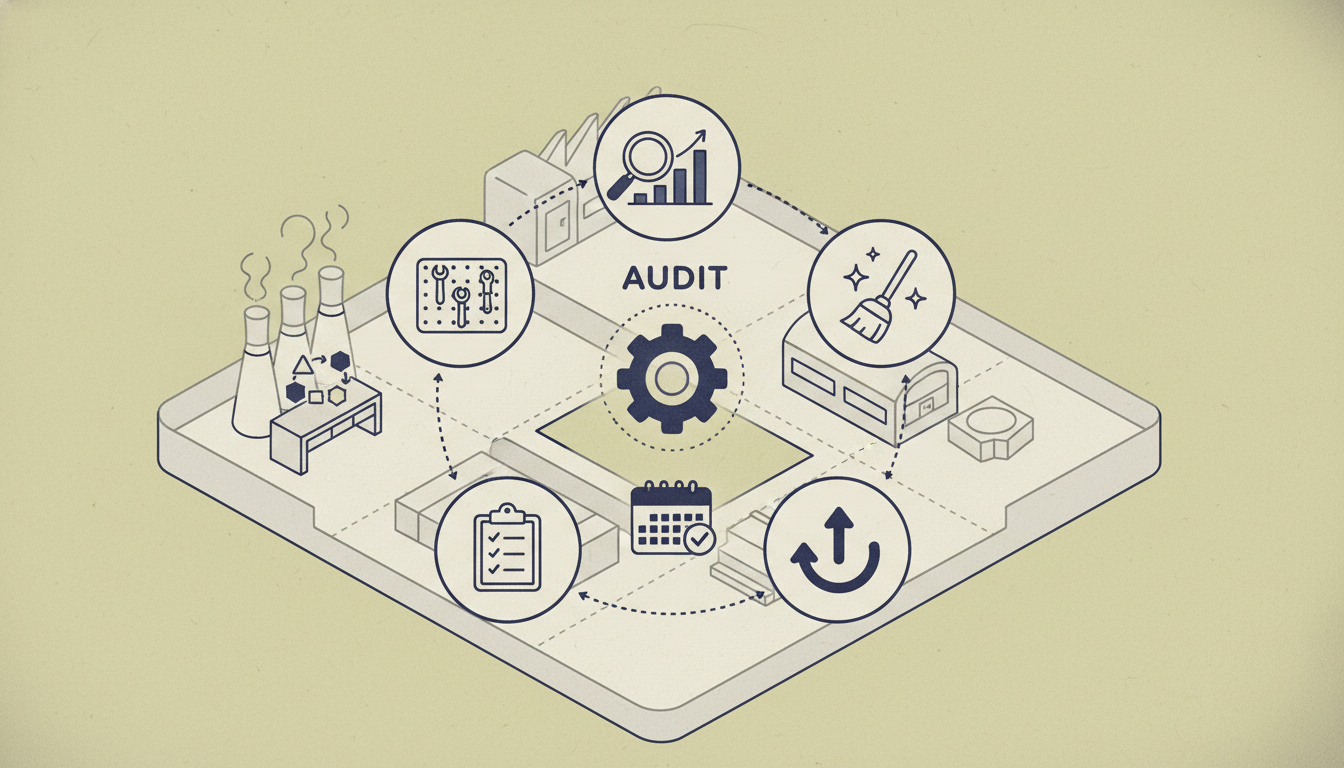
Why a 5S Audit Matters for Your Factory
A messy factory floor isn't just an eyesore,it's a drain on productivity, safety, and quality. When tools are scattered, workstations cluttered, and aisles obstructed, your team spends precious minutes hunting for what they need. These minutes add up, and the costs are staggering.
The Cost of a Disorganized Workspace
Research consistently shows that disorganization is a productivity killer. A study by the National Association of Manufacturers found that workers spend an average of 40–60 minutes per shift searching for tools, parts, or information. That's 8–12% of a workday wasted on the simple act of looking for things. In a factory with 50 production workers, this waste alone can cost over ₹80 lakhs annually in lost labor.
But the impact goes far beyond wasted time. Disorganized environments breed defects. When operators cannot easily find the correct tool or the right component, they are more likely to use substitutes or improvise, introducing variability and error. According to a report by the Lean Enterprise Institute, factories with poor workplace organization systems experience defect rates up to 30% higher than those with structured 5S programs. Defects mean rework, scrap, and worst of all, dissatisfied customers.
Safety is another critical casualty. Cluttered walkways, improperly stored materials, and unlabeled hazards directly contribute to workplace accidents. The Occupational Safety and Health Administration (OSHA) consistently reports that slips, trips, and falls,often caused by poor housekeeping,account for a significant portion of manufacturing injuries. A messy workspace isn't just inefficient; it's dangerous. The financial toll includes increased insurance premiums, regulatory fines, and lost worker productivity from injuries.
Most factory owners start a 5S initiative with good intentions. They spend a week sorting and organizing, and for a few weeks, the floor looks pristine. But without a structured system to maintain that order, entropy takes over. Tools migrate, supplies accumulate, and within a few months, the workspace looks as chaotic as before. This is the most common pitfall of 5S: the belief that organization is a one-time event.
How Audits Drive Continuous Improvement
A 5S audit is the mechanism that turns a temporary fix into a lasting discipline. It creates accountability. When employees know that their workspace will be evaluated regularly against a clear standard, they are motivated to maintain that standard daily. The audit is not about punishment; it is about identifying gaps before they become problems.
Audits provide the data necessary for continuous improvement, or Kaizen. A single audit snapshot tells you the current state. Comparing audit scores month over month reveals trends. Are scores improving? Are certain areas consistently struggling? This data-driven approach allows you to direct improvement efforts where they are most needed, rather than relying on gut feelings.
Furthermore, the act of auditing itself sustains 5S momentum. It forces regular engagement with the system. It makes 5S visible and part of the factory's rhythm. Audits ensure that the initial effort you invested in sorting, setting in order, and shining does not fade away. They transform 5S from a project into a habit.
The quantifiable benefits are clear. Factories that implement rigorous 5S audits report 20-50% reductions in search time, significant drops in workplace accidents, and measurable improvements in first-pass quality. Morale also improves; people prefer working in clean, organized, and safe environments. A well-executed 5S audit is not an administrative burden,it is a critical driver of lean manufacturing and overall factory efficiency.
Preparing for Your 5S Audit: Key Steps Before You Start
A successful audit doesn't happen by accident. It requires careful preparation. Before you set foot on the shop floor, you need a clear plan, a solid checklist, and a shared understanding of what "good" looks like. This preparation phase separates a productive audit from a chaotic walkthrough.
Creating an Effective 5S Audit Checklist
Your checklist is the blueprint for your audit. It must translate the abstract concepts of Sort, Set in Order, Shine, Standardize, and Sustain into concrete, observable criteria. A generic checklist is better than nothing, but the most effective checklist is customized to your specific factory.
For each of the 5 S's, define what you are looking for. For Sort (Seiri) , your checklist should include questions like:
- Are any unnecessary items, machines, or materials present in the work area?
- Are there items that have not been used in the past 30 days?
- Is the red tag area active and properly managed?
- Are disposal or relocation records being kept for tagged items?
For Set in Order (Seiton) , ask:
- Are tool boards (shadow boards) clearly labeled and tools in their designated place?
- Are floor markings (for walkways, work zones, storage areas) clear and up-to-date?
- Is there a designated location for everything, and is it easily identifiable?
- Can an operator find any required tool or material within 30 seconds?
For Shine (Seiso) , include:
- Are machines, workbenches, and tools clean and free of grime, dust, or oil?
- Are floors clean and free of debris?
- Are cleaning schedules posted and logs being maintained?
- Are employees performing regular cleaning as part of their daily routine?
For Standardize (Seiketsu) , look for:
- Are visual standards (photos, charts) posted at each workstation showing the "ideal" state?
- Are Standard Operating Procedures (SOPs) for 5S tasks available and current?
- Is the same level of order and cleanliness maintained across different shifts?
- Are there clear visual controls, like color-coded floor tape or Kanban cards?
For Sustain (Shitsuke) , evaluate:
- Have all employees received recent 5S training?
- Are 5S audits being performed on a consistent schedule?
- Is there evidence of employee participation in 5S improvement suggestions?
- Are there consequences for non-compliance and rewards for excellence?
Your checklist should be a living document. Start with these generic criteria and refine them after each audit. If you notice issues that aren't covered, add them. If certain items consistently pass, consider whether they are still relevant.
Understanding Scoring Systems
An objective scoring system is essential for tracking progress and comparing results. The most common approach is a 1-to-5 scale, where:
- 1 = Poor / Non-existent (nothing is done, area is a mess)
- 2 = Below Average / Needs Improvement (efforts are visible but inconsistent)
- 3 = Average / Meets Minimum Standard (basic elements are in place but not robust)
- 4 = Good / Exceeds Standard (area is well-organized and maintained)
- 5 = Excellent / World-Class (area serves as a model for others, continuous improvement is evident)
Alongside each score, define the specific criteria. For example, for a "Set in Order" item like "Tool board is properly shadowed," a score of "3" might mean "most tools have a shadow, but some are missing or incorrectly placed." A score of "5" might mean "every tool is present in its correct shadow, shadows are clearly painted, and the board is inspected weekly."
Some factories prefer a simpler A-B-C grading (Green-Yellow-Red traffic light), which can be more intuitive for quickly communicating status. Either system works; the key is consistency. Define your standards clearly on the checklist itself, so every auditor applies the same criteria.
Before the audit, assemble your audit team. A cross-functional team is best. Include a supervisor from the area being audited, a production operator, a member from quality, and a representative from maintenance. This diverse perspective ensures a more thorough and fair evaluation. Brief the team on the scoring system and the checklist to eliminate ambiguity. Ensure you have all necessary tools: copies of the checklist, a scoring sheet, a camera for photographic evidence, and any previous audit reports for comparison.
Step-by-Step 5S Audit Process: The 5S Methodology in Action
Now, let's walk through the actual audit process. You have your team, your checklist, and your scoring system. It's time to move through the factory and evaluate each of the 5 S's systematically.
Sort (Seiri) – Eliminate Clutter
The first step is to assess whether the area has been properly sorted. As you walk through, your eyes should be drawn to anything that doesn't belong. Look for items that are out of place: a pallet of old parts stored in a corner, a machine that hasn't run in six months, boxes of obsolete paperwork piled on a shelf.
Specifically, check the red tag area. Is it being used? Are there items there with clear tags indicating their status and a date for review? A healthy red tag process means items are being actively evaluated and removed, not accumulating. If you find the red tag area itself is cluttered with forgotten items, that is a major finding.
Inspect the workstations themselves. Are only the tools and materials needed for the current production run present? Excess inventory on the floor is a clear sign poor sorting. Look for personal items, old fixtures, or broken equipment that should have been removed. Observe the flow. Would a new operator be able to step in and immediately identify what is necessary and what is not? A well-sorted area has a sense of minimalism and purpose. Remember, "when in doubt, move it out" is the mantra, but only if it is truly documented.
Set in Order (Seiton) – Organize Everything
Once sorting is confirmed, evaluate how things are organized. This is where the principle of "a place for everything, and everything in its place" is tested. Examine the shadow boards and tool storage. Are the tools actually in their designated slots? Are the outlines clear and recognizable? Check that high-use tools are closest to the point of use, while infrequently used items are stored further away.
Look at floor markings. Are the walkways clearly defined and free of obstruction? Are the storage locations for pallets, bins, and waste containers marked on the floor? If you see tape peeling, lines faded, or materials stacked outside the designated zones, score accordingly.
Accessibility is a key measure. Can an operator easily and quickly retrieve any needed item without stretching, bending, or searching? Observe the workflow. Does the physical layout of the workstation support a logical sequence of operations, or does it force the operator to take unnecessary steps? Good set in order means minimal movement and maximum efficiency. It is about creating a workspace that works with the operator, not against them.
Shine (Seiso) – Clean to Inspect
Shine is not just about aesthetics; it is about creating a condition where you can inspect. A clean machine allows you to see leaks, cracks, loose parts, and other potential failures before they cause breakdowns. As you audit, look at the state of the equipment.
Run your finger along a beam or under a machine. Is it greasy or dusty? Inspect the cleaning logs. Are they being filled out daily? Is the cleaning schedule followed? Who is responsible for each specific cleaning task? A common mistake is that cleaning is done sporadically or only before an audit. Look for signs that cleaning is truly a daily routine.
Check the overall condition of the factory environment. Are floors swept and free of debris? Are spills cleaned up promptly? Are trash bins emptied regularly? Observe the culture. Do employees appear to take pride in their clean workspace? A truly shining area is one where cleanliness is a source of pride and a non-negotiable standard. The goal is to create a workspace that is so clean that anomalies stand out immediately.
Standardize (Seiketsu) – Make It Routine
Standardization is the glue that holds the first three S's together. It ensures that the improvements made in Sort, Set in Order, and Shine are maintained consistently. As you audit, look for visual standards. Are there clear, up-to-date photographs at each workstation showing the ideal state of the area? Are there quick reference guides for cleaning tasks?
Check if the Standard Operating Procedures (SOPs) for 5S tasks are accessible and easy to follow. Are they posted near the relevant equipment? Do they contain clear steps and visual aids? A key test is shift-to-shift consistency. Visit an area that works multiple shifts. If the day shift is organized but the night shift is a mess, standardization has failed.
Look for visual controls like color-coded floor tape, clear labels on shelves, and indicators showing where items should be placed. A standardized area communicates its own rules without the need for verbal explanations. It is a work environment where the "how" of organization is obvious and consistent.
Sustain (Shitsuke) – Build the Habit
The final 'S' is the hardest and most important. It assesses the discipline and culture of 5S within the team. Review training records. Have all current employees completed 5S training? Is refresher training offered periodically? Look for evidence that 5S is part of new employee onboarding.
Check the audit history itself. Are audits being conducted on schedule? Are the results being reviewed by management? Are action items from previous audits being closed out? A common symptom of weak sustain is a pattern of declining audit scores or the same issues appearing round after round.
Most importantly, talk to the employees. Do they understand what 5S is and why it matters? Do they feel empowered to suggest improvements? Are they engaged in the daily maintenance of their workspace? A high score in sustain means that 5S is not an externally imposed program; it is a deeply ingrained habit practiced by every single person on the floor.
Scoring and Documenting Your 5S Audit Results
As you complete the audit walkthrough, your team will have a checklist filled with scores and observations. The next step is to transform this raw data into a clear, actionable report.
Creating a Visual Audit Scoreboard
The most effective way to present audit results is through a visual scorecard. A simple table with traffic-light color coding allows management and teams to instantly understand the status of every area. Here is an example format for a single area:
| Area | Sort | Set in Order | Shine | Standardize | Sustain | Total Score (out of 25) | Status |
|---|---|---|---|---|---|---|---|
| Assembly Line A | 4 | 5 | 3 | 4 | 4 | 20 / 25 | Green |
| Machining Cell 1 | 2 | 3 | 2 | 2 | 1 | 10 / 25 | Red |
| Warehouse B | 5 | 4 | 4 | 3 | 3 | 19 / 25 | Yellow |
The Status column uses a simple traffic-light system:
- Green (e.g., 18+ / 25 or 72%+): Area is well-maintained, meet or exceed standards.
- Yellow (e.g., 14-17 / 25 or 56%-71%): Area meets minimum standards but has clear gaps.
- Red (e.g., <14 / 25 or <56%): Area has significant non-conformances and requires immediate attention.
This scoreboard should be displayed prominently in the factory, updated after every audit cycle. It creates visual management and healthy competition between teams. Areas that are consistently green become models of excellence. Areas in red become focal points for improvement.
Best Practices for Recording Observations
Scoring alone is not enough. The true value of an audit lies in the detailed observations that explain the score. Take photographs. Before you start the audit, capture the current state of the area. During the audit, take specific photos of both good and bad examples. A picture of a cluttered workstation is more powerful than any written description.
For each non-conformance, be specific. Instead of writing "Sort is poor," write: "Sort – Near welding booth #3, three expired welding gas cylinders and a pile of scrap steel shavings were found. Red tag area was empty, indicating no recent sorting activity." Assign a clear action item with an owner and a due date.
For instance, in the audit report, you would record:
- Issue: Expired gas cylinders in unsafe storage.
- Action: Remove cylinders. Schedule waste disposal pickup.
- Owner: Maintenance Supervisor (Ravi S.)
- Due Date: 10 April 2026
This creates accountability. No finding is left dangling. Every observation becomes a problem to be solved.
Post-Audit: Turning Findings into Actionable Improvements
An audit is only as valuable as the actions it triggers. The final and most critical phase is closing the loop. Collect your data, photographs, and action items, and transform them into a concrete improvement plan.
Developing a 5S Improvement Plan
Convene a post-audit review meeting with the area supervisor, team leads, and relevant support functions (maintenance, quality, safety). Go through the findings one by one. Use a simple table to track the improvement efforts:
| Issue (from Audit) | Root Cause | Corrective Action | Owner | Due Date | Status |
|---|---|---|---|---|---|
| Tool board missing wrenches | No standard for tool inspection frequency | Implement weekly tool inventory checklist | Line Supervisor | 15 Apr 2026 | Open |
| Red tag area overflowing | No defined process for reviewing red tagged items | Create monthly red tag review meeting with shift supervisors | Production Manager | 20 Apr 2026 | Open |
| Cleaning schedule not followed | SOP is not posted, unclear ownership | Update and post cleaning SOP at each workstation | Shift Lead | 12 Apr 2026 | In Progress |
This table turns the audit from a report card into a project plan. Prioritize actions using an urgency matrix. Critical safety issues (like blocked fire exits) must be fixed immediately (within hours). Process issues (like missing shadow boards) can be scheduled over the next week. Cultural issues (like lack of employee engagement) may require a longer-term Kaizen event.
Sustaining Improvements with Regular Audits
One audit is not enough. The goal is to build a rhythm. Conduct audits monthly for most areas. New areas or those with low scores may need bi-weekly audits until they improve. Rotate the audit team members. A fresh pair of eyes can spot issues that the regular team may overlook.
Celebrate wins. When an area moves from Red to Green, acknowledge the team publicly. A simple recognition in a team meeting or a "Cleanest Area of the Month" award goes a long way in maintaining morale and engagement. 5S is a journey, not a destination.
Frequently Asked Questions about 5S Audits
1. How often should a 5S audit be performed?
For most manufacturing environments, a monthly audit is a good cadence. High-risk areas, such as chemical storage or assembly lines with high defect rates, may benefit from weekly or bi-weekly audits. The key is to find a frequency that provides consistent, useful data without becoming a burden.
2. Who should be on the 5S audit team?
A cross-functional team is highly recommended. Include a supervisor from the area being audited, an operator, a quality representative, and a safety officer. Rotating team members ensures fresh perspectives and prevents bias. Never audit your own area alone.
3. What is the biggest mistake in 5S auditing?
Auditing for show. Some teams clean up only before an audit, giving a false sense of security. The audit's goal is to capture the daily reality, not the "audited" state. Be honest. The only way to improve is to see the real picture. Another major mistake is not following up on action items.
4. Can a 5S audit be used for safety compliance?
Absolutely. A well-structured 5S audit directly addresses many safety hazards. Trips (from clutter), fires (from improper storage), and ergonomic issues (from poor organization) are all identified during a 5S audit. Many organizations integrate 5S audits with their safety inspection checklists to create a single, powerful tool.
Conclusion
A structured 5S audit is the backbone of a lean factory. It is the systematic process that exposes waste, reinforces standards, and builds a culture of continuous improvement. Without it, your initial 5S efforts will fade. With it, you build a self-sustaining system for workplace organization that boosts productivity, safety, and quality.
Key Takeaway: A well-executed 5S audit is the backbone of a lean factory,it exposes waste, reinforces standards, and drives a culture of continuous improvement. Do not let your initial organization effort be a one-time event. Transform it into a living, breathing process through regular, structured audits.
Call to Action: Ready to start your first audit? Download our free, customizable 5S Audit Checklist Template and take the first step towards a cleaner, safer, and more efficient factory floor today.
Written with LLaMaRush ❤️