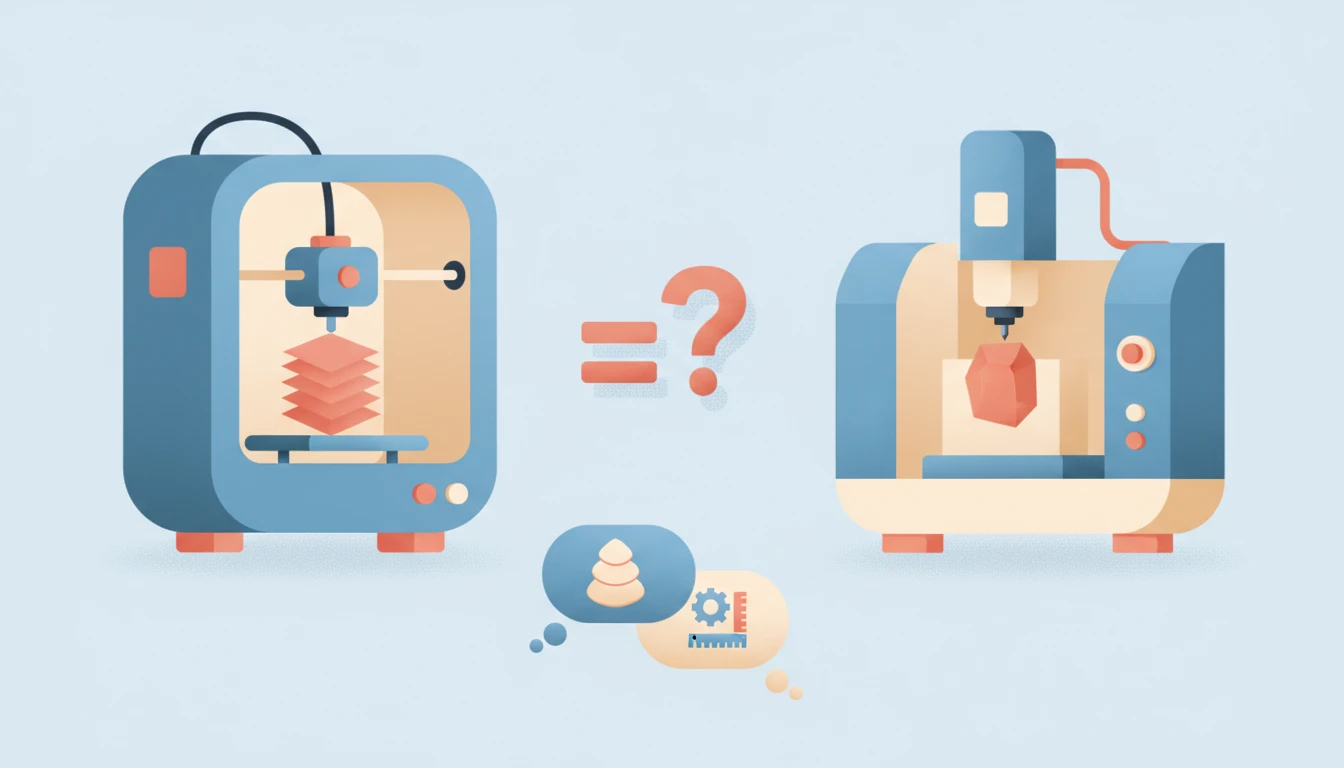
Choosing between 3D printing and CNC machining isn't just a technical decision—it's a strategic one that determines your project's timeline, budget, and ultimate success. Getting it wrong means wasted resources, delayed launches, and parts that don’t perform. Understanding the core differences, strengths, and ideal applications of these two powerhouse technologies is the key to making an informed, confident decision for your manufacturing project.
This guide will strip away the hype and give you a clear, actionable comparison. You'll gain the insights needed to evaluate your project's specific requirements—whether it's a one-off prototype, a complex final-use part, or a full production run—and select the technology that offers the best balance of precision, cost, and efficiency.
Overview of 3D Printing and CNC Machining
At their heart, 3D printing and CNC machining are fundamentally different approaches to making objects. Understanding this core difference is the first step to choosing correctly.
3D printing, also known as additive manufacturing, is a process of creating a three-dimensional object layer by layer from a digital file. The process starts with nothing and adds material precisely where it's needed. Think of it like building a brick wall, one brick (or layer) at a time. Common technologies include Fused Deposition Modeling (FDM), which melts and extrudes plastic filament, and Stereolithography (SLA), which uses a laser to cure liquid resin into solid plastic. For metals, technologies like Direct Metal Laser Sintering (DMLS) fuse fine metal powders.
CNC machining technology, or Computer Numerical Control machining, is a subtractive process. It starts with a solid block of material (called a blank or workpiece) and uses precisely controlled cutting tools to remove material, carving out the desired shape. It’s akin to a sculptor starting with a block of marble and chiseling away everything that isn’t the statue. Common operations include milling, turning, and drilling, performed by machines like CNC mills and lathes.
The history of 3D printing dates back to the 1980s with the invention of stereolithography. Initially used for rapid prototyping, it was famously called "rapid prototyping technology." Over decades, it evolved from producing fragile concept models to manufacturing durable, end-use parts in aerospace and healthcare. CNC machining has deeper roots, evolving from manually operated machine tools in the 1940s and 50s. The integration of computer control in the 1970s revolutionized it, enabling the high-precision, automated production we see today.
The materials for CNC machining are vast, encompassing nearly any engineering-grade solid material. This includes metals like aluminum, stainless steel, titanium, and brass, as well as plastics like ABS, Nylon, and PEEK, and even wood and composites. The material starts in a fully dense, wrought state, meaning the final part inherits the excellent mechanical properties of the raw block.
In contrast, 3D printing materials are often formulated specifically for the additive process. For plastics, these include photopolymer resins (for SLA), thermoplastic filaments (for FDM) like PLA and ABS, and fine nylon or composite powders (for SLS). For metal 3D printing, specialized alloys in powder form are used, such as titanium Ti64 or stainless steel 316L. The properties of a 3D-printed part are anisotropic—stronger in the direction of the layer build—and depend heavily on the printing process parameters.
| Feature | 3D Printing (Additive) | CNC Machining (Subtractive) |
|---|---|---|
| Core Process | Adds material layer by layer | Removes material from a solid block |
| Material Start Form | Filament, Resin, Powder | Solid Block, Bar, Sheet |
| Geometric Freedom | Extremely high (complex internal structures) | High, but limited by tool access |
| Waste Generation | Low (only support material) | High (significant material removed) |
| Best for Complexity | Organic shapes, lattices, internal channels | Prismatic shapes, high-tolerance features |
Comparing Costs and Efficiency
The cost comparison between 3D printing and CNC is not a simple "which is cheaper?" question. It's a nuanced analysis that shifts dramatically based on volume, part complexity, and required material. Efficiency, too, is measured differently for each.
For setup costs, 3D printing generally has a significant advantage for prototyping and low-volume production. There are no custom jigs or fixtures needed. The cost is primarily in preparing the digital file (slicing) and setting up the printer. This makes it exceptionally economical for one-off parts or small batches. The cost per part remains relatively constant in low volumes. CNC machining setup involves higher initial costs. A machinist must program tool paths, design and set up fixtures to hold the workpiece, and select and calibrate cutting tools. This front-loaded time and cost are then amortized over the production run, making CNC per-part costs drop significantly at higher volumes.
Material costs tell another story. 3D printing materials, especially engineering-grade photopolymers and metal powders, are often more expensive per kilogram than their raw stock counterparts for CNC. However, 3D printing’s production efficiency in material usage is superior for complex parts. Since you only use material where the part exists, waste is minimal (often limited to support structures). CNC machining, as a subtractive process, can sometimes remove over 90% of the original block, turning expensive material into chips and scrap. For a part made from a costly metal like titanium, this waste factor becomes a major cost driver.
Time efficiency in production cycles also varies. 3D printing has a "hands-off" advantage once printing begins. A machine can run overnight to produce a part, with no operator intervention. However, print speed is largely fixed by the technology and layer height; making ten copies often takes ten times as long as making one. CNC machining can be slower for a single, highly complex part due to programming and setup, but it shines in volume. Once the CNC machine is set up and running, cycle times per part can be very fast, and multiple parts can often be machined simultaneously on a single fixture.
Consider these economic considerations:
* Small Scale/Prototyping: 3D printing is typically faster and cheaper. You can iterate designs overnight for minimal cost.
* Medium to Large Scale Production: CNC machining often becomes more cost-effective. The high initial setup cost is spread over many units, and the per-unit machine time drops.
* Part Complexity: Here, 3D printing can reverse the cost dynamic. A part with intricate internal channels or an organic lattice structure might be impossible or astronomically expensive to machine but can be printed for a fraction of the cost and time.
Maintenance costs for CNC machining are generally higher. The mechanical systems involve high-speed spindles, precision linear guides, and cutting tools that wear and break. Regular lubrication, calibration, and tool replacement are ongoing expenses. 3D printers, especially industrial-grade ones, also require maintenance (like cleaning optics in laser systems or replacing build tanks), but the moving parts and consumables are often less costly.
Actionable Tip: For your next project, don't just ask for a quote. Provide your digital model to both a 3D printing service and a CNC shop and request a cost breakdown for quantities of 1, 10, and 100. This will visually reveal the crossover point where one technology becomes more economical than the other.
Applications and Suitability
Choosing the right technology isn't about which one is "better"; it's about which one is best suited for your specific project. Their strengths naturally lead them to dominate different sectors of manufacturing.
Ideal applications for 3D printing leverage its design freedom, speed for complex geometries, and efficiency for low volumes.
* Prototyping: Rapid creation of visual, functional, and pre-production prototypes.
* Tooling & Jigs: Custom manufacturing aids, assembly jigs, and lightweight composite tooling.
* Complex, Lightweight Parts: Components with organic shapes, internal cooling channels (for molds or heat exchangers), or lattice structures to reduce weight.
* Small-Batch & On-Demand Production: For parts where traditional tooling (like injection molds) would be prohibitively expensive, such as legacy part replacement or medical devices customized to patient anatomy.
Ideal applications for CNC machining leverage its unparalleled precision, material versatility, and strength.
* High-Precision Functional Parts: Components with tight tolerances (often within ±0.025mm or less), such as engine blocks, surgical instruments, or optical mounts.
* Parts from Specific Engineering Materials: When a project requires a particular grade of aluminum, stainless steel, or specialty plastic with certified mechanical properties.
* Large-Scale Production Runs: Once the initial setup is complete, CNC provides fast, consistent, and repeatable production of hundreds or thousands of parts.
* Parts Requiring Excellent Surface Finish: CNC-milled parts often come off the machine with a ready-to-use surface, while 3D-printed parts typically require post-processing.
Case Study: 3D Printing in Aerospace
The aerospace industry is a leading adopter of 3D printing, driven by the relentless need to reduce weight, consolidate assemblies, and produce complex, high-performance parts. A landmark example is General Electric's LEAP fuel nozzle. Traditionally, this component was assembled from 20 individually machined and brazed parts. Using Direct Metal Laser Sintering (DMLS), GE now prints it as a single, unified piece.
The result is a revolution in parts manufacturing: the 3D-printed nozzle is 25% lighter and five times more durable than its predecessor. It also demonstrated the power of design for additive manufacturing (DfAM)—the internal pathways for fuel and air are optimized in geometries impossible to machine, improving cooling and efficiency. This single part consolidation simplified the supply chain, reduced potential failure points, and significantly cut assembly time. This case shows that when the application calls for extreme complexity, weight reduction, and part consolidation, 3D printing isn't just an alternative; it's the enabling technology.
Case Study: CNC Machining in Automotive
In the automotive world, where reliability, high-volume production, and material performance are non-negotiable, CNC machining plays a critical role. Consider the production of a high-performance aluminum brake caliper. This part must withstand immense clamping forces, resist heat and vibration, and maintain perfect dimensional accuracy for the brake pads and piston.
CNC machining is ideal for this task. A forged aluminum blank is mounted on a multi-axis CNC mill. The machine uses a series of precise cutting tools to carve out the piston bores, bolt holes, fluid passages, and complex internal cavities. The process ensures tight tolerances across thousands of identical parts, guaranteeing that every caliper fits perfectly and functions safely. The final part benefits from the superior strength and thermal properties of the wrought aluminum block. While 3D printing is used for prototyping caliper designs and creating custom low-volume pieces, the high-precision automotive components for mass-market vehicles rely on the speed, consistency, and material integrity provided by CNC machining.
Key factors to consider when choosing:
* Volume: Low volume favors 3D printing; high volume favors CNC.
* Lead Time: For a single part, 3D printing is often faster. For 100 parts, CNC may be quicker.
* Geometry: Internal complexity favors 3D printing; simple, prismatic shapes favor CNC.
* Material & Strength: Need a specific, certified metal alloy? Likely CNC. Need a complex geometry in nylon or resin? Likely 3D printing.
* Budget: Analyze total cost across your expected volume, not just unit price.
Future Trends and Innovations
The landscape of manufacturing is not static. Both 3D printing and CNC machining are evolving, with emerging trends pointing toward a more integrated, intelligent, and capable future.
Emerging trends in 3D printing are focused on speed, scale, and material diversity. New technologies like Continuous Liquid Interface Production (CLIP) from Carbon are dramatically increasing print speeds, making additive manufacturing more viable for higher-volume production. Large-format 3D printing is moving beyond prototypes to full-scale tooling and even direct printing of architectural components and car bodies. Furthermore, the future of 3D printing includes multi-material printing, allowing different properties (flexible and rigid, conductive and insulating) within a single print job, and the expansion into new materials like continuous fiber composites and specialized ceramics.
CNC machining innovations are heavily centered on automation and connectivity. The rise of automation in CNC machining through robotic part loading/unloading and integrated pallet systems is creating "lights-out" manufacturing cells that can run unattended for days. AI in manufacturing is making inroads through predictive maintenance—using machine learning algorithms to analyze spindle vibration and power consumption to predict tool failure before it causes a scrapped part. Furthermore, hybrid manufacturing machines, which combine CNC milling with a laser metal deposition (LMD) 3D printing head, are blurring the lines between additive and subtractive, allowing for features to be added onto a machined base part or for complex printed shapes to be finished to a high tolerance in the same setup.
Looking ahead, we can make several predictions for the future of manufacturing technologies:
1. Convergence, Not Competition: The future belongs to smart factories where 3D printing and CNC machining work in tandem. A part might be 3D printed near-net-shape for its complex geometry and then finish-machined on a CNC to achieve critical tolerances and surface finishes—all within a single digital workflow.
2. The Digital Thread Will Dominate: From CAD file to final inspection, data will flow seamlessly. This will enable true mass customization, where the cost of producing a batch of 10 unique parts approaches the cost of 10 identical ones.
3. Sustainability as a Driver: 3D printing's material efficiency will be a major advantage. CNC will respond with better recycling of metal chips and more efficient tool paths generated by AI to minimize waste. The choice of technology will increasingly factor in environmental impact.
Conclusion
The debate between 3D printing and CNC machining isn't about crowning a winner. It's about understanding two powerful, complementary tools in the modern manufacturer's toolkit. 3D printing excels at complexity, design freedom, and low-volume agility, while CNC machining is the undisputed champion of precision, material strength, and high-volume efficiency.
The key takeaway is clear: The best choice depends entirely on your specific project needs. Evaluate your priorities—is it speed to prototype, final part strength, per-unit cost at 10,000 units, or the ability to create an impossible geometry? By weighing factors like volume, complexity, material, and budget against the core strengths of each technology outlined here, you can move from confusion to confidence.
Don't leave your project's success to chance. If you're still weighing the options for a critical component or production run, expert guidance can save you time and money.
Contact us to discuss which technology is the right fit for your manufacturing project. Our team can analyze your design, requirements, and goals to provide a clear, data-backed recommendation.
Written with LLaMaRush ❤️