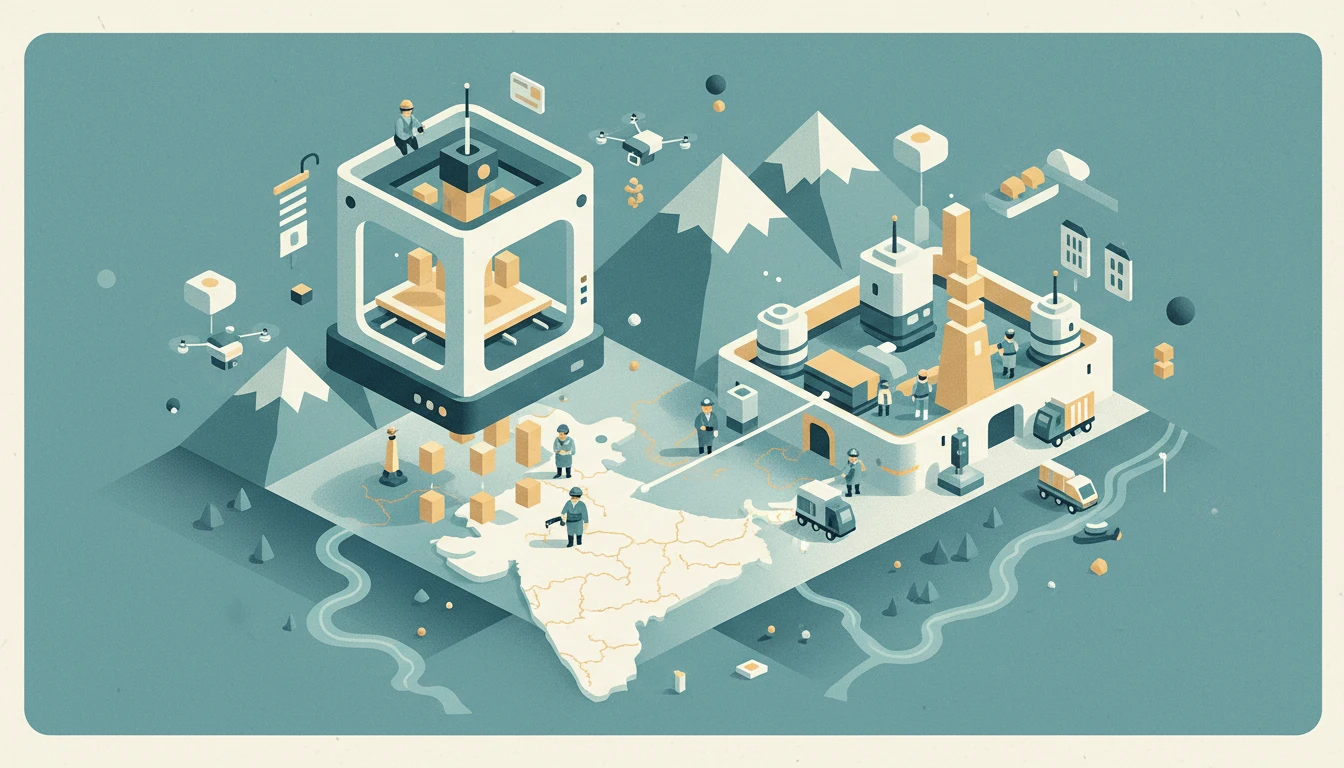
On India's highest and most hostile frontiers, where sub-zero temperatures and oxygen-thin air render traditional construction nearly impossible, a new class of strategic asset is being deployed. This weapon isn’t fired from a barrel but extruded from a nozzle, building protective fortifications layer by robotic layer at a pace that outmaneuvers any adversary. This is the reality of 3D printing construction on India's high-altitude borders, a technological leap transforming a critical military vulnerability into a formidable combat multiplier.
For decades, building infrastructure in regions like Ladakh has been a slow, perilous, and logistically monstrous task. This guide demystifies the breakthrough initiatives, such as Project Prabal, that are solving this existential problem. We’ll move past the novelty to analyze the concrete tactical advantages, dissect the enabling technology, honestly assess the hurdles to scale, and explore what this means for the future of both defense engineering and civilian construction. You will understand why, in modern conflict, the ability to build quickly and securely is itself a decisive weapon.
The Battlefield Problem: Why Traditional Building Fails at the Frontier
The fundamental challenge of frontier defense isn't just holding territory; it's sustaining a presence there. Traditional construction methods, honed for stable, accessible environments, become a crippling liability in the world's highest combat zones. The process,transporting thousands of bags of cement, steel rebar, wooden formwork, and a large crew along winding, exposed roads,is not just slow; it's a glaring strategic weakness.
Case in Point: The Weeks-Long Bunker vs. The Overnight Fortress
Consider two scenarios. In the first, a convoy of trucks labors up a precarious mountain road, vulnerable to disruption, ambush, or artillery fire. Upon arrival, soldiers and civilian laborers mix cement in the extreme cold, where workability plummets from over an hour to just 30 minutes. They assemble formwork and painstakingly pour concrete over days, all while exposed to the elements and enemy surveillance. A single bunker can take weeks.
Contrast this with the new paradigm: a helicopter airlifts a single, palletized robotic printer system and a small team of operators to a forward post. Within hours, the machine is calibrated. Using locally sourced sand and cement, it begins autonomously printing a fortified structure. By the next morning, a complete, blast-resistant bunker stands where there was only empty ground the day before. This shift isn't incremental; it's revolutionary.
The core issues with traditional methods are systemic:
- Logistics as a Vulnerability: Every truck on a high-altitude road is a target. The military logistics vulnerability is immense, requiring massive manpower and vehicle resources just to move building materials, diverting them from other critical missions.
- The 'Time Equals Risk' Equation: Prolonged construction creates a fixed, predictable target. For weeks, troops are exposed at a known location, susceptible to drone surveillance and precision strikes. In modern fluid warfare against peer adversaries, this prolonged exposure is unacceptable.
- Environmental Degradation: The high-altitude construction challenges are severe. Extreme cold (-30°C and below) prevents concrete from curing properly without complex heating setups. Low oxygen saps human labor efficiency, slowing work to a crawl and increasing error rates.
- The Strategic Imperative: Modern conflicts demand agility. The ability to rapidly establish, reinforce, or relocate defensive positions is a key tactical advantage. Traditional building, by its very nature, is slow and static,antithetical to this need.
Project Prabal: The Technical Blueprint of a Construction Weapon
The answer to these challenges materialized as Project Prabal, a pioneering initiative by the Indian Army's Military Engineer Services (MES) in collaboration with indigenous startups. This isn't just a printer; it's a fully integrated, battlefield-ready construction system designed from the ground up for forward deployment.
The system's design principles directly counter traditional weaknesses. The core is a portable robotic arm built to be disassembled, palletized, and airlifted by helicopter or heavy-lift transport aircraft. On-site, a small crew can reassemble it on its mobile platform in a matter of hours. This portability is the first step in breaking the logistics chain.
Material Innovation was equally critical. Instead of relying on a complex cocktail of imported or specially formulated mixes, the system is designed to use locally available sand and aggregate, combined with cement and special admixtures that ensure printability in cold weather. This bypasses fragile supply chains and allows troops to "print from the land."
Perhaps the most significant breakthrough was printing the unprintable. Early 3D construction printing was limited to above-ground, vertical walls. For military use, the most valuable structures are often underground or semi-buried. Project Prabal's team solved the geometry and software challenges of printing the roofs of underground tunnels and the interiors of buried bunkers from the inside, a feat impossible with traditional formwork.
This technology wasn't deployed on a hunch. Its adoption was driven by proven performance in rigorous testing. Live-fire ballistic trials and computer simulations demonstrated that the layered, monolithic print pattern of these structures offered superior blast and ballistic resistance compared to traditional brick or concrete block fortifications. The absence of mortar joints,a point of failure in conventional masonry,creates a more cohesive, resilient structure.
| Feature | Traditional Bunker | 3D-Printed Bunker (Project Prabal) |
|---|---|---|
| Construction Time | 2-3 Weeks | 36-48 Hours |
| Manpower Required | 20-30+ (Laborers, Masons, Supervisors) | 3-5 (Machine Operators) |
| Logistical Footprint | 10+ Truckloads of materials | 1-2 Helicopter Sorties (Printer + Base Materials) |
| Material Source | Complex supply chain | Primarily local sand/aggregate |
| Design Flexibility | Limited to simple geometries | High (Complex, form-optimized shapes) |
| Key Vulnerability | Extended exposure during build | Minimal exposure; rapid completion |
The Strategic Payoff: How 3D Printing Multiplies Combat Power
The tactical benefits of this technology extend far beyond mere construction speed. It fundamentally alters the calculus of frontier defense, providing what military strategists call "force multiplication",doing more with less.
The Historic Milestone: The World's Highest 3D-Printed Military Structure
In May 2024, the strategic value of this technology was etched into concrete at an altitude exceeding 11,000 feet in the Ladakh sector. Here, the Indian Army successfully 3D-printed a permanent, fully operational bunker. This wasn't just a test; it was a statement. It symbolically conquered the most extreme environmental and tactical challenges, proving the system's viability in real-world, high-stakes conditions.
The payoffs are multidimensional:
- Speed as Defense: The most immediate advantage is velocity. Where a conventional bunker took weeks, this structure was printed in approximately 36-48 hours. This 3D printing construction speed breaks the enemy's "targeting cycle." By the time satellite or drone intelligence identifies a construction site, the protective structure is already complete and occupied, rendering that intelligence obsolete.
- Force Multiplication: The reduced manpower requirement is staggering. It shifts the need from large crews of general laborers to a handful of highly skilled technicians who operate the software and machinery. These soldiers are safer, more efficient, and can be deployed elsewhere, effectively increasing the combat power available from the same number of troops.
- Logistical Independence: This approach minimizes the "tail" of the army,the support columns. With the printer on-site and using local materials, the battlefield becomes the factory. This drastically reduces the number of vulnerable supply convoys on contested roads, a critical strategic gain.
- Design Superiority: The technology enables the creation of complex design structures with curved walls, optimized angles for deflection, and integrated internal features that are either impossible or prohibitively expensive with traditional formwork. This allows for structures that are not just built faster, but are inherently better at protecting their occupants.
The Broader Ecosystem: Civilian Tech Fueling Defense Gains
The success of Project Prabal is not an isolated military project. It is the spearhead of a thriving, innovative Indian 3D printing construction ecosystem that was cultivated in the civilian sector. This public-private-academic partnership model is a key reason for the rapid advancement.
From Post Office to Bunker: The Kelvin6k Example
The journey of startups like Kelvin6k perfectly illustrates this cross-pollination. The company cut its teeth on civilian projects, notably printing India's first public building,the Ulsoor Bazaar Post Office in Bengaluru. This project served as a vital proof of concept, working through real-world regulatory, material, and execution challenges. The expertise honed in building a post office directly translated into the capability to fulfill sophisticated defense contracts for the Military Engineer Services, demonstrating a clear path from civilian innovation to strategic application.
This ecosystem rests on three pillars:
- The Startup Vanguard: Companies like Tvasta, Simpliforge, and Kelvin6k pioneered the commercial technology. Their work in printing affordable homes, community centers, and even temples created a viable industry, developed IP, and trained the first generation of experts.
- The Academic-Industrial Complex: Critical research and development flowed from institutions like the IITs. Research into advanced material science,such as geo-polymers, fiber reinforcement, and zero-cement mixes,provided the foundational knowledge. IITs also played a key role in structural validation and testing, giving both civilian and military clients the confidence to adopt the technology.
- Market Momentum: This isn't a niche experiment. The Indian 3D printing construction market is projected to be valued at approximately USD 15.1 Billion in 2026 driven by sectors like aerospace and automotive. This growth is fueled by massive civilian demand, particularly for sustainable and affordable housing, with a national shortfall in the tens of millions of units. This commercial scale creates a sustainable industrial base that defense can leverage.
The Realistic Hurdles: Challenges on the Path to Scale
Despite its promise, the widespread adoption of 3D construction printing faces significant, realistic hurdles. Acknowledging these is crucial for understanding its current limits and future trajectory.
- Material & Structural Limits: While excellent in compression (like traditional concrete), printed concrete still has a tensile strength gap. This currently requires the post-installation of steel reinforcement for certain structural elements, like lintels over openings. There are also ongoing questions about long-term durability in seismic zones and under cyclic freeze-thaw conditions, demanding further research.
- The Cost Equation: The initial capital investment is high, with printers ranging from ₹1.5 to over 5 crore. Furthermore, the current cost of a 3D-printed structure can carry a premium of roughly 5-10% over conventional construction, primarily due to material admixtures and skilled labor. However, this is often offset by long-term savings from speed, reduced manpower, and lower logistics costs,a trade-off that makes strategic sense for defense but requires careful calculation for civilian use.
- The Regulatory Gray Zone: A major bottleneck is the lack of dedicated building codes. The Bureau of Indian Standards (BIS) has yet to codify specific standards for 3D-printed structures. This creates uncertainty, leading to approval delays on a project-by-project basis and hindering widespread adoption by government housing bodies or private developers.
- Skill Chasm: The technology creates an acute shortage of skilled operators. This is not a job for traditional masons. It requires a new breed of technician proficient in Computer-Aided Design (CAD), robotics operation, and advanced material science. Building this talent pipeline is essential for scaling the industry.
FAQ: Understanding 3D Printing on the Frontier
1. How strong is a 3D-printed bunker compared to a concrete one?
Ballistic and blast testing indicates that well-printed monolithic structures can be superior. The layered extrusion creates a continuous, joint-less mass that distributes impact force effectively, often outperforming concrete block construction where mortar joints are weak points.
2. Can this technology be used for permanent civilian houses in remote areas?
Absolutely. This is a primary civilian application. The same advantages,speed, reduced logistics, and use of local materials,make it ideal for rapid housing projects in inaccessible hilly or rural regions, as well as for disaster relief reconstruction.
3. What is the biggest misconception about 3D construction printing?
That it's fully autonomous. While the printing process is robotic, it requires significant human expertise for site preparation, mix design, machine setup, and supervision. It augments and redirects human labor rather than eliminating it.
4. Is the printed concrete as durable over 50+ years?
This is an area of active research. Early structures are performing well, but the long-term durability, especially under extreme weather cycles, is still being monitored. Material formulations are continuously improving to enhance longevity.
5. Will this make traditional construction workers obsolete?
No, but it will change the nature of their jobs. The demand will shift from manual bricklaying and pouring to machine operation, maintenance, and digital design support. Retraining and skill development are critical parts of the technology's integration.
The Future Frontier: Where Does Automated Construction Go Next?
The frontier bunker is just the beginning. The logical next steps involve scaling the technology and integrating smarter systems.
The vision extends beyond bunkers to printing helipads, repair patches for runways, permanent garrison buildings, and even sections of road in remote sectors. The goal is to create entire forward operating bases with minimal logistical footprint.
The next wave will involve deep AI integration. Imagine drones conducting in-situ terrain scans, with AI software automatically generating optimized structural designs. During printing, sensors could monitor layer adhesion and strength in real-time, with the AI adjusting parameters for temperature or mix consistency on the fly, ensuring perfect quality control in changing conditions.
The civilian spin-off from this hardened frontier tech is profound. The materials and techniques developed for blast resistance lead to more disaster-resilient homes in earthquake or flood-prone areas. The speed and efficiency can be channeled into tackling urban housing shortages and infrastructure deficits.
Finally, this positions India in a global race for indigenous innovation in automated construction. Under the Make in India umbrella, mastering this technology stack,from software and robotics to advanced materials,creates not just a strategic military advantage but also a potential exportable industrial capability for the future.
Conclusion
3D printing on India's frontiers is more than a construction novelty; it is a fundamental rethinking of logistics, force protection, and strategic initiative. It proves that in modern conflict, where surveillance is ubiquitous and precision strike capabilities are widespread, the ability to build quickly, securely, and independently is itself a decisive weapon. Project Prabal and the ecosystem supporting it represent a successful model of how civilian technological innovation, driven by market needs and academic research, can be rapidly adapted to solve critical national security challenges. The journey from post office to bunker encapsulates a powerful lesson in strategic self-reliance.
The path forward is clear: address the material and regulatory challenges, invest in the new skilled workforce, and continue to push the boundaries of what can be designed and deployed autonomously in the world's most demanding environments. The high ground of the future may well be defined by who can build upon it fastest.
Written with LLaMaRush ❤️