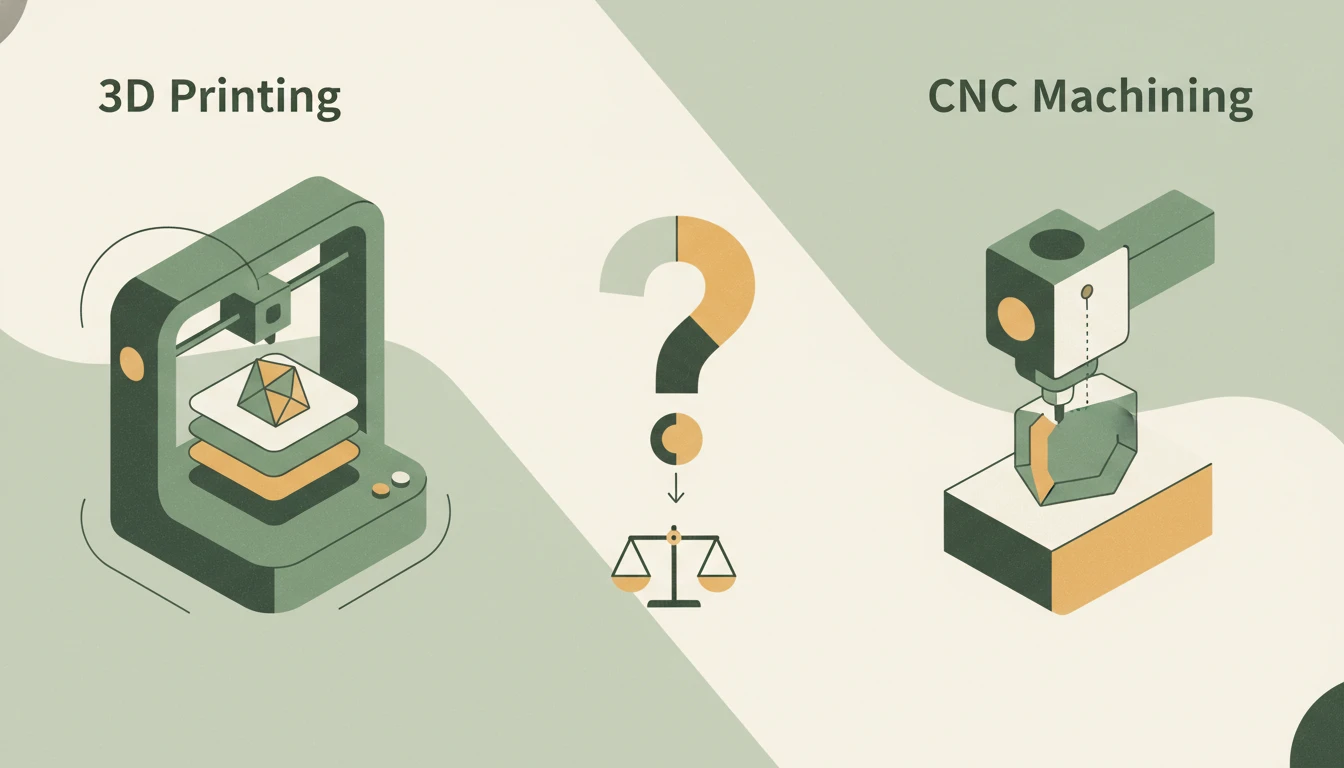
3D Printing vs. CNC Machining: Best for Your Production?
Choosing between 3D printing and CNC machining is a foundational decision that can dictate your project's timeline, budget, and ultimate success. Using the wrong method can lead to wasted resources, compromised part quality, and costly delays. This guide cuts through the uncertainty by providing a clear, authoritative comparison of these two dominant manufacturing technologies. By the end, you’ll have a concrete framework to determine which process is the optimal solution for your specific production requirements.
Overview of 3D Printing and CNC Machining
At their core, both technologies aim to create physical parts from digital designs, but they operate on fundamentally opposing principles: one is additive, the other is subtractive.
Understanding 3D printing basics begins with its official name: Additive Manufacturing (AM). The process builds objects layer by layer from the bottom up, using materials like thermoplastics, resins, metals, or ceramics. A 3D model is digitally sliced into hundreds or thousands of horizontal layers. The printer then deposits or fuses material, one cross-section at a time, to form the complete object. Common technologies include Fused Deposition Modeling (FDM), Stereolithography (SLA), and Selective Laser Sintering (SLS). The key advantage here is geometric freedom. 3D printing can produce complex internal lattices, organic shapes, and intricate hollow structures that would be impossible or prohibitively expensive to make any other way. There is little to no wasted material in the part creation itself, and assemblies can often be printed as a single, functional unit, reducing part count.
In contrast, CNC machining fundamentals are rooted in subtraction. Computer Numerical Control (CNC) machining starts with a solid block of material (called a blank or workpiece), and uses precisely controlled cutting tools—like drills, mills, and lathes—to remove material until the desired shape is achieved. The process is guided by G-code, which dictates the tool’s movements, speed, and coordination. The outcome is known for exceptional surface finish and dimensional accuracy. Machining is ideal for creating parts with tight tolerances, sharp edges, and smooth surfaces directly from the machine. Historically, CNC evolved from manual machining processes (like milling and turning) and revolutionized industry by enabling consistent, automated production of high-precision components.
The historical development and adoption of these technologies tells a story of complementary evolution. CNC machining became the backbone of mass production in the late 20th century, dominating automotive, aerospace, and consumer goods manufacturing. 3D printing, invented in the 1980s, spent decades as a tool for rapid prototyping—hence its common name. However, over the past 15 years, advances in materials, speed, and reliability have propelled 3D printing into the realm of end-use part production and tooling, a shift often referred to as the rise of additive manufacturing.
Actionable Takeaway: Immediately assess the complexity of your part. If it features complex internal geometry, undercuts, or is an integrated assembly, lean towards exploring 3D printing. If your part requires extremely tight tolerances (±0.025mm or better) and a flawless surface finish from a standard material like aluminum or steel, CNC is likely your starting point.
Comparing Costs and Efficiency
The financial and temporal implications of choosing 3D printing or CNC machining are not always straightforward. A simple per-part cost comparison is often misleading; you must analyze the entire production journey.
Initial setup and operational costs diverge significantly. CNC machining has high upfront costs tied to the machine itself, custom tooling (fixtures, jigs, and specialized cutters), and skilled programming. However, once set up, the per-unit cost for large production runs becomes very low. 3D printing flips this model. The initial setup cost is typically minimal—often just the time to prepare and slice a digital file. There are no custom tools or complex fixtures. This makes 3D printing economically superior for one-off parts or small batches. The operational cost, however, is embedded in the material (which is often more expensive than raw stock) and machine time, which can be lengthy.
Material costs and availability further distinguish the two. CNC machining offers access to a vast, inexpensive library of proven engineering materials: metals (aluminum, steel, titanium, brass), plastics (ABS, Nylon, Polycarbonate), and wood. You purchase stock in standard forms (bars, sheets, blocks). 3D printing materials are more limited and specialized. While the range is expanding rapidly, materials often come in filament, powder, or resin form at a premium. For example, a kilogram of standard PLA filament can cost $20-$50, while a kilogram of aluminum 6061 stock might be $5-$10. However, 3D printing uses nearly all the material in the part, whereas CNC machining generates scrap (chips), which can represent significant waste with expensive metals.
To visualize the production efficiency and cost trade-offs across different volumes, consider this simplified breakdown:
| Production Scenario | 3D Printing Viability | CNC Machining Viability | Key Reason |
|---|---|---|---|
| Single Prototype | High - Fast setup, no tooling. | Low - High programming/setup cost for 1 part. | Efficiency in low volume. |
| Batch of 10-100 | Medium to High - Consistent cost per part. | Medium - Setup cost amortized, per-part cost drops. | Economies of scale begin for CNC. |
| Mass Production (10,000+) | Low (with exceptions) - Slow build time dominates. | High - Extremely low per-part cost after setup. | Speed at high volume. |
Long-term financial benefits extend beyond per-part math. 3D printing can offer savings through part consolidation (reducing assembly labor), lightweighting (saving material and operational costs in aerospace), and on-demand production (eliminating inventory costs). CNC machining benefits from the sheer speed of high-volume runs, material cost savings, and the ability to produce parts that are immediately structurally sound and finished.
Actionable Takeaway: Don't just request a per-part quote. For a true cost comparison of 3D printing vs CNC, create a "Total Cost of Ownership" analysis for your project. Factor in design time, setup, material waste, post-processing labor, and lead time. For prototypes and complex low-volume parts, 3D printing often wins. For simple, high-volume production, CNC machining is typically unbeatable.
Applications and Suitability
The "best" technology is entirely dictated by the application. Each excels in domains that play to its inherent strengths.
Ideal applications for 3D printing leverage its design freedom and tool-less production. It is the champion of:
* Rapid Prototyping: Quickly iterating form, fit, and function.
* Complex, Lightweight Structures: Lattice interiors for aerospace or medical implants.
* Customized Products: Dental aligners, hearing aids, and orthopedic implants.
* Low-Volume, High-Complexity Parts: Intricate ducting, customized jigs and fixtures.
* Part Consolidation: Combining multiple assembled components into one printed part.
Ideal applications for CNC machining leverage its precision, strength, and speed for volume. It dominates in:
* High-Precision Functional Parts: Engine components, surgical tooling, mold inserts.
* Large Batch Production: Any part needed in the thousands or millions.
* Parts Requiring Excellent Material Properties: Isotropic strength from solid billet.
* Broad Material Selection: When a specific, proven grade of metal or plastic is mandated.
* Superior Surface Finishes: Parts that require minimal post-processing for a polished look.
Case Study: 3D Printing in Aerospace
Aerospace is a prime example of how 3D printing is revolutionizing parts manufacturing. General Electric's LEAP jet engine fuel nozzle is the canonical case. Traditionally, the nozzle was an assembly of 20 individually machined parts. Through 3D printing (using Direct Metal Laser Sintering), GE consolidated it into a single, unified component. The result was not just simpler assembly. The new design was 25% lighter and five times more durable than its predecessor. The internal passages for fuel and air cooling were optimized in geometries impossible to machine, improving efficiency. This shift highlights AM's value: part consolidation, weight reduction, and performance enhancement through design complexity. It moves beyond prototyping into certified, flight-critical production.
Case Study: CNC Machining in Automotive
The automotive industry relies on CNC machining for producing high-precision automotive components where reliability, speed, and material integrity are non-negotiable. Consider the production of an engine block or cylinder heads. These components are subjected to extreme temperatures and pressures. They are typically milled from a single casting of aluminum or iron alloy. CNC machines achieve the critical tolerances needed for cylinder bore diameter, head flatness, and valve seating—often within microns. The process ensures the material grain structure is intact and homogenous, providing optimal strength and heat dissipation. For high-performance or luxury vehicles, even low-volume components like custom billet aluminum suspension arms are CNC machined for their superior strength and finish compared to cast or printed alternatives. This underscores CNC's role in strength-critical, high-precision, and high-volume manufacturing.
Actionable Takeaway: Map your part's requirements to these industry patterns. Ask: Is my priority design complexity and low-volume speed (favoring 3D printing) or material perfection, high precision, and volume scaling (favoring CNC)? Your answer provides a clear directional signal.
Material and Precision Considerations
The choice of material and the required precision are often the deciding technical factors.
Material types and performance vary greatly. CNC can process an enormous range, from soft plastics to superalloys like Inconel, always starting with a fully dense stock. This results in parts with predictable, anisotropic mechanical properties identical to the raw material. 3D printing materials vs CNC materials is a comparison of process-specific forms versus universal stocks. 3D printing materials (e.g., ABS filament, Nylon 12 powder, Titanium 6Al-4V powder) are often formulated for the process. While their properties are continually improving, they can exhibit anisotropy (strength varying by build direction) and may require post-processing (like heat treatment) to achieve final strength.
The following table highlights common material considerations:
| Material Class | CNC Machining Performance | 3D Printing Performance | Key Consideration |
|---|---|---|---|
| Plastics (e.g., ABS, Nylon) | Excellent finish, full strength. Wide selection. | Good for functional prototypes. May have layer adhesion issues. | CNC for end-use strength. 3DP for form/complexity. |
| Metals (e.g., Aluminum, Steel) | Industry standard. Optimal strength, ductility, & fatigue life. | DMLS/SLM processes offer near-full density. Often more brittle as-printed. | CNC for critical structural parts. 3DP for complex, lightweight metal parts. |
| Composites | Can machine composite panels. Risk of delamination. | Limited. Continuous fiber processes (like Markforged) are emerging. | CNC for trimming/forming. 3DP for embedding complex fiber paths. |
Precision and tolerances achievable is a area where CNC has a historical edge. High-end CNC machines routinely hold tolerances of ±0.025 mm (±0.001") or better across a part. 3D printing tolerances are generally in the range of ±0.1 mm to ±0.5 mm, depending on the technology and part size. While this is sufficient for many applications, it is not suitable for precision interfacing parts like bearings or seals without post-machining. Furthermore, CNC provides superior surface finish right off the machine, while 3D-printed parts almost always show layer lines and require additional steps (sanding, polishing, blasting) for a smooth finish.
The environmental impact of material choices is an increasingly important factor. CNC machining is a subtractive process, generating significant waste in the form of chips and cuttings. While many metals are recyclable, this represents an energy and material loss. 3D printing is inherently less wasteful in material usage for the part itself, especially with powder-bed systems where unused powder can often be reused. However, the environmental footprint includes the energy-intensive production of specialized materials and, in some cases, support structures that are discarded. The most sustainable choice often involves designing for the process to minimize waste overall.
Actionable Takeaway: Before finalizing your technology choice, physically test the materials. If you need a part to withstand a specific stress, temperature, or chemical exposure, obtain material datasheets for both the 3D printing feedstock and the CNC stock. For precision, be brutally honest about your tolerance requirements. If it's beyond ±0.1mm, CNC is the safer bet.
Conclusion and Key Takeaways
The debate between 3D printing and CNC machining is not about finding a universal winner. It's about matching the right tool to the job. Both 3D printing and CNC machining have unique strengths; the right choice depends on your specific production requirements.
- Choose 3D Printing when you need complex geometries, part consolidation, customization, or low-volume agility with minimal setup. It excels in prototyping, tooling, and producing parts where design complexity trumps raw material perfection.
- Choose CNC Machining when you need exceptional precision, superior material properties, high-volume efficiency, or a flawless surface finish from a wide range of standard materials. It remains the unchallenged leader for strong, reliable, and precisely dimensioned components.
Making this decision in a vacuum is challenging. The nuances of your design, budget, timeline, and performance requirements demand expert evaluation.
Consult with our experts at Manufacturenow.in to determine the best technology for your next project. We can analyze your CAD files, discuss your application, and guide you to the most efficient, cost-effective, and high-quality manufacturing solution.
Written with LLaMaRush ❤️